[0:00]So, hey guys, welcome back to the channel. Kaise ho aap sab? I hope ki aap sab safe hoge. Aur aaj ki physiology ke andar jo hum lecture karne ja rahe hai, woh karne ja rahe hai yaha par hum transport through the cell membrane. Matlab mainly transport hum padh rahe honge kaise kaise transport ho raha hai. Kaun kaun se type ke transport hote hai, ye sab hum is lecture me padh rahe honge. Agar naye ho channel pe, channel ko subscribe, video ko like, dosto me share karna na bhule. Instagram me follow karde. Link description me hai. Agar aapne abhi tak Hamare my anatomy notes ko apna nahi banaya toh bhai kya kar rahe ho? My anatomy notes ka link description me hai. Fatfat jaake isse apna banalo. Aur yahan par physiology ki notes bhi jaldi hi aane wale hai. Agar aap baad me dekh rahe ho video, toh aapko description me link mil jayega uska bhi. Baaki fatfat jao, uss pe bahut pyare offers chal rahe hai. Ek baar my anatomy notes ke upar fatfat jaake features dekhlo. So, ye mainly hamari website hai mbbsworld.co.in. Iska link aapko description me mil jayega. Woh fatfat jaake check out kar lena. Niche aap jaoge yahan pe aapko products section me hamari book bhi dikh jayegi. Mai directly isi ka link aapko dedunga. Aap is pe click karoge and yahan par aap dekh sakte ho, ye rahi hamari my anatomy notes. Ye aapka volume one hai. Aur aur ye aapka volume two hai. Theek hai? Yahan pe aap dekh sakte ho, ye pura aapko dekhne ko mil raha hai. Yahan pe combo sale live hai. Combo sale is live. Ya combo sale is live. Aapko 1499 ki jagah 999 rupees me aapko volume one and volume two dono dekhne ko milenge. Aap dekh sakte ho bilkul free shipping hai all over India. Ya aap directly buy it now pe click kar sakte ho. Yahan par iske sabse important point, yahan saare topics ko simplify kiya gaya hai points ke andar. Yahan par aapko dekhne ko milte hai topic based study tracker iske andar. Clinical anatomy aapko har ke andar dekhne ko milegi, har topic me. Practice papers dekhne ko milenge last me. Aur puri anatomy, upper limb, lower limb, thorax, general anatomy, abdomen, pelvis, neuroanatomy and head and neck. Ye sab aapko dekhne ko milega. Yahan par free delivery all over India. Aapko jo updates hai, aapko order ke baad aapko via message aapko definitely aa jayenge. Ye aapko main preview dikhaunga. Aap is pe click karoge. Ye dekho, yahan pe aapko preview khulne wala hai. Ye dekho, anatomical snuffbox aapko dekhne ko mil raha hai. Dekho, yahan pe definition hai, fir boundaries hai, contents hai, clinical anatomy hai aur diagram. Single one page ke andar aapka pura topic covered hai. Toh is tarike se aapke saare lagbhag topic yahan pe humne cover kiye gaye hai. Ye aapki puri video hai. Is video ka link bhi main description me dedunga. Ki maine isme pura samjhaya hai My Anatomy Notes ke bare me. Aapko aur acche se samajh me aayega. Ye kuch reviews hai hamare Instagram influencers dwara. Link description me hai. Inki wajah se aapke number sabse zyada acche aane wale hai. Iski main guarantee deke aapko chalta hu. Theek hai? Link description me hai, fatfat jaake buy, yahan pe buy now pe click kar le aap. Buy now pe click karne ke baad apna pura address wagaira yahan pe aap fill up kar dena. Address fill up karne ke baad free shipping hai. Theek hai? Free shipping hai. Aur directly aap pay now kar sakte ho. 999 rupees ke andar aapko dono combo dekhne ko milte hai. Toh fatfat jao, My Anatomy Notes ka link description me hai. Fatfat jaake ise check out kar le. Toh bhai, agar baat karu transport ki, toh mainly jo cell hota hai, woh aapka constantly exchange karta hai kaafi saari cheeze. Hai na? Substances with the ECF, matlab extracellular aapki jo fluid hai, uske saath yahan pe exchange kar raha hota hai. Nutrients andar aa rahe hote hai aur waste jo material hai, woh bahar jaa raha hota hai. Generally aapko pata hi hai obviously. Aur ye jo transport mechanism hota hai, ye mainly cell membrane ke across yahan par ho raha hota hai, jo ki aapko pata hai lipid plus protein ki bani hoti hai. Lipids plus proteins. Theek hai? Ye bahut basic si baate thi. Chaliye. Ab, basic mechanism baat karu toh aapko pata hai do type ke transport hote hai, bachpan se padhte aa rahe ho. Kya? Passive transport aur active transport. Ab aapka jo passive transport hai, aapko pata hai usme koi bhi energy nahi lagti, matlab koi bhi ATP yahan pe use nahi hoti. Aur ye downhill movement hota hai. Downhill matlab kya hota hai, yahin se samjha deta hu. High concentration to low concentration. Aur aapka jo active transport hota hai, ye aapko pata hai isme ATP matlab energy ki requirement hoti hai aur ye uphill hota hai. Uphill hota hai, matlab niche se upar, low concentration to high concentration. Ye mainly kaam kar raha hota hai. Isme transport ho raha hota hai. Ab, sabse pehle main baat karunga passive transport ki. Toh aapko pata hai, passive main already bata diya along the concentration yahan pe gradient yahan pe transport ho raha hoga, electrical gradient matlab aapke downhill. Higher concentration to low concentration. Ab, iske bhi alag alag types hote hai, woh padhte hai. Sabse pehle aapka jo hai woh hai simple diffusion, fir aapka hai facilitated diffusion ya fir carrier mediated diffusion keh sakta hu. Aur teesra aapke special types aate hai isme teen, bulk flow, filtration aur osmosis. Ye aapne kahi na kahi life me zarur suna hoga. Usi ko ek tarike se revise karwa raha hu, samajhlo ye. Passive transport aapko, aapko bataya gaya hai mainly yahan pe high concentration to low concentration, downhill movement hai. Downhill movement aapko dekhne ko milega, high concentration to low concentration. And yahan par across the cell membrane aapko yahan pe ye passive transport dekhne ko milega. Baaki abhi aage samjha deta hu saari cheeze. Theek hai? Chaliye, sabse pehle baat karunga simple diffusion ki. Ab simple diffusion jo hai, aapko pata hai molecules jo honge isme high se low concentration me directly move kar rahe honge. Wohi cheez jo batai thi abhi. Ye kiske through hota hai? Ek lipid layer hoti hai, aur aapka ek protein layer hoti hai, hai na? Matlab channels bol sakta hu. Hai na? Cell membrane dono ki bani hoti hai. Ab, sabse pehle baat karunga diffusion me simple diffusion ki through the lipid layer. Ab lipid layer ke through jo simple diffusion ho raha hai, uski sabse pehle baat karenge. Cell membrane lipid layer aapko pata hai, woh permeable hoti hai. Aur yahan pe jo lipid soluble substances hai, kaun kaun se pass ho sakte hai? O2, CO2, steroid hormones, alcohol. Toh mainly jo diffusion hota hai, woh solubility of lipids pe depend karta hai. Abhi main aapko aage factors bhi bataunga ki kaun kaun se factors pe diffusion aapka, uh, jisse fark pad raha hota hai diffusion ko. Ye aap dekh sakte ho, yahan pe dikhaya gaya hai, ye wala jo upar wala diagram hai, isme lipid soluble substances jo hai woh kaise pass kar rahe hai diffusion ke through high concentration to low concentration. Ye woh bataya gaya hai. Theek hai? Yahan par aapka jo baat kari gayi simple diffusion through the protein layer. Ab jo niche protein channels hai, jo protein layer hai, isme jo membrane hote hai, iske andar kya hote hai? Protein channels hote hai, hai na? For water soluble substances. Ab alag alag type ke yahan pe protein channels ho sakte hai. Pehla, ek toh leak channels ho sakte hai, hai na? Ungated jisme gate na ho, theek hai? Jo hamesha open hote hai, hai na? Gate nahi hoga toh hamesha khule rahenge. Theek hai? Jaise potassium leak channels. Theek hai? Dusra kya hote hai? Aapke hote hai gated channels. Ab gated matlab gate wale channels hai. Toh isme hamesha khule nahi rahenge, theek hai? Open only when required hamesha. Jab aapko zarurat hogi jabhi khulenge. Pehla, voltage gated channel. Jo ki open due to electrical change, voltage samajh me aa raha hai. Voltage hoga toh electrical change ki wajah se jo ho raha hai. Examples, sodium channels ho gaye. Ligand gated channels kya hote hai? Open when chemical bind karta hai jabhi khulte hai. Ye theek hai? Jaise aapka ACh acetyl choline agar mai baat karu neuromuscular junction ke upar, woh jo aapke junction, aapke channels ho gaye. Fir mechanical gated channels, ye mainly jab physical pressure lagega, jabhi khulega. Theek hai? Jab physical pressure lagega. Example, pacinian corpuscle, theek hai? Ye aapke ho gaye jo humne bata diya. Dekho protein, jo channels uske through dekho yahan pe channel hai, uske through yahan pe aapka movement aapko dekhne ko mil raha hai, ye aapko samjha diya. Theek hai? Chaliye, ab agli cheez jo hai woh hai facilitated diffusion. Hai na? Facilitated diffusion ke bare me baat karenge. Maine bataya tha na passive transport me simple diffusion ho gaya facilitated diffusion ke bare me baat karenge. Ab, ye kya hota hai? Ye mainly large water soluble substances jo ki pass nahi kar sakte channel ke through unke liye mainly yahan pe ye ho raha hota hai. Jaise glucose ho gaye, amino acids ho gaye. Inka kya mechanism hota hai? Maanlo koi molecule aaya, dhyan se sunna, woh kya kar raha? Bind kar raha carrier protein se. Carrier protein se bind kara. Uske baad carrier jo hota hai apni shape ko change karta hai. Carrier ne apni shape, molecule aaya carrier pe, carrier ne shape change kari. Uske baad molecule release ho jata hai cell ke andar, hai na? Uske baad carrier apne wapas reset maar jata hai jaise pehle tha. Toh ye is tarike se ye aapka transport karata hai aur isme koi bhi need energy needed nahi hoti, but diffusion simple diffusion ki baat karu toh usse zyada faster hoga ye. Obviously ba, obviously si baat hai carrier use ho raha hai. Kaam use ho raha hai beech me. Ab factors affecting the rate of diffusion. Kaun kaun se factors hai? Jaise permeability agar membrane ki zyada hogi toh diffusion aasani se hoga. Obvious permeable agar hoga jaldi jayega toh diffusion zyada ho jayega. Agar temperature zyada hai, toh diffusion jaldi hoga. Concentration gradient agar bada hai, obviously diffusion zyada hoga. Concentration gradient jitna bada hoga toh downhill movement hi toh hai. Higher to lower slope agar jitna aise hoga utni jaldi niche jayega. Agar aise ho jayega toh dheere dheere jayega. Toh jitna gradient bada, utni tez diffusion. Lipid soluble diffusion jo hota hai woh diffuse faster karta hai. Hai na? Thickness agar membrane ki zyada hai toh woh diffusion kam hoga. Bhai agar itni moti deewar hogi beech me toh time lagega na jaane me. Kam hoga. Size agar bada hoga toh bhi kam hoga. Size jitna bada bhejunga aur chota sa bhej dunga toh kam, obviously. Size bada hoga diffusion kam hoga. Size of the ions hydrated radius, smaller ions diffuse faster. Obviously si baat bata diya. Agar charge hai ions ki baat karu, jitna agar charge zyada hoga ions me, toh diffusion slower hoga. Jaise agar baat karu toh calcium Ca2+ jo hota hai aur agar Na2 Na+ ki diffusion dekhu toh usme Na+ ki jaldi hoti hai. Ye dekho, ye maine aapko, aapko mechanism samjhaya tha. Ye dekho, yahan par molecule jo hai woh carrier protein se aake yahan pe bind kara. Aur carrier ne apne yahan pe change shape ko change karo. Toh yahan pe woh dikhaya gaya hai proper mechanism. Ab special type of passive transport maine bataya tha aapko jo bulk flow. Bulk flow me kya hota hai? Large quantity of substances due to pressure difference. Example, gas exchange ho raha hai alveoli aur blood ke beech me. Filtration me kya hota hai? Aapka movement of water plus solutes due to hydrostatic pressure. Hydrostatic pressure se capillary filtration me ho gaya. Glomerular filtration me ho gaya. Fir aapko osmosis. Isme kya hota hai? Water jo hota hai movement hota hai semi permeable membrane ke through yahan pe move kar raha hota hai, lower solute concentration to higher solute concentration. Ab ye downhill movement nahi hai. Aap dekh rahe ho osmosis. Theek hai? Ye yaad rakhna. Creates yahan pe osmotic pressure banta hai, osmosis ho raha hai. Aur mainly agar baat karu colloidal osmotic pressure blood ke andar, woh mainly plasma protein ki wajah se banta hai jo ki lagbhag 25 mm Hg hota hai jo yahan pe likha bhi gaya hai. Ya ek extra point hai, yaad karna chaho toh kar sakte ho. Ab ye toh osmosis rahi. Low solute concentration to high. Ab, iska ulta karu matlab reverse osmosis ki baat karu toh isme aapka higher to lower concentration aapka water move kar raha hota hai. External pressure agar apply kara jata hai, toh yahan ulta ho jata hai. Theek hai? Ab osmosis ke bhi type ho sakte hai. Ek hota hai endosmosis, ek hota hai exsomosis. Endo matlab andar se kuch samajh me aa raha hai. Toh matlab water andar aa raha hai, cell ke andar aa raha hai. Exosmosis me water bahar ja raha hai. Toh ye majorly baate ho gayi. Theek hai? Chaliye, ab passive transport khatam, active transport shuru. Active transport aapko pata hai ki aisa transport jahan pe energy lag rahi hai, ATP lag rahi hai. Toh ye aapke against the concentration gradient hoga. Toh kya hai? Movement against the concentration gradient, uphill hai. Uphill hai, aise ja raha hai upar. Isme ATP ki requirement hogi. Aur like swimming against the river flow, agar maanlo pani ka flow us taraf se aa raha hai aur main aise aise bhag raha hu, aise aise tair raha hu, youn youn youn karke, hai na? Aur pani udhar se aa raha hai, toh main against kar raha hu. Agar main maanlo pani ka flow aise hi hai aur main aise aise tairta ja raha hu, jaldi jaldi jaunga toh diffusion ho gaya na? Matlab woh diffusion matlab passive transport hai. Theek hai? Chaliye. Isme facilitated diffusion se alag kaise? Bhai usme aapki ATP, aapki usme ATP nahi chahiye toh yahan pe ATP chahiye. Yahan pe move against the concentration gradient hai. Aur yahan pe carrier jab bhi move karta hai, jaisi agar ATP hydrolysis hogi toh. Ab, carrier proteins bhi isme hote hai. Dekho, carrier protein matlab isme carrier proteins ka istemal istemal hota hai iske andar iske andar bhi. Theek hai? Sabse pehle uniport. Uniport me kya hota hai? Ek substance ek direction me ja raha hai. Theek hai? Yahan pe dekho, ek substance hai A, woh ek direction me ja raha hai yoon. Theek hai? Toh ye aapka uniporter ho gaya. Theek hai? Symport me kya hota hai? Symport, symport me kya hota hai? Two substances, do substances ja rahe hai same direction me toh symport. Aur do substances agar opposite direction me ja rahe hai toh antiport. Ye dekho. Do substances hai A aur B aur ye dekho same direction me ja rahe hai. Toh ye symport. Antiport matlab A idhar ja raha hai, B idhar ja raha hai toh antiport ho gaye. Basic si baate hai. Chalo, ab types of active transport ki baat karu toh mainly isme primary active transport hota hai aur secondary active transport hota hai. Do type ke active transport hote hai. Theek hai? Ab, jo aapka primary active transport hota hai, iska mainly jo movement hota hai substances ka against the concentration gradient aap already aapko bata chuka hu. Aur isme mainly directly energy use kis se ho rahi hoti hai? ATP se, ATP ki energy mainly use ho rahi hoti hai. Isme jo carrier protein hota hai, woh aapka ATP se bind karta hai. Theek hai? Uske baad ATP toot jata hai. Aur yahan pe energy release karta hai. Carrier protein aaya, ATP se bind kiya, ATP toota aur energy release hui. Aur yahan pe jo protein hota hai, unko apna change karta hai shape. Aur ion jo hota hai isme pumped uphill against the gradient. Jaise agar main baat karu yahan pe sodium potassium pump, very very classical example, hai na? Isme kya hota hai? Aap yahan dekho, teen sodium aapke bahar ja rahe hai aur aapke do potassium andar aa rahe hai. Ye cardiac cell ka example hai aap dekh sakte ho. Toh ye sodium potassium pump ki baat ho rahi hai. Theek hai? 3:2 rehta hai, matlab teen sodium yahan pe bahar jaate hai, dikhaya jaise ki maine, aur do potassium potassium andar aate hai. Calcium pump ho gaya. Theek hai? Primary active transport mainly ATP ka, is directly requirement hoti hai. Ab secondary me kya hota hai? Isme against the gradient toh hota hai. Isme transport hoga against the gradient, but koi bhi yahan pe isme directly ATP use nahi hoti. Directly ATP use nahi hoti secondary wale me. Hai na? Isme jo energy aati hai, woh sodium gradient se aati hai. Jo ki sodium potassium pump yahan pe banata hai. Sodium gradient se aati hai. Ab maanlo sodium jo hai woh move down its gradient, hai na? Sodium aaya, toh ye jo downhill movement hai, sodium jaisi downhill movement aayega, uss downhill movement se jo energy release hogi, woh yahan par use kari jayegi, hai na? To move another substance uphill. Maanlo aapka, uh, sodium downhill aaya, high high concentration se low concentration aaya. Sodium ke downhill aane se energy create hui aur energy create hone se woh energy hum use kar sakte hai dusre substance ko uphill pahunchane me. Ye mota mota baat hai. Jaise aapka ho gaya co-transporter, symport. Sodium plus glucose, both move inside. Sodium amino acids me ho gaya. Counter-transport agar antiport ki baat karu toh aap dekh sakte ho sodium andar aaya, calcium bahar gaya. Sodium andar aaya, H+ bahar gaya. Toh mainly jo secondary active transport hota hai, woh sodium gradient ka use karta hai as its energy source. ATP ka kaun use karta hai? Primary active transport. Theek hai? Secondary energy ka use ATP se nahi karta, woh sodium ke movement se karta hai. Theek hai? Ye baate ho gayi. Yahan pe aapko dekho dikh bhi raha hai saaf saaf ki dekho aap primary active transport jo hai primary active transport hai. Yahan mainly ATP ki requirement ho rahi hai. Antiport cheeze ho rahi hai toh hi aap yahan pe use is cheez ko kar pa rahe ho, hai na? ATP ka istemal karke aap against the concentration gradient uphill, uphill movement aap kar rahe ho, hai na? Aur yahan secondary active transport me aapka yahan par sodium ke aise andar sodium andar aaya, theek hai? Toh iske yahan pe movement se aap glucose ko andar laa pa rahe ho isse jo energy nikli. Hai na? Ab ye sym, ye aapka symport hi ek tarike se hai na? Dekho, so glucose bhi saath me aa raha hai. Sodium plus glucose, both moves inside toh ye classical example hai. Theek hai? So guys, I hope ki definitely tumhe samajh aaya hoga. Video pasand aayi. Video ko like, channel ko subscribe, dosto me share karna na bhule. Instagram pe follow karde. Link description me hai. Agar aapne abhi tak hamare My Anatomy Notes ko apna nahi banaya toh bhai kya kar rahe ho? My Anatomy Notes ka link description me hai, fatfat jaake isse apna banao. Bahut pyari sale chal rahi hai. Iski help se aap definitely bahut acche marks laa rahe honge anatomy ke andar. Aur physiology ki notes bhi jaldi launch hone wale hai. Agar aap baad me dekh rahe ho, uska bhi link description me dedunga. Milenge next video me. Stay blessed, good bye. Bye bye.
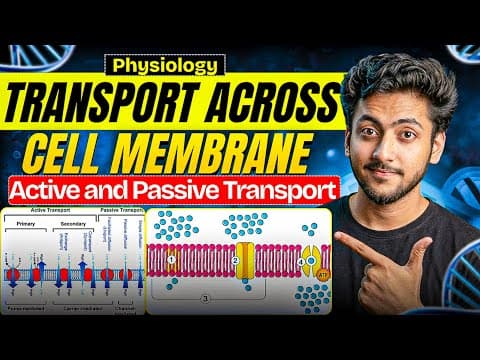
Physiology -Transport Across Cell Membrane | MBBS 1st Year | Explanation With Exam Notes |MBBS World
MBBS World
13m 57s3,316 words~17 min read
Auto-Generated
Watch on YouTube
Share
MORE TRANSCRIPTS
![Thumbnail for 🔴 [MULTISUB] BABYMONSTER COMEBACK LIVE LET'S CHOOM | Weverse Live PART 1 - [04.05.2026] by Kpopgirls](/_next/image?url=https%3A%2F%2Fimg.youtube.com%2Fvi%2FzT9WpzV7PzA%2Fhqdefault.jpg&w=3840&q=75)