[0:09]Everyone knows, the history of science is riddled with discoveries that have been attributed to chance. But as Pasteur said, chance favors only the prepared mind. Henri Becquerel is one of those scientists whose talent was rewarded by chance. He was a brilliant physicist from a family of scientists. His father went to Polytechnic, he went to Polytechnic and his son went to Polytechnic. Like his father, Henri Becquerel was interested in fluorescence. Fluorescence, the capacity that some materials have to emit light under certain conditions. At the time, X-rays had just been discovered. X-rays are invisible and yet photographic paper reacts with them just like with a very intense light. Becquerel was interested in this strange behavior of light and so he started to examine it from his point of view as a fluorescent specialist. He decided to carry out experiments with a highly fluorescent material called uranium. That's right, uranium. Today, we have forgotten that this substance was once used because it glowed. People even used it to give a bit of color to their crockery, without the slightest idea that uranium might have other properties. For his experiments, Becquerel took uranium salts, conditioned them so that they became highly fluorescent and looked to see if the photographic paper reacted as with X-rays. And lo and behold, it worked. He continued his experiments until one day he left non-fluorescent uranium in total darkness together with photographic paper, which reacted all the same. He realized that the photographic paper was not responding to the fluorescent properties of the uranium, but something else. Radioactivity. There, the secret is out. Not only does uranium emit pretty colors after being exposed to light, it continuously emits an invisible and powerful ray, which no one knew anything about. And that's what was making the photographic paper react. The discovery captured the curiosity of young researchers, including a certain Marie Curie, who decided to make it the subject of her PhD thesis. It was such an exciting project that her husband Pierre abandoned his own research on magnetism to work in collaboration with her. They couldn't have imagined the effects of radioactivity. Pierre and Marie Curie managed to isolate radium, an even more active element than uranium. Becquerel took a tiny sample, put it in his pocket and ended up with a severe burn. Pierre Curie suffered the same misfortune with his arm, on both occasions the wound took six to eight weeks to heal. For their research, Henri Becquerel and Marian Pierre Curie received the 1903 Nobel Prize for physics. Henri Becquerel died five years later, aged just 55. In his honor, the becquerel has been adopted as the unit for measuring the activity of radioactive substances.
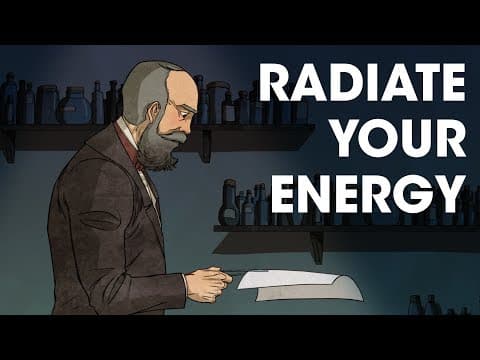
Episode 4 - Henri Becquerel
Ecole polytechnique
3m 29s454 words~3 min read
YouTube auto captions
Transcript source
YouTube auto captions
This transcript was extracted from YouTube's auto-generated caption track. The transcript below is server-rendered so it can be read, searched, cited, and shared without opening the original YouTube player.
Pull quotes
[0:09]Everyone knows, the history of science is riddled with discoveries that have been attributed to chance.
[0:09]His father went to Polytechnic, he went to Polytechnic and his son went to Polytechnic.
[0:09]Fluorescence, the capacity that some materials have to emit light under certain conditions.
[0:09]X-rays are invisible and yet photographic paper reacts with them just like with a very intense light.
Use this transcript
Related transcript hubs
Watch on YouTube
Share
MORE TRANSCRIPTS


