[0:00]Welcome back to The Deep Dive. Today we are, uh, really strapping in for something quite extraordinary. We're looking at a high stakes constitutional drama out of Pakistan in 1988. And this wasn't just, you know, about an election. This was about wrestling democracy back from the edge, really. Our mission today, yours and ours, is pretty focused. We want to get under the skin of the political firestorm brewing back then and more importantly, pinpoint the exact constitutional lever that aha moment in the law that let the court step in. How did the rule of law manage to override some really blatant government interference and well, trigger this huge historical shift without violence importantly? And that lever, that specific legal mechanism, it's absolutely central to the whole story, that's where we're going to spend some proper time unpacking it. The source material we're drawing on today is, well, it's pretty robust. We're mainly looking at a detailed legal analysis of the case Benazir Bhutto versus Federation of Pakistan. This comes from a series called South Asian Judicial Stories, Pakistan, and specifically, uh, the work of constitutional lawyer, Mr. Zaheer Ahmad Mir. What's really fascinating, I think, is that these sources don't just give you the bare facts of the lawsuit. They go deeper, they really explore the implications, showing how one, uh, very carefully considered court decision can anchor an entire system. Especially a system trying to find its feet after, you know, decades of instability. And the stakes here, well, they couldn't be higher for you listening in. Maybe you're studying constitutional law. Maybe you're prepping for a meeting on political risk analysis in the region, or maybe you're just, like me, incredibly curious about how democratic structures actually managed to survive under pressure. If you want to understand how the judiciary can act as a check on executive overreach, honestly, this case is foundational. You need to grasp in detail how the courts stood firm when the caretaker government, the very people meant to ensure fairness were, well, actively rigging the game. So, to really feel the weight of that legal fight, we absolutely have to paint the picture of 1988, first. Okay, so the year is 1988, Pakistan is, well, the sources describe it as taking this complicated breath, almost a sigh of relief, but laced with anxiety. The country had just come out from under the shadow of General Zia ul Haq. His rule is often called the Long Iron Rule, we're talking over a decade. And this wasn't just, um, standard military oversight, it involved suspending parts of the Constitution, periods of martial law, and frankly, the pretty complete suppression of political opposition and basic democratic freedoms. That's a really key point to emphasize, the sheer weight of that decade. Zia's death wasn't planned, he died in a plane crash, quite suddenly, and that created this immediate, massive political vacuum. It wasn't a smooth transition, it was more like chaos bumping up against opportunity. And what happens to that vacuum? Pakistan finds itself gearing up for its first general election in, get this, a decade. So this wasn't just ticking a box, holding another election. No. It was seen, both inside Pakistan and internationally, as this profound test. Could the country actually pivot back to civilian rule? And crucially, could the Constitution, which had been sort of pushed around and misused during the martial law years, could it actually prove resilient? Could it work? And the atmosphere around this election, it was anything but celebratory or calm. Our sources describe it as being charged with fear and suspicion. Hmm. And you can see why, right? Because the system itself, even in this supposed fresh start, this transition phase, seemed to be actively working against what people might have wanted. It sounds less like setting up a fair election to rebuild trust, and more like, um, behind the scenes maneuvering to make sure certain groups came out on top, political survival, basically. That maneuvering, that's exactly what sparked the legal showdown. The sources make it really clear, despite all the talk about returning to democracy, the interim government, the caretaker set up put in place after Zia died, well, it was anything but neutral. This government's main job, it's only job, really, should have been to oversee a fair transition. Impartiality was key, but instead, they were, and the sources use this phrase, openly favoring one alliance. They were actually using the tools of the state, the resources, the institutions they temporarily controlled, to try and manage the election result before anyone even cast a vote. Okay, so let's name names here. Who was getting the preferential treatment and who was being targeted? The alliance that was clearly being favored, according to the sources, was the Islami Jamhoori Ittehad. That's the IJI. They were essentially being given a leg up institutionally. And on the other side, the main opposition, led by Benazir Bhutto and her party, the Pakistan People's Party, the PPP, they were the ones facing the squeeze. Actively restricted, actively disadvantaged. And we need to be clear about what actively restricted actually meant on the ground. This wasn't just, you know, negative campaign ads or tough rhetoric, this was systemic. It was about using state resources unfairly. The sources point to things like limiting the PPP's ability to campaign effectively. Like restricting their access to state run TV and radio, which back then were obviously the main ways to reach people. There were reports about difficulties getting permits for big public rallies, or if they got a permit, suddenly there were, uh, security issues or logistical support just wouldn't materialize. Basically, the caretaker government was leveraging its temporary control over money, information, security, infrastructure, all of it, to make it way harder for the PPP to connect with voters, compared to the IJI. And this really hits at the core issue of system integrity, doesn't it? It shows why this case is so relevant for anyone studying governance, anywhere. When a caretaker government, whose one job is neutrality, starts playing favorites, using public money, public institutions to boost one political group, it's not just unfair competition. It feels like a fundamental betrayal, right? A betrayal of public trust. It sends the message that state institutions are still just tools for whoever holds power temporarily, not servants of the Constitution, the actual foundation. And that's the huge betrayal that Benazir Bhutto decided she couldn't just accept, she challenged it, instead of just playing on a tilted field. Let's take a moment to talk about Benazir Bhutto herself, because her profile, her background, it adds so many layers to this whole drama. She was, undeniably, a formidable figure, only 35 at the time, which is young for leading such a massive political charge. Her education was top tier Oxford. That gave her a real command of constitutional ideas, international law too, that was definitely critical. But maybe the biggest factor was the sheer political weight of her family name. She was, of course, the daughter of Zulfiqar Ali Bhutto, the Prime Minister who had been overthrown by General Zia and later executed. So she wasn't just another politician leading a party. For many people, she represented the democratic dream that had been crushed a decade earlier when her father was removed from power. The personal and political legacy is absolutely central. You have to understand that to grasp the risks she was taking. Challenging the state machine, right after a long period of authoritarian rule, when many of the same people were still embedded in the system, in the bureaucracy, that was dangerous. Seriously dangerous, fear was palpable, not just fear of losing an election, but fear of arrest, repression, maybe even worse. And yet the sources really stress this, she refused to be silenced. And that refusal, it feels like more than just political strategy, it was an act of constitutional bravery. She must have realized that just going along with it, participating in an election that was clearly being manipulated without fighting back on the process itself, well, that would essentially legitimize what the caretaker government was doing. The only path forward, if she wanted to honor the idea of a democratic mandate, was to assert the supremacy of fairness, of the Constitution through the courts. It's genuinely remarkable, isn't it? That foresight, that nerve, to transform what could have been just another messy political fight into a fundamental constitutional battle. She wasn't primarily asking the court to say we won. She was asking the court to say make the process fair. That's a huge difference. Exactly. That's the brilliance of the strategy. Look at the situation. The state interference was massive, it was ongoing, and the election was just around the corner. She couldn't afford to get stuck in the usual court procedures, appeals that could take years. She needed something immediate, something decisive. So what did she do? She didn't start with lower courts, no, she took the case directly to the Supreme Court of Pakistan. Right, and this is where we hit that constitutional aha moment. The specific legal tool she used, every student of law, anyone interested in governance, really needs to understand this bit. She invoked Article 184 of the Pakistani Constitution. Now, for those of us not deeply versed in Pakistan's legal system, this sounds technical, but the sources describe it as a bold constitutional step. Can you break that down? What does using 184 actually let you do and why was it so critical here? Why was it maybe the only option? Absolutely. Article 184 is fascinating, it gives the Supreme Court something called original jurisdiction. Now, normally in most systems, cases start low down, right? Local courts, maybe high courts, and then they get appealed upwards to the Supreme Court. That takes time. Original jurisdiction means the Supreme Court can take the case straight away, at the first instance. But and this is crucial, it can only do that under very specific conditions. There are two main tests. One, the case has to involve a question of significant public importance, it can't be a trivial matter. And two, it must directly concern the enforcement of one of the fundamental rights guaranteed in the Constitution. Okay, so invoking 184 I3 is like hitting the legal fast forward button straight to the top court. Why is that so powerful in this context? What procedural hurdles does it just leap over? It leaves over the entire standard appeals process, all the potential delays, the procedural reigning in lower courts, gone. And in a political crisis, especially one unfolding just weeks before a national election, time is everything. Delay basically means the injustice stands. So by using 184 to A3, Benazir Bhutto's legal team was essentially making a powerful statement to the Supreme Court. They were saying, look, this isn't some minor dispute about campaign posters. This is a full-blown crisis of democracy. The actions of the caretaker government are violating the fundamental rights of every single citizen in Pakistan to choose their government freely and fairly. She was arguing that the very integrity of the election was so deeply tied to fundamental rights like the right to political association, freedom of speech, participation, that it qualified as this overriding public emergency, demanding immediate Supreme Court attention. That framing is absolutely key, isn't it? By defining the state's interference not just as unfair politics, but as a direct violation of fundamental rights, she lifted the whole thing. It wasn't just a political squabble anymore, it became a constitutional imperative. It meant the issue wasn't just politically important, it was legally fundamental, threatening the very basis of the state as defined by the Constitution. Precisely. Her legal team built the argument very carefully. They asserted that a free and fair election isn't just a nice idea, it's the primary mechanism through which the people express their sovereign will. Therefore, any action by the state, the caretaker government in this case, that actively undermines that process, that skews the playing field, is by definition violating the fundamental right of citizens to participate in their own governance. And that right, the right to political participation, is explicitly protected under the Constitution. So let's nail down the core principle she was asking the Supreme Court to affirm. What was the absolute bedrock legal assertion? It was clear and powerful. She challenged the government's interference based on the fundamental principle that free and fair elections are the absolute cornerstone of democracy. This isn't just rhetoric, it's a potent legal argument because it sets a non-negotiable standard. It implies it's not good enough to just hold an election, anyone can stage a sham election. The process itself must be demonstrably impartial. If it's not, the argument goes, then the government that emerges from that flawed process lacks true constitutional legitimacy. I think that's such a vital philosophical point for listeners to really absorb. This wasn't just about the PPP trying to win more seats, Bhutto was positioning electoral integrity, not just as something desirable, but as a legal pre-condition for any government to be considered legitimate under the Constitution. In doing that, she was powerfully asserting the Constitution's supremacy over the actions of a temporary executive branch, the caretaker government, that seemed to be acting in its own interests, or the interests of its favored party. She was arguing effectively that if you compromise the process, the whole structure of power that rests on it becomes illegitimate, unconstitutional. And that framing really forced the Supreme Court's hand. Because the case was brought under Article 184, 3, citing fundamental rights, the court couldn't just wave it away as politics. They were compelled, constitutionally compelled to examine the evidence. Were the actions of the caretaker government playing favorites with state media, restricting PPP rallies, giving advantages to the IJI, were these actions directly violated the constitutional rights of citizens? The rights to associate freely, to participate politically, to have their votes count in a fair contest, that's what the court had to decide. Okay, so now we get to the verdict itself. The tension must have been incredible. The whole country, probably parts of the world, too, watching, would the judiciary just emerging from the shadow of Zia's rule, actually stand up to the executive? Or would it find a way to sidestep the issue? This judgment was delivered by the Supreme Court, and the bench was led by Chief Justice Muhammad Afzal Zula. This really was a defining moment, wasn't it? For the court's role in the post Zia era? It absolutely was, a moment requiring immense judicial courage. And they delivered, they stood firm. The court issued what our sources describe as a truly powerful verdict in favor of democratic integrity. And its power wasn't just in the immediate political outcome, but in the clarity and force of its legal reasoning. It laid down three core legal principles. Lawyers call this the ratio decidendi, the rationale for the decision. And these principles fundamentally reshaped the understanding of the relationship between the state, the election process, and the rights of the citizens in Pakistan. We really need to spend some time unpacking these three principles carefully. They're the absolute core takeaways, the nuggets of legal knowledge from this landmark case. Right, let's do that, let's hammer home those retro decidendi, these are the foundations the judgment rests on. Where do we start? What's the first key principle? Principle number one, the constitutional mandate. The Supreme Court stated unequivocally that free and fair elections are not merely a political slogan. They are in fact a constitutional right in themselves and they are the essential pre-condition for legitimate governance. Let's pause on that. Defining fairness as a constitutional mandate. Why is that so much more powerful than just saying, you know, fairness is a good political goal to aim for? It's the world of difference. A political goal is, well, it's aspirational, it's subject to negotiation, political wins, compromise, maybe you achieve it, maybe you don't. But a constitutional right, especially one declared enforceable by the highest court, that's different, that's mandatory. It imposes a positive legal obligation on the state. Before this ruling, you could argue the state's duty was just to hold an election, any election, tick the box. After this ruling, the state had an active legally enforceable duty to ensure the process was genuinely free, fair and impartial. Any action by the government, by the executive, that undermined that impartiality, that was now clearly a violation of the Constitution itself. This effectively weaponized the Constitution as a shield against abuse of power in the electoral context. That is a massive legal shift. It basically elevates the mechanics of democracy, the fairness of the vote to the same level of constitutional protection as say, freedom of speech or the right to property. It means any government action that skews the electoral playing field, whether it's biased media coverage, unequal funding access, blocking rallies, becomes immediately challengeable in court, likely again using Article 1843, based on this precedent. Precisely. And that's vital for building any kind of long-term constitutional stability. It wrote into law the fundamental idea that the system's legitimacy hinges entirely on the integrity of the process used to choose the government. This principle handed citizens and political parties a powerful, permanent legal defense against future attempts to rig or manipulate elections. It was preemptive. Okay, that's a huge first principle. What was the second key point the court established? This seems to flow logically from the first. It does. Principle two dealt with the institutions actually running the election machinery. The court underscored the crucial requirement that the election commission must operate independently, completely free from governmental pressure or influence. The Election Commission, thinking of it as the referee in the democratic game as you said earlier. Now, if the caretaker government, which was openly backing one team, the IJI, is also telling the referee what to do, maybe by controlling its budget or influencing staff appointments or causing delays in opposition strongholds, well, the game is fixed, isn't it? Exactly. The game is inherently compromised. So the court's ruling here acts like a constitutional firewall. It established the Election Commission not just as an administrative body, but as an autonomous institution whose independence and integrity are themselves constitutional prerequisites for a fair election. Any attempt by the government of the day to interfere with its operations to lean on it, became constitutionally suspect. What does that mean in practice, though? Enforcing independence sounds good, but political influence can be subtle, pervasive. How does a court ruling make a real difference? It makes a huge difference because it provides the legal basis for judicial review. After this ruling, if there were credible signs of government interference, say, manipulating voter registration lists, or unexplained delays in announcing polling dates, or appointing clearly biased officials to key election posts, the judiciary now had a clear mandate, grounded in this 1988 precedent, to intervene. They could investigate, they could issue orders to protect the commission's operational autonomy. The ruling essentially says, governmental pressure on the Election Commission by definition compromises electoral fairness. You don't need to prove specific outcomes were changed. The interference itself is the violation. It protects the referee from being subtly bought or bullied. That's a critical point for anyone looking at governance systems globally, I think. The institutional independence of the election body isn't just a nice to have. The court made it an absolute requirement for constitutional trust. Okay, a constitutional mandate for fairness, independent election Commission. What was the third core principle? This one seems to hit directly at the specific actions that triggered the lawsuit. Absolutely. Principle three was the prohibition against the misuse of state power. This is where the court got very specific. It clearly stated that the state, meaning the government and its institutions, cannot misuse public resources or its authority to influence election outcomes in favor of any particular party or candidate. This principle directly addressed the kind of favoritism and restrictions the caretaker government had been deploying against the PPP. Can we get more specific examples here? What kind of misuse were the sources and presumably the court pointing to? Well, the evidence presented according to the sources, included things like heavily biased coverage on state-controlled television and radio. Giving loads of positive airtime to the IJI, while ignoring or even actively criticizing Benazir Bhutto and the PPP. It also involved the practical stuff. Using government vehicles for IJI campaign activities, providing state security details more readily to their politicians, making official buildings available for their meetings. Well, at the same time, the PPP was facing bureaucratic hurdles, rallies getting canceled, supposedly due to sudden security concerns, permits being denied for using public grounds, that sort of thing. The Supreme Court's ruling effectively drew a bright line. These resources, media time, vehicles, buildings, security, belonged to the people of Pakistan. They are funded by the public purse for the public good. They cannot be weaponized to manipulate the election and favor one political faction over another. It's a violation of fairness and by extension, a violation of the fundamental right to political participation. Wow. So the verdict wasn't just theoretical, it was a direct legal order against the specific tactics being used right then and there. It dismantled the machinery of interference. But hang on, how did the court actually ensure compliance? You have a caretaker government that's already shown its bias, potentially hostile to the PPP, how does a court ruling, even from the Supreme Court, guarantee they'll actually follow through, especially coming out of an era where executive power often trumps judicial rulings? That's the million dollar question, isn't it? The enforcement power of the judiciary, especially in transitional moments. The court primarily relied on a few things. First, the immense moral and constitutional authority of the Supreme Court itself. Defying its direct order, especially one grounded so clearly in fundamental rights and public importance under 1843, would precipitate a massive constitutional crisis. Second, the political reality, if the caretaker government had openly refused to comply, they would have lost any shred of legitimacy, both domestically and internationally. It could have triggered widespread protests, civil unrest, complete chaos potentially. The verdict essentially cornered them, comply, allow a reasonably fair election and maintain some semblance of order and legitimacy. Or defy the Constitution openly and risk plunging the country into turmoil. They chose compliance. The supreme observation. The sheer clarity, the force of this verdict, and the judiciary really stepping into its role as the guardian of the Constitution. It seems it was all summed up in one particularly powerful quote from the court's judgment. What was that key observation? Yes, there's a line from the judgment that really resonates, quoted often in analysis. The Supreme Court observed, the will of the people is supreme. Any interference with its expression is a betrayal of the Constitution. The will of the people is supreme. Just hearing that phrase from the highest court, especially as you said, after a decade where military and executive dictates often felt supreme. That must have been electrifying. Absolutely. It was more than just a legal finding, it felt like a moral and political reorientation. It powerfully reaffirmed the principle of popular sovereignty. It served notice that the ultimate source of legitimate authority in Pakistan wasn't the army, wasn't the interim government, wasn't any single institution. It was the collective will of the electorate expressed through fair elections. And this ruling cemented the judiciary's role as the final guarantor of that principle. And that word choice, betrayal, that's incredibly strong language for a court judgment, isn't it? It frames interference not just as illegal or improper, but as something treacherous, a fundamental breach of faith with the nation's founding document and its people. Exactly. It sets an incredibly high moral and legal standard for anyone holding state power. Interfering in an election isn't just a political foul, it's a constitutional betrayal. That language provided crucial intellectual and moral weight to the ruling. It gave everyone, the public, the bureaucracy, even the international community, a clear benchmark. It reinforced the idea that the Constitution isn't just a piece of paper, it's the living framework for the nation, and its vitality depends on an independent judiciary willing to defend it, even against the government itself. So let's trace the consequences. This wasn't just a legal victory on paper, right? This act of judicial courage, this detailed legal reasoning, it had immediate real-world effects, huge effects. The judgment, as the sources state, literally paved the way for Pakistan's first democratic transfer of power in 11 years. That's the immediate headline impact, 11 years. Think about that gap. A whole generation had come of age under non-democratic rule. The court's decision didn't just correct a few procedural errors, it stabilized a deeply volatile and biased situation. By ordering the removal of those state-sponsored road blocks, by demanding neutrality, it forced the whole electoral process back onto constitutional tracks. And because the playing field was, well, maybe not perfectly level, but significantly more level thanks to the court's intervention, the actual preference of the voters, the popular will that the caretaker government had tried to suppress, was finally able to manifest itself. And the result of that election, held shortly after the court ruling, was itself historic. It underlined the global significance of this case. Benazir Bhutto, the petitioner who brought the case, her party won the election, and she went on to become Prime Minister. Making sure the first female Prime Minister in the Muslim world. That outcome is incredibly symbolic, isn't it? It really embodies this idea of a nation's rebirth through law. It's a powerful example for the world, showing that democracy can sometimes be revived not through conflict, but through strategic, courageous use of existing constitutional and legal frameworks, especially the judiciary. Absolutely. But beyond that immediate, dramatic political outcome, the case carved out a deep and lasting legal legacy. It significantly strengthened the interpretation and application of a specific part of the Constitution, Article 17. Okay, let's clarify Article 17 for everyone listening. What fundamental right does it protect? Why was bolstering this particular article so important as a long-term consequence? Article 17 deals with the fundamental right to freedom of association. That includes the right to form or be a member of a political party. And crucially, it also encompasses the right to engage in political activity, campaigning, participating, advocating without undue interference or impediment from the state. Exactly. Now, before the Benazir Bhutto case, you might have interpreted Article 17 somewhat narrowly, just the basic right to join a party. This judgment created a powerful precedent by explicitly linking the fairness of the entire election process, including equal opportunities in campaigning, fair access to media, no misuse of state resources, directly to the fundamental right guaranteed by Article 17. The court essentially forged a legal chain. State interference violates electoral fairness. Violating electoral fairness infringes upon the right to effective political participation and association. And infringing on that fundamental right is a direct violation of Article 17 of the Constitution. Ah, so it makes the shield of Article 17 much broader and much stronger. It means any future attempt by a government to subtly tilt the electoral playing field can now be challenged as a violation of this fundamental right to political association and participation. Precisely. It transformed Article 17 into a much more potent tool for defending democratic space. That's why the case remains as our sources put it, a beacon for electoral jurisprudence in Pakistan. It established a clear, actionable legal framework. A framework that has been invoked in subsequent years to challenge other attempts by governments or state actors to manipulate elections through biased resource allocation or pressure on institutions. It effectively codified the hard-won lessons from the Zia era and that fraught transition period, ensuring that legal principle, not political convenience, should be the ultimate measure of electoral legitimacy. Which brings us back to that core theme, the moral of the story, really, highlighted in the source material. This victory demonstrated that when power genuinely starts to return to the people, facilitated by a courageous judiciary, the Constitution breathes again. Democracy can actually be reborn from the courtroom. It's such a compelling, detailed illustration of the judiciary acting as that essential backstop, that final line of defense for political fairness and the principle of popular sovereignty when the executive tries to overstep. It really is, it showcases the judiciary fulfilling its role as the ultimate institutional check, preventing the executive branch from sliding towards unchecked power by clearly defining the boundaries of legitimate state action in the democratic process. This case, Benazir Bhutto versus Federation of Pakistan, fundamentally defined the baseline for electoral legitimacy in Pakistan's modern era. It set a standard that, once established so clearly by the Supreme Court, becomes very difficult for any subsequent government to ignore without risking another major constitutional crisis. So just to quickly wrap up and synthesize the key things we've explored in this deep dive. There are really four crucial high value takeaways you should hold onto from this case. First, the verdict established free and fair elections, not just as good practice, but as a constitutionally mandated precondition for legitimate governance, legally enforceable. Second, it powerfully affirmed the absolute necessity of judicial independence and the independence of the Election Commission as firewalls against executive interference. Third, it highlighted the potent effectiveness of Article 1843 as a direct pathway for citizens to bring urgent matters of fundamental rights and public importance straight to the Supreme Court. And fourth, the undeniable historical outcome. This judgment directly enabled Pakistan's first democratic transfer of power in over a decade. And by digging into the details, the specific articles invoked, the political pressures, the precise legal principles the court laid out, you hopefully now have a much richer, more practical understanding of how constitutional democracy actually functions, or rather, how it must be defended. Especially in challenging contexts. The judicial branch isn't just interpreting law in a vacuum, it can be and sometimes must be the active defender of the entire democratic structure.
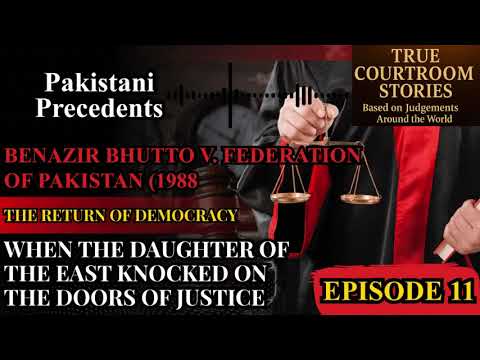
EPISODE 11 – Benazir Bhutto v. Federation of Pakistan (1988) – “The Return of Democracy”
True Courtroom Stories: Based on judgements
29m 1s5,074 words~26 min read
YouTube auto captions
Transcript source
YouTube auto captions
This transcript was extracted from YouTube's auto-generated caption track. The transcript below is server-rendered so it can be read, searched, cited, and shared without opening the original YouTube player.
Pull quotes
[0:00]We want to get under the skin of the political firestorm brewing back then and more importantly, pinpoint the exact constitutional lever that aha moment in the law that let the court step in.
[0:00]How did the rule of law manage to override some really blatant government interference and well, trigger this huge historical shift without violence importantly?
[0:00]And that lever, that specific legal mechanism, it's absolutely central to the whole story, that's where we're going to spend some proper time unpacking it.
[0:00]We're mainly looking at a detailed legal analysis of the case Benazir Bhutto versus Federation of Pakistan.
Use this transcript
Related transcript hubs
Watch on YouTube
Share
MORE TRANSCRIPTS


