[0:04]Hi, it's Mr. Anderson and today I'm going to talk about linked genes. Uh when I teach biology, one of the hardest things to explain is linked genes. And so I'm going to kind of go through this slow and make sure that I hit all the points and hopefully you can have that aha moment when you finally understand how linked genes work. Most of this is through the work of Thomas Hunt Morgan. He bred fruit flies and kind of took the work of Mendel and then pushed it into modern day and so this is one of the early 1900s. And so the people, Thomas Hunt Morgan, the people who worked in his lab discovered so many things that we now kind of take for granted. Uh first of all, these are fruit flies. Fruit flies are really hard to see with an eye, you have to look at them under a dissecting microscope. But basically you grow them in a medium like this, they'll lay eggs, you take the eggs out, they'll hatch into larvae and then the next generation of flies shows up. And so this is what a fruit fly looks like when you could zoom into it. You can actually, if you were to look really closely, you'd see that there are two types of fruit flies here and and they're separated by gender. In other words, this one right here is going to be a male, it kind of has a rounded rear end, and then it also has these things up here on its arms, those are called sex combs. And the sex combs are a good way to tell the difference between the male, so this would be a male right here, and then you could tell right here no sex combs, kind of a pointy end, so this is going to be a female right here. And so you could go through and figure out which ones are male and female, but that's not what we're interested in. What we're interested in is linked genes. And so in the fruit fly lab of uh Morgan's fruit fly lab, basically, whenever he found a mutation, then he would breed that mutation till he had a pure amount of that. And so you can see here that this is a fruit fly that's got two mutations. First of all, it's got a color that's black, and then it has these vestigial wings. And so everything else is going to be same between these two fruit flies, except the color and then the uh wings, vestigial wings. They can't fly uh because they have these little nubbins of a wing. And so basically he was doing work on fruit flies and so the the nomenclature for genetics on fruit flies is pretty simple, but it can be a little scary if you've never seen it before. So basically we take uh trait, in this case, this BLBL is going to stand for the black uh mutation, and then the VGVG stands for the vestigial wing mutation. And so then you just take those letters and then you add a plus to it for the wild. And so this would be wild type for both of those genes. Okay, so, let's say we were going to do a cross between these two. The way you would set it up, and again, if you're not sure on how to do this, make sure you watch the podcast on on Punnett squares, but basically this one can either give the vestigial or the vestigial, or excuse me, the wild or the wild. And this one can give the wild or the wild. So basically, in meiosis, it's only going to be able to produce this one gamete right here, uh the female. The male over here since it has two of the mutant genes, it's only going to be able to produce this gamete right here. And so if we were to do a cross between the two, this would be what we get. Um, so we're going to have a hybrid for these two traits. So it's going to be heterozygous, heterozygous. And so you might think to yourself, what what's that fly going to look like? Well, if this is if these are recessive genes, uh then we would expect it to look like a wild type. If these are dominant genes, we'd expect it to look like the mutant type, but if it's a combination of the two, we might have one that's black with normal wings or so. Let's figure that out. So I'm going to go to the fruit fly lab. So fruit fly lab, this is at sciencecourseware.comvcise/drosophila/. And so basically you can do any cross that you could imagine. So I'm going to order those fruit flies. So I'm going to order the flies. Again, the female was of the wild type, so I'm going to add that to the cart. And now I'm going to figure out the male, so the male again had a body color that's black. And then it had a wing size that was vestigial. So I built the male. I'm going to buy that, and I'm going to check out. And they already arrived in the mail. So I'm going to throw this cross in the incubator. Remember it's going to hold on to those ones that I ordered, and I'll come back to that in just a second. So I'm going to throw it in the incubator. And so two weeks later we're going to have that next generation.
[4:26]All right. So now I'm going to pull those out and we're going to, let's have it again. I'm going to pull those out and we're going to put it underneath the microscope so we can see what came from that. So throw that under the microscope. I'm going to sort it. Normally you apply like ether to the flies and then you can separate them with a paint brush, so you don't want to kill them. They're just asleep because you're going to use them again. So what I got is two piles of flies. And so let me look at the female right here. So the female right here is wild for color and wild for wings. And so we know that those two mutations are recessive. Now what I'm going to do right now is add this and use it in a new mating. I'm going to add that, and we'll come back to that in just a second. Let's make sure the male, so the male's over here. Those are all same thing, so they're going to be wild as well. And so it looks like those two different traits were recessive traits. So let's kind of go back to the keynote for a second. And so what did we get for a fruit fly? We got wild type of those two. Okay. So that made sense to Thomas Hunt Morgan. Uh this was just Mendelian genetics, and so if you were to stop there, you wouldn't have learned anything. And so what I'm going to do is take this, the daughter in this trait, and let's cross that with uh homozygous mutant for both types. Okay? So now we have a hybrid over here, and then we it's essentially a daughter from that cross and we're going to cross it with the dad in that first cross. I know that's gross, but that's basically what we're going to do. Okay, so what could we get for gametes? Well, this one again can only give the BL or the black mutation, and then the VGVG stands for the vestigial wing. But this one over here can actually produce four different types of gametes because you could have the wild with vestigial, we could have the wild with uh wild with wild, we could have the black with wild, and we could have the black with vestigial. So there are essentially four different gametes that we could get for that. So let me lay those out here. So we've got that, and if we were to do our Punnett square, these would be the four types that we could get. And so in this cross, what would they look like? Well, this right here would be um, this it's going to be wild, wild. This one right here is going to be wild vestigial wings. This one right here would be black wild and this one would be black vestigial wings. And so this is what the fruit flies would look like. And so according to Mendelian genetics, we would have a 4x1 Punnett square. And so we would expect if we bred these, that we'd have 25% of each of these four types. Now, the reason I've shaded these ones in yellow right here is that those are parental types. In other words, they look like the parents. So this one looks like the mom. This one over here would look like the dad, but this one's going to be a combination of the two. This one's going to have that normal coloration but vestigial wings. This one would be the black. So this is what they predicted would happen in the cross, but what they found was way different than that and it led to the discovery of the linked gene. So let's go back to the lab again. So what I'm going to cross now is I'd already taken that female, so that heterozygous female from this cross. So now what I'm going to do, I added her to this mating right here, but I'm going to add the dad to that as well. So I'm going to add the dad to that mating. Yes. And I'm going to let them mate. Uh and so two weeks later we're going to take a look at the offspring that come from that. All right. Let me pull that out. Put those under the microscope.
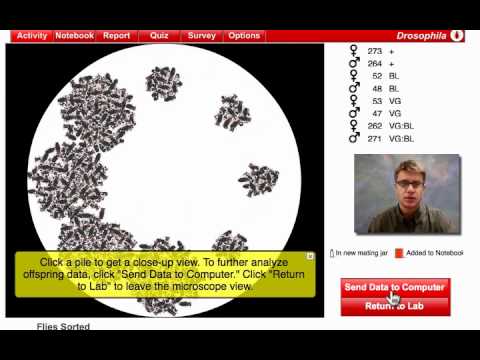
[8:14]And so you should be thinking, you know, hypothesis testing, what should I find under here? Well, it always is going to sort them according to gender. And so we should get eight piles of flies and they should be equal in size. So let me sort the flies and see if that's what we get. And so this is weird. The results you get should freak you out a little bit, and they freaked out Thomas Hunt Morgan as well. So let's click at what this is. Well, this is a normal wild, so let's zoom out again. This one, so that was one parental type. This would be the other parental type. So it looks like there's actually more of the parental type than there are of the recombinant. So if I look at the recombinant, this would be black with normal wings, or if I were to look down here and this is probably going to be normal coloration but vestigial wings. And so if you look at the data, well, let's actually send the data to the computer and look at the results. And so I'm going to click this button up here to ignore sex because there's no difference in the genders. In other words, if we look right here is a wild type male, 264, wild type female, 273, there's no difference between those, doesn't look like it's sex linked, so I'm going to ignore the sex. And so what do we find? Well, we find that roughly we are getting 42% of the wild type. We're getting 42% of the vestigial parental type, but we're only getting like 7.8% of the two. So about 8% of each of these two. And so when they got these results, it it kind of freaked them out. In other words, what they found is that they normally ended up getting around 83% of the parental type, these two. And then they only got around 16, 17% of these other two. And so they thought there was a mistake, so they crossed it again and again and again and again, and they found the same thing. It just kept happening over and over and over again. So let's go back to our flies. And so what we're getting instead of a one to one to one to one ratio, we're getting this weird ratio where we have basically of these two parental type, we're having like 83% of them on the parental type. And of these two, we're getting like 17%. And so they crossed it again and again and again, and they just kept getting the same thing over and over and over. If I remember right, they started to think maybe there's something about 17% percent, maybe they discovered the new pie, this new irrational number and they couldn't figure it out. Uh basically, I love this story because one of the students of Thomas Hunt Morgan, his name is Sturtevant, uh his last name's Sturtevant. Uh I think Reginald. I can't remember, Alfred. I'll have to look it up. Uh, but basically, Dr. Sturtevant will call him, uh was up one night, he was a student, so 19 years old, something like that. And he was trying to solve, what is it about this 15%? Just thinking about it, one night he just blew off his homework and worked on it all night and then came up with the solution. And the solution is that those genes are linked. What that means is that they're on the same chromosome. Now, they had discovered the work of Mendel. They had seen these things called chromosomes, they could see them under the microscope, but what Sturtevant and and Morgan did is they brought together these two concepts, the concepts of Mendelian genetics and chromosomes and you came up with chromosomal genetics. And so what does that mean? These two genes are on the same exact chromosome. And so that means that they tend to go together through time, genetic time. Example in humans, freckles and red hair are on the same chromosome, so they're going to tend to travel together. Now this is the point where people tend to get it. Oh, I get it now, uh and then they leave it. And they don't really go deeper in linked genes and try to figure out, well how does that all work out? And so when I was thinking about how to present this, the best way to do it is to show you the chromosome. So we're going to go through the same exact crosses that I had, but instead of just putting the terms down here, I'm going to actually show you the chromosomes. Okay. And so how does this work? Well, this is that first cross. This is going to be through the wild type and the double mutation, black vestigial wings. And so this is what the chromosome would look like. Now, there are actually going to produce four chromosomes, but since these are the only genes they have, you can only create one type of chromosome. No matter how you organize it, you can only create one type of chromosome. And remember, in meiosis, let me bring up a color that I can actually draw in. Let's try black. There you go. So again, in meiosis you're going to produce a sister chromatid to this, so it's going to look like that. We're going to have the two genes on it. Remember, there's going to be another homologous chromosome down here. This is awful drawing. So this is going to have the same exact genes, and there's going to be a crossover between these two. But since these are the only genes that you have, as you go through meiosis, the only gametes that you can produce are going to be gametes that look like that. That's the only thing that we can produce. And so let me show you how that works on the Punnett Square. Well, these are the two chromosomes now that have the genes on it that are going to come together. And those are going to create a new fly. And so that fly is going to be a hybrid of the two types. So this should make sense, and it made sense also when they did the crosses, but let's get to the now the F1 cross. Okay. So if we look at this parent right here, this parent right here is going to have gotten the wild genes, so that wild chromosome. You can back up again, so it's getting this chromosome, this is the daughter remember. It's getting that one, uh and then it's getting this one. And so if we look on the next slide, so this would be the two chromosomes that we have. Um, this one right here, no matter how much mixing and crossing over and independent assortment we have, you just got these two genes. So you can mix them up as as much as you want, but you can really only produce this one chromosome down here. But this one up here, it can produce, it can just hand this chromosome off, and this would be one parent. It could hand this chromosome off, chromosome off, and it would create another parental cross. So it could produce these two parental crosses, but how could we ever create these recombinants? How could we ever do that? Well, basically the only way we could do that is if as it makes a copy of itself and puts the chromosomes over here. So it would be a BL plus and a VG plus. And this one is going to do the same down here. Like that. And again, they're going to do crossing over and this is the BL on this side and the VG plus. The only way we could create one of these new chromosomes is if it were to cross over and we were to cut between right here between these these two genes. And this one were to swap down here, and this one were to swap back over here, or this one were to swap here and this one were to swap back. In other words, if you look as a chromosome like this, during that crossing over event, if you have two genes that are really far apart, crossing over is fairly random. And so sometimes it might cut here, sometimes it might cut here, sometimes it might cut here, cut here, cut here, it's just going to make all these cuts. But the closer the two genes are, the less likely that it's going to cut between those two and create recombinant chromosomes. And so basically, to build these recombinants, you have to have a crossing over event that cuts the two in half. And so what does that mean? Well, the frequency of recombination right here was again 17%, and that 17% means that the genes are relatively close together. What would it mean if our frequency of recombination is 50%? Well, 50% means that they're on different genes. And so there's going to be what Mendel produced, what Mendel, uh what Mendel thought that you'd have 50% parental and 50% recombinant. And so if we ever get a frequency of recombination or frequency of these new recombinant fruit flies that is less than 50%, that means that the genes are linked. And the less that number is, that frequency of recombination, the lower it is, the closer those genes are going to be. And so let's say it's 48% frequency of recombination, that means that the gene is going to be right here, and the gene's going to be way out here. But if the frequency of recombination is really low, let's say it's like 2%, it's really, really rare, that means the genes are really close to each other. Now that frequency of recombination doesn't tell us where the genes are, but you could do a number of crosses between other genes that are linked. And that's what Sturtevant and Morgan did, and you can create what's called a gene map. And that's kind of fun to figure out where the genes are located on it using a bunch of different frequencies of recombination. And so that's linked genes. I know that took a while, but I think it's important you have a really good conceptual understanding of how that works.


