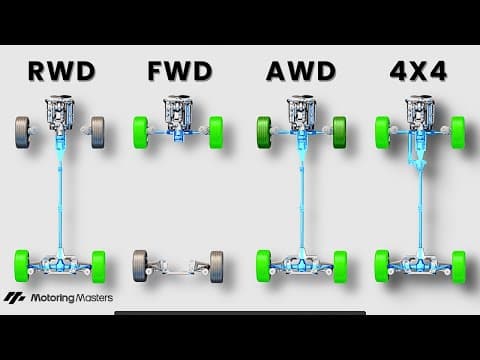
[0:00]You're cruising down a smooth highway at high speed, and your car is feeling stable and in control. Suddenly, the journey changes, you're now navigating a snow-covered road with limited traction. Later, you find yourself on a muddy trail, the wheels spinning and struggling to find grip. Finally, you're climbing a steep rocky incline, with every wheel fighting for traction to keep you moving forward. What makes your car adapt to these wildly different conditions? Here comes the different drive trains. Rear wheel drive, front wheel drive, all wheel drive, and four-wheel drive. To understand this, let's start with a key component of all these systems, the differential. Imagine a simple car axle with two wheels attached. When the car moves in a straight line, both wheels rotate at the same speed because they travel the same distance. In this case, both wheels are in sync. Now, the car takes a turn. The outer wheel has to travel a longer distance than the inner wheel because the outer wheel's path is larger. If the two wheels were rigidly connected, like on a solid axle, they would both try to spin at the same speed. This causes skidding of the inner wheel. The differential is a mechanical device placed between the two wheels on an axle.
[1:27]It allows both wheels to receive power from the engine. It lets each wheel spin at different speeds when needed. Inside the differential, there are gears called pinion gear, ring gear, side gears, and spider gears. The ring gear receives the power from the engine via pinion gear. When driving straight, the spider gears stay stationary, and both wheels rotate at the same speed. When turning, the spider gears spin, allowing the inner and outer wheels to rotate at different speeds. This helps take a turn smoothly as the inner will rotate slower than the outer wheel. It's a small but ingenious component that makes modern driving smooth and safe.
[2:16]Now let's zoom out and look at the bigger picture, how this fits into the world of drivetrains. First up, rear wheel drive. This is one of the most classic and performance-oriented drivetrain setups. Let's break it down. The engine's power goes through the transmission. From the transmission, the power flows through a long drive shaft that runs to the back of the car. The differential receives the power and splits the power between the two rear wheels allowing them to rotate at the same speed. The differential also allows the wheels to rotate at different speeds when one will loses traction. These wheels propel the car forward while the front wheels focus on steering. The separation of steering and power results in more precise control. Rear wheel propulsion allows for sharper acceleration, especially in sporty or luxury cars. In slippery conditions like snow or ice, the rear wheel drive can struggle as the rear wheels may lose traction more easily. But not all driving scenarios are the same. So, how does this compare to front wheel drive? Let's find out. In front wheel drive cars, the engine and transmission are usually mounted together in a single unit called a transaxle, located at the front of the vehicle. The engine generates power, which passes through the transmission, where gears adjust speed and torque. The differential, integrated into the transaxle, splits the power and sends it to the front wheels through CV axles. These wheels propel the car forward. The front wheels not only handle wheel rotation to move the car forward, but also manage steering. Just like in rear wheel drive, the differential allows the wheels to rotate at different speeds when one will loses traction. But compared to rear wheel drive, front wheel drive cars are less suited for sporty driving dynamics. Front wheel drive is all about practicality and efficiency, making it perfect for everyday use. But what if the road disappears, the terrain gets unpredictable, and you need to drive anywhere, no matter how rough the conditions? That's where four by four comes in, giving you the traction and control needed for any terrain. Let's see how it works. Here, the transmission is placed after the engine and after that, there is another component called the transfer case, which is the heart of the four by four system. This component delivers the engine's power to both the front and rear axles. There are two main types of transfer cases, part-time four by four and full-time four by four. The part-time transfer case has one input shaft from transmission and two output shafts to the rear axle and front axle. And they're three modes: 2H, 4H, and 4L. First up, two high range mode. Here it receives power from the transmission and sends power only to the rear wheels for regular driving. The front axle is disengaged. It works the same as the rear wheel drive system.
[5:24]Second up, four wheel drive high range. When you need extra traction, the transfer case engages the front axle through a chain or clutch system. This splits power equally between the front and rear axles. Both axles receive 50% of the engine's power, ensuring that all four wheels contribute to propulsion. Each axle in a four high system has its own differential. These open differentials allow the left and right wheels on both axles to rotate at different speeds. If one wheel on an axle loses traction by being stuck in the mud, the open differential will send most of the power to the spinning wheel. This can cause the wheel with no traction to spin uselessly while the other wheel, with traction, receives little to no power. So, many 4x4 systems include locking differentials to address this issue by forcing both wheels on an axle to rotate at the same speed. The mechanism inside the differential locks both axle shafts together. Simply, it is likely deleting the differential from the axle.
[6:26]Now it acts like a solid axle and both wheels rotate only at the exact same speed regardless of traction differences. Power is evenly distributed to both wheels, ensuring the wheel has a better grip and can propel the vehicle forward. Here, the left will has no traction and is not spinning uselessly.
[6:47]The power is evenly distributed to the right wheel, which has traction, moving the vehicle forward. 4H is designed for moderate to high speeds, typically 30 to 55 miles per hour depending on conditions. Switching back to 2H on stable roads helps maintain efficiency and prolong vehicle life. So when to switch to four wheel drive low range. 4L is a drivetrain mode designed to provide maximum torque and control for extreme off-road situations, like climbing or descending steep, rocky, or driving through deep, sticky mud. The transfer case engages a low gear ratio, commonly between two to one and four to one. If the input shaft from the engine rotates four times, the output shaft rotates only once. This increases torque four times and reduces the speed four times. For example, if your vehicle's output is 300 Newton meters of torque, a four to one low range gear ratio can deliver 1200 Newton meters to the wheels. Due to high torque, the tire pushes against the ground and the ground pushes back with an equal and opposite force. This reaction force propels the vehicle forward. So with high torque, adding a differential lock to this system makes 4L better suited for any challenging off-road conditions. And in full-time four wheel drive vehicles, there's an advanced component known as the center differential. It adds flexibility by allowing the front and rear axles to rotate at different speeds. But one axle might lose grip, causing the differential to send most of the torque to the axle with less resistance, typically the slipping one. Locking the center differential ensures torque is evenly distributed between the front and rear axles, preventing one axle from slipping and maintaining control. Let's move to a more modern and automated solution. All wheel drive. This is an always ready sibling of four by four, designed to handle a mix of conditions without different modes like 2H, 4H, or 4L. It does not use a transfer case. Instead, it uses a center differential or a multi-plate clutch to manage power between the front and rear axles. For better understanding, we will take the multi-plate clutch used in modern vehicles as an example. This system has wheel speed sensors on all wheels. These sensors continuously monitor wheel speed. If the front right will loses traction, the sensor detects the spinning wheel and sends a signal to the AWD control unit. Control unit engages the clutch plates. This gradually connects the rear drive shaft to the transmission, sending more power to the rear axle. Instead of power being wasted on the spinning front right wheel, the system redirects torque to the rear wheels, helping the car regain traction. And this system does not contain low gear ranges, so it is suitable for on-road performance and moderate off-road conditions. And there you have it. Each drivetrain is purpose-built to excel in specific scenarios. Drive safe, and thanks for watching.


