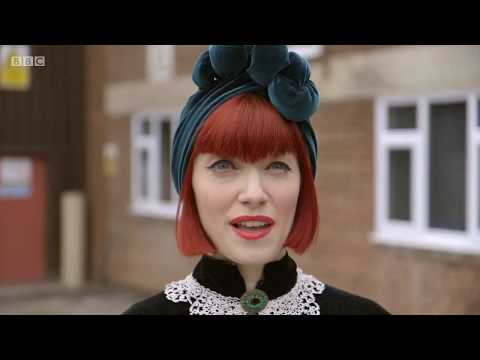
[0:01]Clothes are the ultimate form of visual communication. By looking at the way people dressed, we can learn not only about them as individuals, but about the society they lived in. I'm Amber Butchart, fashion historian. And in the words of Louis XIV, I believe that fashion is the mirror of history. So, taking historical works of art as our inspiration, traditional tailor Ninia Mikhaila and her team will be recreating historical clothing, using only authentic methods. Oh, look at that. It's changing colour in the air. And I'll be finding out what they tell us about the people who wore them, I'm assuming the king wouldn't be dressing himself though, right? And the times they lived in. and seeing what they're like to wear.
[1:02]The picture that launched a thousand theories, Jan Van Eyck's famous double portrait, painted in 1434, is considered one of the most complex paintings in Western art. I chose this portrait for a number of reasons. It's something that has been written about extensively in art history. There's a real appetite for new information that can shed light on this portrait and the sitters. Now, historically speaking, it's also a very fascinating period. We've seen the emergence of mercantile capitalism all around port cities in Europe. So we begin to see the effects of trade really heavily on the way that people are dressing. Now, also the emergence of the merchant, this is quite an interesting character. They challenge the previous very rigid structures of society. So there's an element of social mobility here. You can become very rich through trade. You don't necessarily have to have been born into wealth. And I'm really interested to see if this element of social mobility is reflected in the way that people are dressing. So there are a number of things going on with this portrait, plus I really love the colour green.
[2:16]This dress is so alien to our modern aesthetic and really interested to find out from Ninya just how complicated it will be to make. I suppose the thing that strikes you first is just quite how much fabric there is in there. And then as you zoom in, you see these huge hanging sleeves, which have the most incredible decoration going on at bottom of them. What you're seeing there is literally layers of the fabric, which have been cut with a special tool, a pinking tool, to give that very fragile, frayed look. And so the fabric itself, this gorgeous green fabric. What is this? What what material is it? It was a kind of cloth that was woven very wide, so it was called broadcloth. This fabric today is usually called doe skin or super fine, but what these very small samples don't really show, is how beautiful that looks in the picture. And that's because you need a larger piece of the fabric. So this is a piece of doe skin.
[3:17]So you can see that once it starts to drape and actually get the light on it, it becomes a much more silky looking material. Yeah. People don't usually associate wool as being a luxury fabric, do they? They don't. And at this state, it really was one of England's finest exports and it was bought and used all over Europe. But it's not just the wool that we're seeing here, is it? There's this fur trim as well. Now, where does this fur in particular come from? We're still thinking about what it might be, and one possibility is it might be an Arctic fox. Wow. Where does one get hold of Arctic fox? Well, for these people, it would have been imported, it would be Baltic. It's another expensive luxury item. And that's quite helpful in an age before central heating, isn't it? would be really keep you warm. Yes. wool and fur. Now, we're not going to be using any Arctic fox. I'm assuming for this. No. So what will we be using? We'll be looking for a faux fur. So really, throughout here, we're seeing quite a an opulent display of wealth here, this literally wearing your wealth on your sleeves. And trailing it on the ground.
[4:32]Given that this dress seems to be such a conspicuous display of wealth, I'm fascinated to find out more about the couple in the portrait and why they might have chosen these clothes to be painted in. I'm hoping art historian Jenny Graham can shed some light on the subject. So this portrait, one of the most contested, most debated in the history of Western art. Who do we think these people are? There are a very wealthy couple. We know that they come from the Arnolfini family, who traded in luxurious fabrics and exotic items, such as the four oranges that you can see. This really represents their conspicuous consumption of wealth and splendid things. Now this picture has become ensconced within popular culture. Even Charles Dickens refers to it as that strange mirror picture. Why do you think it's got such an enduring appeal? I can't think of another painting in sort of Western art history whereby we know so very much about how it's been interpreted in different ways over the years. It seems to be a painting which triggers all kinds of detective-like attempts to solve the enigma, the riddle. One of the overriding theories that's now been discredited is that she's pregnant, but that's not the case, is it? No, the pregnancy theories first crop up in the 19th century. But a modern reading of the painting is very much that she is holding up the green wool dress, very, very heavy. And so the painting now is much more understood, I think, as a display of opulence and wealth. And it's more than that as well. It's very, very interesting in terms of gender politics. If she were to let go of the folds of the dress, it would pull out all around her in a way that would make it almost impossible to walk. And we know for example that there were lots of ways that women in this at this time signalled their social status, the fact that they weren't going to be moving around or undertaking anything manual. Everything seems to signal restraint. So the dress we're seeing here represents a number of different things. It can speak to us about the position of women in society. It can speak to us about the couple, the status as merchants. So it really does an awful lot going on here, isn't there? Yes, I mean, interestingly, the green dress is made of wool, which was very much associated with trade between Bruges, where Jan Van Eyck paints the portrait, and Italy. We know that the Arnolfini family traded in cloth particularly. So there's a sort of familial significance there. But green itself was a colour associated with high finance and banking. When one made a trade in um Italy during this period, one would place down a green cloth. So I think there's a real significance given the trade in which they've made their money.
[7:29]Just as the painting's complexity provides continual debate for art historians, so the dress's design is proving a challenge for Ninya. I'm trying to work out how the sleeves on this Arnolfini gown actually work because they're incredibly complicated. If you go to the bottom of the strips.
[7:52]See, look, isn't that the bottom edge of a strip and that's the bottom edge of the strip? So it's like there's layers. It's tears, isn't it? It's got a sort of fold at the bottom, doesn't it? I was at a point maybe it's not a raw edge, maybe it's folded. I don't think that is a raw edge, look, it doesn't it's not pink the edge. The edge is is definitely different. That's not a pink edge, that's a fold. How about it's one piece that's really long and it's folded up behind itself and pinned? So that the so it's behaving. The long things would come down to there and then fold back up. Yeah, and that would give it more body so it would stay it would give it its sort of flat front thing. I think that's worth a shot. Need to do another twirl. In something thicker. Yeah, how about if I cut it in wool and then we can cut into it and see. Yes, it'll have more body, won't it?
[9:08]It's just incredible how many different stages this fabric has gone through to get it into this beautiful finished state. And it's even more astounding to think that in the 15th century, each of these different stages would have actually been done by hand.
[9:33]It really goes to show just how expensive this fabric would have been. It was a real status symbol and a real show of wealth.
[10:48]After arriving in tightly compacted bales, the wool is pulled apart and aerated in the blending process.
[10:58]So this is what it looks like when it comes off the out of the machine. Yeah, so you can see how different it looks. How aerated, how pulled apart it is. Next, the aerated wool is sent to carding. This machine is going to take all of this and make it look like this. Okay, and how does it do that? Carding is where the wool fibres are broken up and aligned into strands. That really does look like clouds, doesn't it?
[11:25]You can really see it starting to take that shape now.
[11:33]This is what you get out at the end. So this is what we call slubbing. If you pull it apart, you can see that there's no strength in there, but you can take the same piece and put all those twists in and turn it, and turn it, and turn it. And then try and pull it apart. You can see that you've got more strength in there. So that's the spinning process that we have to go through next to make it into the yarn that can be put through. The yarn is spun onto spools and then woven into cloth.
[12:09]The next process is what makes our wool so special. It's washed and beaten, which shrinks the cloth, meshing the fibres together, giving it its felt-like texture and enabling it to be cut without fraying. Then, tentering. So, you know the saying tender hooks, being kept on tender hooks, that's where this saying comes from. It would have been carried out into a field, would have been pinned actually onto wooden A-frames and left out into the sun to dry. Yeah. Obviously, it would have taken a very long time, and therefore being kept on tender hooks. But this is the modern day equivalent. So you see these holes? Yeah. That's where you tender hooks are. Ah. Wow.
[12:50]So this is your doe skin. Oh my gosh, so this is it. So beautiful. Look at that colour. I know. It's the sheen. It's the face of the fabric that gives it that beautiful, beautiful sheen. How exciting, I can't wait to see it made up.
[13:09]It's just incredible how many different stages this fabric has gone through to get it into this beautiful finished state. And it's even more astounding to think that in the 15th century, each of these different stages would have actually been done by hand. It really goes to show just how expensive this fabric would have been. It was a real status symbol and a real show of wealth.
[13:43]Come and see how gorgeous it looks. Oh. Wow. It could just make you cry, it's so beautiful. That is gorgeous. Look at it. It's like liquid, isn't it? It's just what you wanted. It's it's so perfect. And I did have to think quite carefully about how to cut such a wide pattern piece from the wool, and it it had to have pieces, extra pieces sewn into it. So we've got those pieces at the sides here. Oh, wow. And you can see how where they're upside down, the light falls completely differently. Yeah. On it, and nowadays, that's something we wouldn't find acceptable at all. But of course, you know, in the gown, you just you just don't see it with the way it falls. Yeah, it just gets lost in the in the pleats and the folds. The the real complex features of this gown are not there yet. So we've got the pinking in the sleeves and also there's all this very tight pleating in the front and back, I suspect of the gown. I've done quite a lot of samples of the pinking because it's quite scary to go, you know, you can only cut once. Yeah. Oh. So I've done one strip here. Oh, it's quite effective, isn't it? It's really effective. So exciting. It is exciting. It's all, you know, it's all such experimental archaeology, it's brilliant, you know. You don't you don't make these things all the time and you can't possibly know all of the answers without just doing it, which is what we're doing. You like to go. Okay, yes, yes, I would. Sound like it might not be hard enough.
[15:13]Oh, there we go. Yeah. That's good work.
[15:42]You start to get a real feel for how delicate and yet how complex it looks, doesn't it?
[15:53]Yeah. Which is really interesting, maybe part of that stance is to do with the weight of the fabric, balancing it.
[16:11]And we know for example that there were lots of ways that women in this at this time signalled their social status, the fact that they weren't going to be moving around or undertaking anything manual. Everything seems to signal restraint. So the dress we're seeing here represents a number of different things. It can speak to us about the position of women in society. It can speak to us about the couple, the status as merchants. So it really does an awful lot going on here, isn't there? Yes, I mean, interestingly, the green dress is made of wool, which was very much associated with trade between Bruges, where Jan Van Eyck paints the portrait, and Italy. We know that the Arnolfini family traded in cloth particularly. So there's a sort of familial significance there. But green itself was a colour associated with high finance and banking. When one made a trade in um Italy during this period, one would place down a green cloth. So I think there's a real significance given the trade in which they've made their money.
[17:19]Just as the painting's complexity provides continual debate for art historians, so the dress's design is proving a challenge for Ninya. I'm trying to work out how the sleeves on this Arnolfini gown actually work because they're incredibly complicated.


