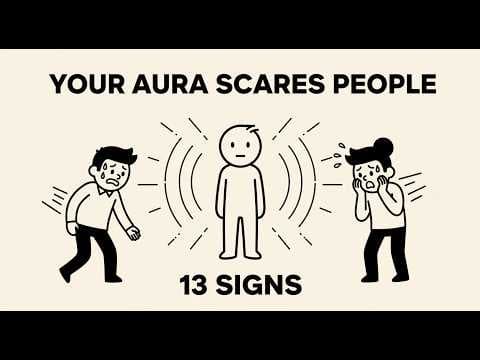
[0:00]Have you ever walked into a room and suddenly something feels different? Conversations slow down. Someone avoids eye contact. Another person starts explaining something you never even asked about. You didn't say anything, but somehow your presence changed the atmosphere. It's subtle, but people notice it. And the strange part? Most of them don't even understand why it happens. Because what they're reacting to is an arrogance. And it's not hostility, it's something far more unsettling. Your presence disrupts their psychological comfort. Human beings rely on predictable social patterns to feel safe, but when someone enters a room and doesn't follow those patterns, the brain reacts instantly. Not with fear, with awareness, and awareness makes people uncomfortable. Today we're breaking down 13 psychological signals that your presence quietly intimidates people. These are not personality traits. Their behavioral patterns studied in social psychology and human perception. And sign number 13 explains why certain people keep thinking about you long after you leave the room. Number one, you don't follow the small-talk script. Most conversations follow predictable patterns. How's work? Busy week, crazy weather lately. These exchanges aren't really about communication, they're social camouflage, but you tend to skip it. You either speak with real intention or you stay quiet. And silence breaks the script. When a familiar social pattern disappears, the brain experiences a spike in cognitive load. People suddenly know what they role supposed to play. That tension people feel around you isn't awkwardness. It's their brain trying to recalibrate the situation. Number two, your eye contact is steadily. Most people break eye contact within a few seconds. Not intentionally, their brain does it automatically. Because prolonged eye contact activates vulnerability circuits in the brain. You don't stare aggressively. You simply stay present, calm, focused, un-rushed, and that removes the psychological cover people normally hide behind. Micro-expressions appear, body language shifts. People suddenly become more careful with their words. Not because you're threatening, but because honesty becomes unavoidable. Number three, you speak slower than most people. Rapid speech often signals anxiety, but slow, deliberate speech signals control. Neuro-linguistic research consistently shows that measured pacing increases perceived authority. You pause before speaking. You choose words carefully. Your sentences carry weight instead of urgency. And when someone controls the tempo of a conversation, the brain unconsciously assigns them higher status. Number four, you don't chase approval. Many people constantly broadcast subtle signals of validation seeking. They laugh too quickly, apologize too often and over-explain themselves. You removed those signals. You're polite, but you're not performing. Psychologically, this creates something powerful, scarcity. When attention isn't freely given, it becomes more valuable. Suddenly, people start trying to earn your attention instead. Number five, you notice things most people miss. Human communication is mostly nonverbal. A delayed smile, a forced laugh, a slight shift in tone. These micro-signals reveal emotions before words ever do. Your brain processes them quickly. And when someone realizes their performance isn't convincing you, discomfort appears immediately. Because the mask stops working. Number six, emotional manipulation doesn't work on you. A lot of social influence depends on emotional reactions. Praise to gain compliance, criticism to provoke insecurity, guilt to create obligation, but your emotional baseline stays stable. Compliments don't inflate your ego. Criticism doesn't shake your identity. Without predictable reactions, manipulation loses its power. And people who rely on those tactics suddenly feel exposed. Number seven, your boundaries are clear. Weak boundaries usually contain hesitation, long explanations, apologies, and justifications. Your boundaries are different. When you say no, it's calm, simple, and final. No anger, no drama, but also no negotiation. Psychologically, that signals high self-respect and low dependency. And people instinctively recognize that persuasion will fail. Number eight, you don't feed emotional chaos. Emotions spread through groups like a chain reaction. One person gets angry, another escalates, soon the entire room is reacting. But you don't join that loop, you observe instead. Your calm presence interrupts the emotional momentum. And when someone expects outrage but receives composure instead, their brain struggles to process the situation. Number nine, your discipline makes people uncomfortable. Consistency is rare. Most people talk about goals, but very few pursue them daily. When someone commits fully to something, without excuses or distractions, it creates an uncomfortable mirror. Your focus isn't aggressive, but it's undeniable. And that consistency forces others to confront the gap between what they say and what they actually do. Number 10, people explain themselves around you. You may notice this often. Someone begins defending a decision even though you never questioned it. Or explaining a story with unnecessary detail. That happens because your presence triggers evaluation awareness. People assume you're analyzing them, so they start building arguments before criticism even exists. Number 11, you don't rely on approval systems. Many people organize their behavior around acceptance. Social media approval, group approval, authority approval. But you seem detached from those systems. You behave the same way regardless of who is watching. Authenticity replaces performance. And when someone stops seeking permission to exist comfortably, others notice immediately. Freedom is powerful, but it can also trigger envy. Number 12, your presence creates strong reactions. "Authenticity rarely produces neutral responses." Some people admire it, others interpret it as arrogance, but both reactions come from the same source. Contrast. Your behavior exposes how much social performance exists around you.
[6:37]And not everyone enjoys seeing that comparison. Number 13, people keep thinking about you. The most powerful presence in a room isn't loud, it's memorable. Certain people replay conversations with you, long after the interaction ends. They analyze what you said, remember your expressions, and wonder what you were thinking. Psychologists call this cognitive occupancy. When someone occupies mental space without even trying. It usually happens when a person behaves in ways the brain cannot easily categorize. You didn't try to impress them. You didn't try to dominate the room. “You simply behaved with a rare level of alignment between thought, emotion, and action." And authenticity at that level is unusual. The psychologist Carl Jung once wrote, "The privilege of a lifetime is to become who you truly are." Most people spend years constructing identities designed to gain approval. Very few dismantle them. And when someone finally does, their presence changes. Not louder, not more aggressive, just undeniable. So if people sometimes feel uncomfortable around you, that isn't a flaw. It's simply the psychological effect of authenticity in a world built on performance. You were never meant to be universally liked. You were meant to be impossible to ignore.


