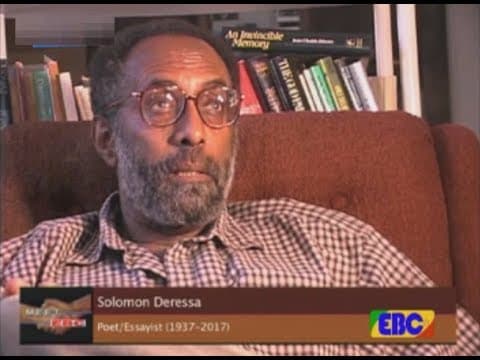
[11:18:00]Hello and welcome, I'm Tefera Ghedamu.
[11:19:35]My name is first name Salomon, last name Diesel and David I R E S S A. So that's the great number, 5487623515.
[11:21:40]The date of birth is 71437
[11:31:02]17 years ago in 2000, I flew to the US to interview and film Ethiopian filmmakers, musicians, and writers for a series of features.
[11:41:40]Well, one of them happened to be the poet, essayist and public intellectual Solomon Deresah who passed away two weeks ago.
[11:48:07]He picked me at the airport in Minneapolis where he lived and right there, we started a conversation that went on for two days.
[11:55:04]And breaking with tradition, tonight, we're going to air longer versions of the interview.
[12:03:04]Salam.
[12:08:08]Hi. He is, yeah.
[12:11:05]Three bucks. Three bucks?
[12:13:08]All right. You sound like you're from East Africa. Are you?
[12:19:04]Yep.
[12:21:05]Where about?
[12:22:04]Huh? Where about?
[12:24:08]Eritrea. Eritrea? All right.
[12:27:08]I'm from Ethiopia. Oh, nice to meet you.
[12:41:03]I came to the states at the beginning of 73 and went directly to Iowa, to Iowa City.
[12:50:07]And from there came to Minneapolis. Minneapolis itself was a small town and uh, it's grown a lot in the last 26 years.
[12:58:05]And the Ethiopian community was maybe 100 and 10 and 120 maybe.
[13:06:05]And uh, including Eritreans whom we consider Ethiopians at that time.
[13:14:02]Some of them thought of themselves as Ethiopians, some as Eritreans already.
[13:18:07]Including them, I think maybe there were 125 of us. And uh, including our neighbors, the Somalis maybe 140 altogether.
[13:21:05]Solomon became famous with the publication of his first book of poems in 1971.
[13:26:07]Rebuked by some for his uncanny style, but welcomed by many, he arguably set Amharic poetry on an entirely new course.
[13:44:03]Amharic poetry, as they say, was never going to be the same again.
[13:48:07]But it took him nearly three decades to publish another anthology of poems. I was wondering why when we sat down for this interview.
[13:56:07]There are times when I write every single day and then there are dry periods.
[14:02:07]If I were a serious writer, I would be very worried, concerned when there is nothing coming out.
[14:12:07]But you know with me it really doesn't matter when it comes, I write sometimes every single day, sometimes 24 hours a day.
[14:19:07]During the Mengistu era, I really went through an experience of a shutdown.
[14:26:07]Uh and uh, decided that probably I was lucky to be alive and lucky not to be in a torture chamber.
[14:40:07]And even luckier not to be doing that to my friends, you know, to some other Ethiopians because it it it really devastated Ethiopia, it devastated us as human beings.
[14:52:07]Not only the ones who died, not only the ones who were tortured, but the ones who tortured, the ones who killed also.
[15:00:07]I think they died in their souls. I could have been one of those.
[15:06:07]And uh, here I was in uh living in Minneapolis, bringing up two kids.
[15:15:07]And uh, at one time four. And uh, I think something inside me died also at that time.
[15:25:07]And there was a kind of a lack of contact with the ground that one walks on.
[15:30:07]Uh, I disliked being in America. I disliked being in Minnesota.
[15:42:07]I would have disliked being anywhere. There was nothing wrong with America, nothing wrong with Minnesota.
[15:48:07]I was an unhappy man. I was doing that for the same reason that most people in Addis Ababa were drinking themselves to death.
[15:56:07]You know? It was their way of shutting down. It was their way of shutting out life, shutting out the pain.
[16:03:07]I think I did the same thing.
[16:05:07]And initially actually I also was drinking and then I looked at the fact that I have responsibility for two kids and I just said that doesn't work and I stopped.
[16:16:07]Fortunately, I am lucky in that also, I can't stop what I do.
[16:21:07]Just like I recently about seven months ago, one day I just decided to stop smoking and I stopped.
[16:27:07]Period. So I stopped drinking, but I also stopped writing.
[16:34:07]I think I can say that most Ethiopians some part of them died.
[16:40:07]Really, the revolution. I'm not saying there weren't some good I'm not saying some good things I did not come out of it.
[16:51:07]That's I'm not into political criticism, but as a simple honest statement of simple human experience without getting theoretical about it.
[16:58:07]Everything indicated that something died in each one of us.
[17:01:07]And uh, I was no exception, that's why I stopped writing.
[17:05:07]Solomon was living alone and traveling a lot.
[17:08:07]Little did I know that his divorce led him into a territory that was entirely new. One thing led to another and the way he was to earn his living was to be dictated by the circumstances that led to his divorce.
[17:21:07]When I look back, I see everything that I did wrong, not just in the separation, but in the marriage itself.
[17:33:07]Uh, some of it I can't tell you about it because I can't talk about it without talking about her.
[17:39:07]And I don't particularly like that because she's happily married somewhere and she's not here to answer for herself.
[17:45:07]But from my point of view, there were some things I had not learned. Uh, I did not grow up in a culture.
[17:55:07]That's something that I've have have to learn here. I did not grow up in a culture. I don't know that there are such cultures.
[18:00:07]Maybe Americans don't have it to either, but I know I don't have it. I know it's not part of Ethiopian culture which is really simply stopping and looking at oneself, at myself.
[18:15:07]Simply keeping quiet if you say, Solomon, you know, there are some things that you do wrong.
[18:21:07]Instead of saying panicking and saying, I don't do anything wrong. What are you talking about? Simply saying, tell me, Tafera, what is it that I do wrong?
[18:29:07]But not as a challenge, but truly to listen. I didn't know how to do that.
[18:37:07]So, there was no way she could tell me the things that I was doing wrong. It's not that she was not saying them.
[18:43:07]I couldn't hear them. I was I'm an Ethiopian. I'm God's gift to the earth.
[18:50:07]I don't do anything wrong. We don't do anything wrong in Ethiopia. Do we? None of us.
[18:56:07]You know, we are created perfect.
[18:59:07]You know, our color is the right color, the shape of our nose is the right no shape, our lips are the right lips, our eyes are the right eyes, the way we dress, what we eat, the way we make love, the way we express ourselves, everything, our civilization, we are 3000 years, we are God's gift to the universe.
[19:08:07]We are beyond criticism by definition.
[19:12:07]If you really stop and think about it, that is where we start from.
[19:20:07]And I know where it I shall not speak of other Ethiopians because, as I say, I'm one that's beginning to accept my imperfections.
[19:26:07]I know where my mind come from. It didn't come from my being a bad person.
[19:30:07]Anymore than for other Ethiopians, it came from a childhood that was painful.
[19:40:07]It came from being put down. It came from adults constantly screaming at you.
[19:46:07]It came from watching people panic all the time.
[19:56:07]It came from watching adults bow down to anyone who is in power.
[20:03:07]I'm not talking about just political power. I'm talking about bowing down to the Pope or we the judge of the Sharia court or, you know, anyone who has gray beard, not questioning.
[20:15:07]I walked around scared to find out I may be wrong about some things.
[20:21:07]And then you get married. I was with my children because they were young and they were not a threat.
[20:28:07]I could hear them. But with somebody who was my equal, I was too scared to hear any criticism.
[20:38:07]You know, people think that it's a political issue whether a country has a freedom of the press, freedom of speech and so on and so on.
[20:46:07]It's not a political issue, it's a personal issue. Can you imagine any person in Ethiopia, any ruler in the whole history of Ethiopia being made fun of the way Clinton is being is made fun of here?
[20:58:07]It's not possible. It's not that it doesn't hurt him when they do.
[21:03:07]You also know it's not the end of the world.
[21:07:07]So I was faced with that. I don't know, well I do know, but I will not go into what my ex-wife's problem was.
[21:15:07]I'll tell you what mine was. One of the main ones was it's too painful for me to hear that I was not perfect.
[21:26:07]And what happens that in those cases are you are willing to give your life to avoid finding out you're not perfect.
[21:35:07]I was willing to give up a marriage to avoid finding out maybe I wasn't perfect. And then I got so angry at her, she became horrible and I became an angel in my own eyes.
[21:46:07]It took about four years to finally sit down and accept what my part of the problem was.
[21:51:07]And you know what came out of that? How I make my living now?
[21:56:07]People very often tell me, you know, you can't say things to people very directly.
[22:04:07]That and I'm accepting from you things I wouldn't accept from somebody else. It's not an accident.
[22:10:07]It is the result of an Ethiopian accepting his imperfections.
[22:17:07]What I do for a living is uh, I, you know, it's very difficult, it sounds almost funny, but I I'll tell you what I do, I what I do is I coach people in almost anything they want to be coached.
[22:31:07]I've coached people in writing, I coached people in parenting.
[22:37:07]Right now I am coaching a couple in getting divorced without becoming enemies.
[22:42:07]Sometimes lovers come, I coach them.
[22:46:07]I some people get interested in the arts and they don't know where to start. I coach them in that.
[22:54:07]So essentially, if you ask me, what do I do?
[23:01:07]I teach anyone who will pay for my time how to look at a problem, how to look at the situation, that's what I do.
[23:15:07]I don't help them solve it. So essentially, what I do is simply say, Tafera, has it have you considered looking here instead of where you're looking?
[23:30:07]Amazingly enough, one of the nice things about in America is if you have anything that people consider useful to them, you can make a living doing it. It doesn't matter what it is.
[23:41:07]So that's what I do. Like while you were here, a phone call came and I'm going to New York tonight to work with some people who are they're working together, but they've come to at to an impass.
[23:58:07]Well, they can go and hire a lawyer, which in America can cost you literally hundreds of thousands of dollars.
[24:06:07]Or you can call in hire me and it would cost you my plane ticket and not even thousands, but hundreds of dollars.
[24:14:07]So I'll work for a few days and I'll come back. What people ask me is how do you know you'll you'll always have work? I don't.
[24:24:07]If you don't like the work I've done for you, two things happen. One, you will not call me back. Two, you will not give my name to somebody else.
[24:36:07]When you call me back two, three times, you don't have to say I did well. I know, because I charge you for every hour.
[24:44:07]And all of my clients work in English because they're Americans.
[24:49:07]When I'm really having a difficult time, you know what I do? Kind of getting to the root of problems.
[24:55:07]I listen to you as you speak in English and I translate it into either Amharic or Oromo.
[25:01:07]Particularly the Oromo that I grew up because it can be richly descriptive of the way people are.
[25:10:07]And uh, in some when it comes to what people are having difficulty with, like what I was talking about, much better than Amharic because Oromo like English is a hip language.
[25:21:07]You know, Amharic is a language of clarity like French. It takes itself a bit too seriously.
[25:29:07]I regret that I don't I didn't live long enough among my own people to write poetry in not instead of Amharic, also.
[25:38:07]But uh, Amharic is like French. I don't know, maybe Tigrinya. I suspect Tigrinya might be a bit like Amharic also.
[25:46:07]A language that takes itself too seriously, too important, you know, it's the language of the Bible at this time.
[25:51:07]Anytime a human institution or human beings take themselves seriously, there is something that becomes closed down.
[26:00:07]And uh, but in spite of that, when I want clarity, I translate it into Amharic.
[26:06:07]And I play it back to them in English. I don't have to say very much.
[26:10:07]So I'm making a living out of being an Ethiopian failure, so to speak.
[26:14:07]He passed away at the age 80, but when we did this interview, he was 62.
[26:20:07]And I was surprised to learn at how ready he was for the inevitable.
[26:24:07]I had a car accident and completely destroyed my car. I'm lucky I survived.
[26:38:07]I still my knees still hurt and my neck and my shoulders and arms hurt for quite a while.
[26:46:07]So, I mean, you know, I haven't given collected the insurance money to buy a car. I don't want to buy a car.
[26:52:07]Sometimes when people come to visit, I kind of say I wish I had a car to go and meet them at the airport.
[26:58:07]But the rest of the time, once I get to Minneapolis, everything is within walking distance, the lakes and everything else I told you.
[27:05:07]No, I really am no longer afraid of anything. I wouldn't I'd like to avoid physical pain.
[27:12:07]But my death is something that I have thought about a long time.
[27:16:07]In fact, now that you ask, I'll tell you something about it.
[27:20:07]I there is a there was a program that no longer exists here in Minneapolis. I think it existed for two existed for about two years.
[27:30:07]I was lucky to get into it and what you did was you went and saw a doctor and the doctor gave you a disease.
[27:40:07]And uh, after that, you were given eight weeks to prepare for your death. And uh, I was given my illness.
[27:50:07]I won't go into that to make to make a long story short, week by week, I'd go and see my doctor and he'd tell me how much worse I'm getting.
[28:00:07]And the final night, actually, I was checked, I checked into the University of Minnesota Hospital and the Protestant preacher, although I'm not Protestant, I'm I was brought up Orthodox.
[28:13:07]came but, you know, he was a Christian priest so he came and uh, he didn't say last rights, but he prayed for me and my soul.
[28:22:07]And I went through that process. And amazingly enough, every single person who went through that program either died or somebody very close to them died within a few weeks.
[28:34:07]And in my case it was my mother. And uh, I wanted to see, of course, you cannot, you cannot pretend to be dying and compare that to dying.
[28:44:07]So I'm not saying I know how it feels. What I am saying is it took something away from me.
[28:53:07]You know? And uh, this was maybe eight, nine years ago and uh, maybe 10 years ago.
[29:02:07]And ever since then, and I've been thinking about it, I've talked to my daughter many, many times, as she was, you know, because I am very important in her life.
[29:13:07]She has a mother, but I know that I'm very important in her life. So I've been just in case, because I know that I'm not immortal.
[29:20:07]Intellectually, I've always known it. Now I really, I think I know that I'm not immortal, someday I will die.
[29:28:07]And I've been preparing her in just talking about it. And uh, I have sat with friends who've died.
[29:36:07]I can honestly say, I'm not afraid of dying. I'm not afraid of anything in particular.
[29:43:07]And my hope is, of course, I don't want to die tomorrow.
[29:48:07]And I'd like to get my stuff in order. I'd like to see my younger daughter, whom we've met, kind of on her way. She kind of done with her graduate school and set herself up.
[29:53:07]But that's a wish. If it didn't happen and I died tomorrow, it's okay too.


