[0:00]Something extraordinary has just happened. The International Energy Agency, which is basically this grouping of rich nations, just set up to deal with energy price crises like the one we're going through at the moment, have just done the biggest emergency stock pile release that we've ever seen.
[0:16]Basically, they they have stock piles that are for emergencies like this of oil around the world, and they've decided to release an unprecedented amount of this. And like when I say historic, have a look at the previous episodes where they've released these stock piles before.
[0:29]So back the first Gulf War, this is showing the total amount in millions of barrels of oil, 75 million barrels of oil in the first Gulf War. Hurricane Katrina 60 million.
[0:40]2011 Libya Civil War 60 million and then 183 million in 2022 when Russia invaded Ukraine, that was actually in two tranches.
[0:50]And now look at what we're talking about this time around. Just look at that. 400 million barrels of oil. We have never seen anything like it.
[1:01]Um and perhaps you're kind of wondering, well, has this had an impact? Has this managed to bring oil prices down? Well, let me just show you what's happened to oil prices in the last few days.
[1:10]Uh this literally just going back to Thursday because it's been such a roller coaster recently. Thursday, Friday, they were kind of climbing up, getting towards $100 a barrel.
[1:19]Uh then on Monday, they kind of went through the roof, up nearly to $120 a barrel. Then Donald Trump kind of kind of stepped into the debate in Florida. He said the war is complete, and that caused prices to kind of go down pretty sharply.
[1:34]And then this is where we are at the moment. So we've just had that news from the IAA. And if you're wondering, you know, did it have an impact? Did it bring those prices even further down? Here's what happened.
[1:45]You can kind of barely spot it, can't you? Basically, they they ticked over. They haven't really moved at all. And all of this raises the question, why?
[1:52]Why is it that markets just haven't responded? Why is it that this unprecedented amount of oil being poured out into the world, hasn't had, you know, that price impact that some people might have expected?
[2:02]Well, partly, you know, maybe it was because it was semi-anticipated, but also there's something deeper going on here, just about the nature of the oil market, and the fact that there's a big gap here.
[2:13]I'll show you that in a second. But first of all, just note the fact that when you talk about oil, and when you think about oil being pumped out of the ground, the dynamic here is about flows. The oil flows out of the ground, often at high pressure, it flows into places like refineries.
[2:26]It goes through the pipes, and in those pipes it's turned into all sorts of different products, you know, obviously petrol, but kerosene, petrochemicals that go into plastics and pharmaceuticals, all sorts of things.
[2:38]Um, but it ends up eventually at the your local petrol station and in other places as well.
[2:44]Along the way though, it's all about motion. It's all about flows, it's all about pipes, and it's all about continuing those flows so the global economic machine that, you know, despite the fact that we're in 2026, despite the fact that we have more renewable energy, is still really dependent on fossil fuels for a lot of people's livelihoods and you know, a lot of that.
[3:05]Um, that those flows need to continue. And if you look at just where the oil is being pumped out of the ground, so where this begins, well, they've got kind of Asia, Russia, quite a lot of in Russia, really a lot, an increasing amount used to share oil and fracking in America.
[3:19]But if I just take these bars and kind of stack them up next to each other, the leader is as it has always been the Middle East. 30 million barrels a day. And what we're talking about here
[3:31]is the total amount each day. And there's there's a reason that we focus on that. I'm going to kind of put them together so you can see.
[3:38]100 million barrels of oil a day is kind of what you need to pump into the economic machine to keep it satisfied right now.
[3:47]And the real problem, you know, the nub of the economic situation we're faced with at the moment is that a massive chunk of those barrels at the moment or hitherto have come out of the Strait of Hormuz.
[3:55]They've come basically from this area that's affected by the fighting right now, about 15 million barrels a day. And you kind of don't have them right now.
[4:09]And this is what everything comes back to. It comes back to the fact that there's a gap here between what the world needs in terms of its oil and what it's potentially getting when the Strait of Hormuz is closed.
[4:20]I'll just show you the geography there because it's kind of it's striking to look at this.
[4:27]Um so much, when you're talking about those 30 million barrels of oil a day, so much of it is coming from such a concentrated part of the world.
[4:33]If you just look here, what these kind of light blue areas are showing you is the oil and gas fields and just look at how they are congregated here. It's just kind of due to a quirk of geology really, um things happening kind of hundreds of millions of years ago.
[4:46]You've got, for instance, over here, that's the North Field. That is the biggest gas field in the world, unparalleled actually, as a kind of source of primary energy, it's very hard to find anywhere else that could have compete.
[4:58]You've got there, that's Ghawar, which is in Saudi Arabia, that's the biggest gas oil field, uh more crude oil there than anywhere else in the world.
[5:08]Um, and if you're looking at this area, you probably can see that a lot of it kind of begins here, and it's kind of landlocked, isn't it?
[5:15]And the reason that the Strait of Hormuz matters so much is that's basically the only way out for most of this oil.
[5:23]Now, one of the questions a lot of people have been asking over this period is, well, hold on, could you just get it out differently, a different way?
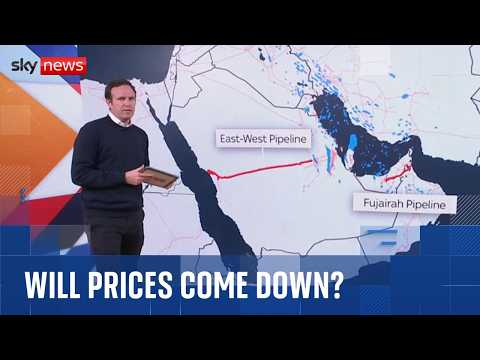
[5:30]And in some sense, the answer is yes, because there are lots of pipelines that are dotted around this area. So, for instance, let me just focus on a couple of them.
[5:38]This is the East-West pipeline that traverses Saudi Arabia. You can get quite a lot of oil out of that. Over there, that's the Fujairah pipeline that kind of goes through the UAE, and takes that oil so that you can get it, you don't have to go through the Strait of Hormuz.
[5:53]It's the other side of the straight, if you kind of see there. Um, if you can kind of rely on not getting bombed around there, you don't have to go through. But the key thing, of course, is that's that's Iran.
[6:03]Um, but here's here's the catch. These pipelines already have a certain amount of oil going through them. Um you could get more, you could certainly get about, maybe, optimistically, about 5 million barrels of a day through the East-West pipeline and maybe getting toward kind of 700,000, uh through this pipeline there.
[6:21]Add that up and remember, what we're talking about is the gap. 15 million barrels a day. That's the key number to keep in mind. Well, that kind of takes, so there's the gap there.
[6:32]So it's all about how we bridge that gap. Pipelines might get you 5.7 million of the way. But of course, you still have a big gap there. You still got 9 and a quarter million barrels short.
[6:44]So then you have to start looking at other things. And that's where we come back to the IEA. And remember this chart I showed you right at the start. The biggest ever.
[6:53]It turns out this is not the key chart. What really matters here is not the total amount of oil that's going to be released, you know, over the course of the next few months.
[7:01]Instead, what really matters is how much oil is going to be released a day. And last time around, you know, each of these different kind of conflicts and moments, there were the flows kind of vary, but they were more or less about 2 million barrels a day.
[7:16]This time around, the IEA hasn't actually told us how much it's going to be releasing a day. Not yet, at least, at the time of recording this. If it were to be 2 million a day, then, to be honest with you, if you look at so take that, add that to our kind of pipeline amounts, you can still, there's there's still a big gap, isn't there?
[7:34]Seven and a quarter million barrels short. But if on the other hand, the amount that's going to be released each day is going to be bigger, that really would be historic.
[7:44]That would be historic, and you know, based on what we're seeing at the moment, it could well be kind of four, maybe four and a four and a half or so million barrels a day, which is important to keep that machine fed. And if that's the case, put that over there, add it to that, and the gap is much more narrow.
[8:02]But there's still a gap. And there is one other kind of thing that might well bridge it. Look back at this map here. Look at the Strait of Hormuz.
[8:09]Now, as you know, it's kind of effectively closed, but it's not entirely closed, because there are still one or two ships going through it.
[8:18]This is showing you the flow of tanker traffic, it's oil and gas, before this conflict began, and then after, and, you know, it's it's really night and day, isn't it?
[8:31]There looks like there's basically nothing going through there. However, this is just, um, tankers that are going through officially, with their transponders on.
[8:39]But there are some that turn their transponders off, they go through kind of the shadow fleet. And if you add them to the equation, look, it's ever so slightly different.
[8:52]You do have a handful of tankers that are passing through the straight, taking that risk. And if you just make a guess about the kind of amount of oil you might be talking about here, it might be, and like I say, this is an estimate, it might be kind of maybe about a million barrels a day, optimistically.
[9:07]And if you add that to that, well, look, you can see the gap is slowly being bridged. It's slowly being bridged. But this is the key thing to have in your mind in the coming weeks.
[9:16]It's a gap, and all of these measures, whether it's the pipeline flows, the stocks, the shadow fleet, we've yet to see them fully kick in.
[9:27]But if they kick in, they might well kind of reduce that to some extent. Um, but it is still short. And around the world, you're still seeing the economic implications of this. So look in India, in Mangalore, there's a refinery which has issued a force majeure notice, so basically saying it can't, uh, honor its contracts.
[9:41]You've got rules coming in in India, uh, which are rationing LPG supplies to domestic households, uh, across in Thailand, in Vietnam, employees have been urged to work from home.
[9:53]You see the way that the consequences of an energy price shock fan out around the global economy. That is happening right now, all the way through to to Europe, you know, thousands of miles away from the Gulf.
[10:04]Um petrol prices are very high in the UK. And in Germany, actually so much so that there's been a clamp down on petrol price rises so that that, you know, gas stations can only raise them once a day.
[10:13]Um these kinds of things we're likely to see much more of in the coming weeks. As long as the consequences of the war continue, as long as those prices stay high, and as long as that gap between what we need and what we have remains so large.


