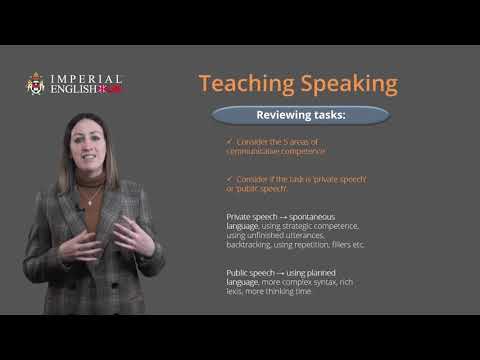
[0:03]Welcome to session nine. In order to prepare for this session on teaching speaking, please consider or talk about the following questions. Can you think of a successful speaking activity that you have arranged as a teacher in the classroom, or a successful speaking activity you participated in as a student? What were the features that made that speaking activity successful? And what problems can there be with speaking activities in class? What is speaking? Speaking tends to be the most commonly accepted evidence of how good someone is at English. It is also the most obvious skill to indicate if a learner is not confident with spontaneous English. It does not necessarily indicate that a student doesn't understand or cannot produce appropriate English, but it could suggest that they're not comfortable with real time. Thinking back to the EDA, what were we testing in the speaking session? Fluency, pronunciation, grammar, and vocabulary are the four main features of speaking that we tend to focus on. How successful a learner is in each area will depend on their ability to generate language and formulate their ideas in real time. The teacher's book will guide you in all tasks, but some general things to consider in speaking tasks are interaction, who are the students talking to and with. The type of things they're asked to say, are they short fixed phrases, long utterances of their own creation, incorporating vocabulary just covered, etc. The situation or context. Is the task a role play, an information gap, or a game? For all speaking tasks on the app, there is a record function. Whenever students are asked to speak, discuss, or work in pairs, they can record their answers and conversations. When submitted, this will be saved in their work record and also sent to the teacher. Speaking tasks will need to be carefully planned. You may need to think about practicalities like students having to hold their tablets so they can record in presentations or mingling tasks. It's important to remember that interaction through speaking and listening takes place throughout the lesson, not only in the designated speaking tasks. So the teacher has a key role to play. We've highlighted in these sessions that the teacher is the model in the classroom. You are the example that the students have of the language they learn. When teaching speaking tasks, it's necessary to be clear what communicative competence is.
[2:55]Trisha Hedge sets out five areas. Linguistic competence. This is the knowledge of spelling, pronunciation, word formation, grammatical structure, sentence structure, semantics, or the relationship between words and meanings. Risk taking and errors in learning are part of the process of achieving communicative competence. We learn from mistakes and by talking about our mistakes and difficulties in the target language.
[3:24]The implications for oral skills in the language classroom are the need to achieve grammatical accuracy, have accurate pronunciation, use stress, rhythm, and intonation to express meaning, build a range of vocabulary, and achieve accuracy in word formation. Pragmatic competence. This is an area the teacher has a major role to play when teaching English through English. It partly means knowing how to use the language in order to achieve certain communicative goals and intentions. For example, it's hot today, could be a statement about the weather in order to start a conversation, an intimation for someone to open the window, or even an attempt to persuade someone to get you a cold drink. So it's important that in the class, the teacher exposes the students to a range of functional language, such as making suggestions, expressing disagreement, or invitational language. It also needs to be clear that language must be appropriate to the social context in terms of formality and informality. For example, if a student needs a pen, they shouldn't say to the teacher, give me a pen. They should say, please could I borrow a pen, or eventually, in a more natural level, is there a spare pen I could borrow? You would use different phrasing and language to convey the same message depending on who you're talking to. This is also true for non-verbal communication. For example, in some cultures, it's acceptable to click your fingers to get someone's attention. But in other cultures, that's considered very impolite. The type of teaching also refers back to the question of whether the teacher should be knowledgeable and or interested in the cultures of the target language.
[5:24]The implications for oral skills in the language classroom are the need to learn the relationship between grammatical forms and functions, for example, modality, use stress and intonation to express attitude and emotion, learn the scale of formality, and use the pragmatic rules of language. Pragmatic competence is a skill you can play around with according to the learner's level. It's something they will become better at and more intuitive towards as they gain more understanding of the language. Discourse competence. This includes how to take turns in conversation, how to maintain a conversation, and how to develop the topic. To do this, learners need to acquire useful language for strategies like initiating, interrupting, turn-taking, and checking and confirming.
[6:17]The use of pronouns, conjunctions, and synonyms are part of discourse competence, as they are in writing. So you can see how important it is for the teacher to have conversations in English with the students as well as give basic classroom instructions in English. You need to be confident about your own English language skills in order to build the student's confidence. Some implications for oral skills in the language classroom are the need to take longer turns, use discourse markers, and open and close conversations. Let's take a moment here to focus on useful activities we can use for discourse competence in the classroom. Initiating, turn-taking, interruptions, and checking and confirming are complex strategies that students need. Think about a group of intermediate students who want to focus on these areas. What activities could you prepare? Pause for a moment and think about this task. Strategic competence. This is an area which some researchers say learners cannot be trained in. Strategic competence is the strategies learners use when they are unable to express what they want to say because they lack the language or vocabulary to do so. Circumlocution and paraphrasing are features of this when the learner cannot think of the word they want, so they describe it or try to get the support from the listener with phrases like, you know what I mean. We can actually help students a lot in this area. One obvious way is by having a classroom language wall chart and referring to it regularly. These posters are offered with Imperial English courses and include phrases like, can you repeat that please? How do you spell or pronounce that? What does this mean please and so on. To develop these strategies, a meaningful context is required, and a language classroom is certainly an authentic setting when students are communicating in English with the teacher or discussing with classmates. Some implications for oral skills in the language classroom are the need to be able to take risks, to use a range of communication strategies and the language needed for these strategies, for example, what do you call a thing or person who, etcetera. Fluency. This is the ability to link words, phrases and chunks of speech together without unintentional slowness, hesitation, and without difficulty. Fluency involves learning and being able to use chunks of language or lexical phrases such as colocation. The teacher needs to understand that these elements combine to make a person a competent communicator, and that exposure can come from the teacher's performance in the classroom as well as specific noticing activities in the course. Some implications for oral skills in the language classroom are the need to deal with the information gap of real discourse, to process language and respond appropriately with a degree of ease, to be able to respond with reasonable speed in real time. There are so many different ways to practice fluency. Think about any suggestions you might have. One method is encouraging students to not try and think too much about what they're saying. Forget worrying about mistakes and just try to talk for as long as possible. You could do this with everyday mundane things like trying to talk about a pencil for two minutes. A common concern from students is that they get embarrassed when they have to speak in front of other people and inevitably make mistakes. So let's look at a way of practicing without the attention. The five areas of communicative competence that we've looked at all involve the teacher and rely on them playing a variety of roles. The general English series and academic English series contain a variety of speaking activities that have been carefully planned and constructed, but the teacher needs to do the following things. Prepare for the lesson in advance in detail, explain methodology and rationale to any learners that haven't studied for a while so they can understand the way of working, build a cohesive and positive classroom dynamic by thinking about things like seating arrangements and interactions. Consider the composition of groups for teamwork, particularly in academic group projects, and be prepared to change pairs between tasks to ensure you gather a variety of opinions. Consider assigning roles in group work to ensure a variety of functions are catered for, for example, a discussion leader, scribe or spokesperson. Since speaking is the skill that requires the most spontaneity, it can be a challenge to teach, as the teacher has to find activities that will prepare students for situations outside the classroom where spontaneous conversation is required. The classroom speaking tasks act as rehearsals for the real thing, but of course the real thing could be subtly different in appearance, but lead to a whole new conversation that the student feels out of their depth in. We're going to look at an example speaking task from the General English series. Remember that the course has taken integrated skills approach, so there could be a reading or listening input and the product of the lesson could be a piece of writing. When reviewing the speaking activities, we should not only consider the five elements of communicative competence, but also think about whether the task is primarily private speech or public speech. Are the students using spontaneous language and employing strategic competence, where we can expect unfinished utterances, backtracking, using repetition and fillers. Or are they presenting in public, where the planned language is likely to include richer lexis and be more complex in syntax, because the speaker has had more time to think and plan? This raises the question of accuracy in speaking, which we will consider in the last part of this session. This task illustrates how using the app is no different to studying with a traditional course book. The technology does not detract from the students and their participation being the focus of the lesson. The task requires a teacher led review of question formation and probably intonation. This then leads to a mill drill with the students moving around the room communicating with each other to exchange information. What opportunities can you suggest as a followup here? Think about this for a moment. There is the potential for group or class survey leading to a wall display which helps give students ownership of the classroom, or an oral presentation using the language of comparison and implementing critical thinking skills. None of these activities restrict the learners to working from the app or reduce the importance of the teacher. As well as reinforcing learner focus of the General English course, this task highlights the inclusion of personalization and differentiation. This is not a test for the students. It's an opportunity for students to express their views and discuss experiences. When giving feedback, either as a class review or when monitoring, it's important for the teacher to show the interest in the individual learner views and personal examples, not only on accuracy and the range of language the students use. Remember not to rely on the IRF approach too much. Throughout the Imperial English UK course, do not forget the importance of the teacher as the facilitator and the need for advanced preparation. The teacher should think through the possible language forms and functions that the students might use or need to use when participating. These are the hashtag words to take from this session. Write a short summary of the session using the hashtag words and examples where possible.


