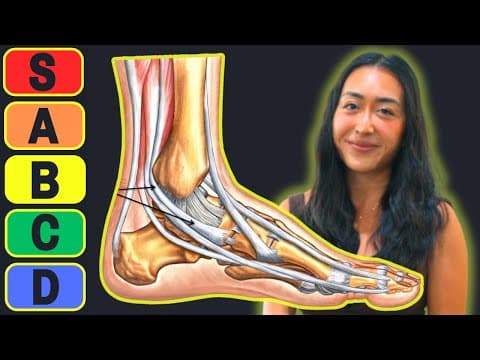
[0:00]Do your feet collapse inward when you walk or run, or maybe your calves are really tight and your shin splints or arch pain just won't go away? The hidden culprit could be a weak tibialis posterior muscle. The tibialis posterior muscle is one of the most underrated muscles in your lower leg. When your tibialis posterior muscle is weak and not addressed, it can easily cause foot arch pain, shin splints, chronically tight calves and even recurrent ankle sprains. In this video, I will show you the best exercises that I have personally used clinically as a physical therapist to help my clients strengthen their weak tibialis posterior muscles. Like my most recent videos, I will be ranking them from easiest to hardest, from the D tier, which is the lowest tier, tailored more towards beginners, and all the way up to the S tier. With S, which stands for superior, meaning the exercises in the S tier will be more tailored towards those of you who want to challenge yourselves, so those exercises will be the more difficult ones. A quick anatomy recap before we dive into the exercise demonstrations. Your tibialis posterior muscle originates on the tibia, fibula, and interosseus membrane of the lower leg, running along the inside of your shin and inserts into several bones in the foot, including the navicular, cuneiform, and the bases of the second to fourth metatarsals. Specifically, the function of your tibialis posterior is to help with ankle planter flexion and inversion of the foot. Functionally, when you are weight bearing on your feet, the job of your tibialis posterior is to support your foot arch and control ankle pronation. If your tibialis posterior muscle is weak, your foot arch collapses, your ankle wobbles, and the stress can then travel up the chain to your knees, hips, and even your lower back. Knowing that, you're probably wanting to know the best exercises to strengthen your tibialis posterior muscle, so let's dive into our exercise demonstrations. The first exercise that we're going to be going over is the banded ankle inversion. So this exercise is going to go into the D tier because it helps to work on activating your tibialis posterior muscle. So you can attach a band to something that is solid. Having that attached, try to get the ankle going inwards like this. So heel is going to be on the ground, going in, come back. So the biggest thing with this exercise, you want to make sure that you're not moving your knee and you're not moving the hip. Going all the way in, hold it for a few seconds so you can feel this muscle working right here, and then come back. Go in, hold it for a few seconds, come back. So these are the banded ankle inversions. Again, make sure the band is going to be pulling from outside, because the resistance has to be pulling from here so then you're resisting this way. So that's the banded ankle inversion and this exercise goes into the D tier. So the next exercise is the short foot. This short foot exercise is going to go into the C tier because now we're going to be doing it more functionally because we're weight bearing onto our feet. So to do this exercise, very easy. All you're going to do is think about your foot here, there's your ball of the big toe, and then there's your heel. And essentially you're going to try to shorten this distance here and make an arch, make a little bridge. Shortening this distance of your foot here, trying not to scrunch your toes when you're doing it, and you're just using your muscles in the foot to do so. Once you have the static arch, if you're able to get this, is if you could do a little bit of a single legged balance while you're holding that arch, would be great. First, you want to shorten that distance between the ball of the big toe and the heel, and then if you can balance while you're holding that. So that's the short foot exercise and this exercise goes into the C tier. So now we're going to go into the B tier where we have the ball calf raise. To do the ball calf raise, all you need is a ball. And you're going to put this in between your lower legs and just above your ankles. And essentially, what you're going to do is trying to squeeze the ball with your ankles as much as you can, and you're going to come up into the calf raise. So squeeze it as hard as you can, come back down. And squeeze, hold it for a few seconds at the top and come back down. So this is a more functional exercise now. You're getting into that weight bearing, you're teaching your tibialis posterior to be used as you're coming up into that calf raise. And this also prevents you from rolling out of your ankle when you're doing that calf raise. A lot of people when they're doing a calf raise, if your tibialis posterior muscle is weak, you're going to roll out like that. So now when you're squeezing the ball, it gets you to come all the way up and pushing up from the ball of the big toe as well. and squeeze it hard. And I like to prescribe about three sets of 15 to 20 with this exercise. This is the ball calf raise and this exercise goes into the B tier. So now we move onto the A tier where we have the single legged calf raise with an e-version bias. To further strengthen your tibialis posterior with a calf raise, we can add in a band. But the band has to be pulling laterally, so it's going to be pulling that way. So I'll demonstrate, if you have a similar setup as me, you might need a stick for support, or just something you can hold onto. And I usually like to hold onto it on the opposite side for balance. What you're going to do is with the band pulling laterally on your forefoot, like so. You're going to try to come up onto that calf raise, come back down. Up, come back down. The band's going to be trying to pull you laterally and you're trying to resist that motion with your tibialis posterior. And again, if you can hold it up top for a few seconds, that would be great. If not, just work up to it, and this is going to help you load that calf muscle and load that tibialis posterior at the same time, and you're doing it single legged, which is going to be very challenging for a lot of people. And if you can't do a single legged yet, feel free to do it double legged. If you have two bands where you can attach your ankles to, you can do it at the same time. If not, you can always just do it one side at a time. So I like to prescribe three sets of 15 for this one, and this exercise goes into the A tier. Now we go onto the S tier, where we have the banded step down. In the S tier, we're going to be testing the tibialis posterior with that eccentric control. You're going to be combining, strengthening other muscles as you're also working your tibialis posterior muscle. You want the band to be pulling you laterally, going outwards. The band's going to be attaching to the forefoot of the working leg, and as you come down, your tibialis posterior is going to be resisting that lateral force. You want to slowly step down and controlling the band from pulling you laterally.
[7:12]So make sure when you have the band setup that the band is attached to the forefoot of the working leg, and you want to try your best to keep that short foot of what we have initially practiced with that short foot exercise, and trying to hold that dynamic arch as you're coming down.
[7:33]So I like to prescribe three sets of 12 for this. Banded step downs with a tibialis posterior bias, goes into the S tier. Okay, so this is the final of the three S-tier exercises. This is the resisted skater lunge with a bias of the tibialis posterior. To do this, again, the band is going to be attached to something solid to your forefoot. It's going to be pulling laterally. Then you're going to try to maintain that short foot, that foot arch, and you're going to slide the other leg out to the side and come up. Making that short foot best that you can, and coming down while the other leg is going down into that lunge. So you could do it laterally like this. You could do it like that. I personally like this direction the most because this is going to challenge that tibialis posterior muscle the most while you're trying to criss-cross that leg over. There you have it. This is the sliding lunges with a tibialis posterior bias and this is the final exercise that goes into the S tier.
[10:12]So, there you have it. These are the best exercises to help you strengthen your tibialis posterior muscle to address flat feet, tight calves, shin splints, and improve your ankle stability. If you enjoyed these live demonstrations of exercises used in physical therapy, hit the like button below to support me and my channel. Also, subscribe if you want to see more of me and I hope to see you in my next one.


