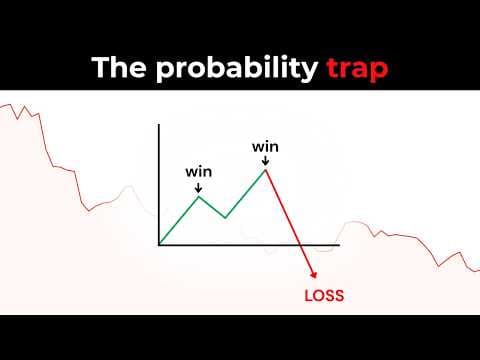
[0:00]In this class, we are going to talk about the math behind successful trading because if you don't understand this, it doesn't matter how well you do everything else. You are never going to win. I'm going to show you a bunch of different concepts you probably haven't seen before and show you how to actually play this game in a way that makes you win. So the first big misconception that we need to talk about is people's perception of trading as a game of skill. Now, the majority of traders spend the majority of their time trying to master sniper entries or technical concepts, but these are not the things that actually make you win. Now, sure, being skilled is good. If you can take great trades, then you're going to win trades more frequently. We all like to do that, and that will be positive for your probabilities-based system. But it's actually the probabilities and the mathematics behind the scenes that decides whether your account grows or completely burns to the ground, okay? So that is why we need to focus in on probabilities and maths. That is what we're going to be doing in this class. So we're going to start with this very simple point. Now, I'm sure you've heard this before, that money is made over large samples of trades and not over individual positions. And while you might have heard it, you might not fully understand it, or you might not put enough attention on it. So I want to bring you to where you are day-to-day when you take trades to reflect upon this for a moment. I presume when you take a winning trade, you probably feel rather excited and you feel like you're succeeding. And when you take a losing trade, you probably get kind of angry. You feel a bit frustrated and you're annoyed that the trade lost because now it's set you back. You judge your trading performance and your abilities as a trader off of these individual wins and losses. But if you think about it, what does it take to win a trade and what does it take to lose a trade? Well, it's a 50/50 coin flip. You either buy or you sell and then the market goes up or it goes down. So judging your trades off of these individual outcomes is really not a good idea because at the end of the day, anyone can win a trade and anyone can lose one. But only some people with the right system in place can make money over the long term. Now, what we need to do is eliminate our need to be right, which is what most people operate from, it's kind of ego driven. And instead, focus on building something we call positive expected value or for the case of this video, you'll probably hear me refer to it as plus EV. So when I say that, that's what I mean. Now, positive expected value is basically a way of building our trading that will essentially naturally print positive results and profits over time. Providing we follow a strict system, okay? And that is what this class is all about. It's about building this positive expected value into the way that you trade. So let's begin by talking about expectancy, because this is the metric that matters above all else. So what exactly is expectancy? Well, it's how much you make or lose per trade, and this includes your wins and losses. So you can think of this as a new way of calculating your individual trade performance, rather than looking at every win you took and every loss you took. We can actually condense everything down into an EV number, or an expected value, okay? So to do this, we have a simple formula. And in order to work out the expected value of your system, you are going to need the performance of the past, say, 50 or 100 trades you took. Now, if you don't have this, that is absolutely fine, and I presume most people won't because most people don't track their trading. But throughout this video, I'm going to show you how to build a system that has positive expected value so that you can build one, test one, and then come back and fill in this equation to work out your expectancy to see whether you are a profitable trader or not. Now, what I would like you to do is follow what we're about to explain with just the past few trades you've taken to see what your short-term expectancy looks like based on the trades you've got. Now, the more data you've got the better, but I don't expect most people will have a whole lot. Okay, so to calculate our EV, we follow this little equation. We get our win ratio. So how many times we win out of one. So if we win 50% of our trades, that would be a 0.5 win ratio, okay, for example. And we times that by our average win size. So if our average win size is $2,000, for example. And then we minus from that our loss ratio times our average loss size. And the number that we get is our expectancy. So let's take a look at an example. Here is an EV formula for a 50% win rate with one to two risk reward. So this means this trader is winning half the trades they take, and they are making $2,000 on a win, or in this case, $2,000 on a win. And they are losing $1,000 on a loss, okay? So they're trading with a one to two risk reward ratio. So how we do the formula then, we have a 50% win rate. So the ratio is going to be 0.5. So 0.5 of all of the trades we take, half the trades we take are winners. And the average win size is $2,000. So then we put that in at the top, and that will equate to $1,000. Then we take our loss ratio, because we're with a 50% win rate, that means 50% of our trades are also going to lose. So we have 0.5 times our average loss size, which is 1,000, that creates 500. So if we then get 1,000 - 500, the result is $500, okay? Now, if this was complex, let me explain it in a more human form and then we'll get into how this actually works and helps and benefits you. So if you took 100 trades, okay, this is the human example. Imagine yourself in this situation. 50 of those trades have won. And they have returned to you $2,000 per trade, okay? 50 of those trades lost and they took away from you $1,000 per trade, okay? So your 50 winners at $2,000 is equivalent to $100,000 in profits. Your 50 losers of $1,000 is equivalent to - $50,000 in profits or capital, okay? So we get the 100,000 in profits minus the 50,000 in losses, and that's going to equate to a $50,000 profit over 100 trades. So, instead of looking at trades as wins and instead of looking at trades as losses, we can equate from this that when we take 100 trades with this system, each trade, whether it won or lost in the moment is worth $500, okay? That is your expectancy, or your expected value. Regardless of whether your trade wins or it loses, it is going to make $500 in EV, okay? So long-term, every trade is just worth $500. Now, if your formula, this formula we've just looked at, actually comes out with a negative expectancy, so let's say it's - $100, then that means your trading is unprofitable and you have to fix that before you start trading it live because otherwise you are burning money. But in this case, of course, we have a positive expectancy, and this is what we need to know so that we can trust our system over time. Because we know every single trade we take, rather than looking at it in wins and losses, it's just worth $500. Okay? Every single win is worth $500, and every single loss is worth $500. Now, obviously, it's not going to look like that in the short to medium term because you're going to see a week where you've lost $3,000 or you're going to see a week where you've won $6,000. But the maths stacks up, and if you take enough trades with this system, every single action you take will be worth $500 in the end. This is the way we want to look at trading, because it allows us to just consistently repeat the right system and trust ourselves in the process, okay? So what we want to do at this point in time, or not quite yet if you don't have enough data to build your expectancy out, is stop thinking about taking trades. So stop thinking about taking great trades and taking winning trades all the time. Instead, everything you do, whether it wins or loses, is just the execution of a $500 decision. And the only thing you need to focus on is executing the $500 decisions, or the decisions that actually create the $500 expectancy, all right? Now, if you have a system already, you can of course calculate the performance based on anything you've got in terms of data, in terms of back tests, in terms of journals, anything like that. But if you don't have one, that's okay, because we're going to build out how to actually create plus EV decision making inside of your trading. So there are actually many, many different ways to reach the same outcome in trading, right? You see me teaching trading styles on my YouTube. There's probably a thousand other people doing it as well, and we all trade in different ways. But a lot of us are actually profitable, even though the way that we trade is completely different to that of someone else. And that is because of the different ways that we can build plus EV systems, all right? So there are two primary metrics that will shape your expectancy. They're going to be win rate, so that is how often you win or lose, and your risk to reward, which is how big your winners are in comparison to your losses, okay? So the dream scenario in trading would be of course to have a high win rate and a high risk to reward ratio. So, for example, we'd like to win 90% of trades, and we'd like to make ten times more on our winners than we would on our losers. But they kind of have an inverse relationship, all right? So we can't really win often and win big, as much as we would like to do that. So this little graph here that I put together kind of shows the disparity between high risk reward and high win rates, okay? I want to start from the top here. So your risk reward being ten, so that means you're making $10 for every $1 you risk. Sounds like the dream situation, but generally, the further you try to extend your targets, the lower your win rate is going to be. And the simple reason for that is because you are having to hold your trades for ages, so there's bigger risk of them turning around. And you have to have small stop losses to achieve these big risk rewards, which increases the risk your stop gets hit, very simple, basic stuff, okay? But that means the higher the risk reward we go, the lower our win rate is generally going to be. So although you're making $10 for every $1 you risk, you might only win one in ten trades, which means essentially, you're going to be break even, okay? That is the disparity that most people miss. So, likewise the other way, yeah, one R, if you're going for $1 risk to make $1 return, yeah, you'll get a high win rate, maybe 70% or so. But it's still not entirely going to be optimal, although it is possible to win that way. So let's talk through some of the different ways that you can achieve the same outcome in trading, or a similar outcome at least. Now, if we have risk reward of around $8, or $9, or $10, we'll call it $8. Generally, our win rate is probably going to be in around the 10 to 15% mark. So if every trade we take does not close at take profit until we have made eight times what we're risking, so if we have a ten pip stop and 80 pip target, we're not going to win those trades very often at all, 20% or less of the time. Probably closer to ten or 15. Simply because, as we've said, those trades have to go so far without coming back a tiny distance for our stop. So we're not going to have high win rates with this. But if you think about it, and we'll talk through the expectancy in a moment, even if you lose eight out of ten trades, this is pretty much yeah, still borderline profitable. Because you win two trades, you make 16% or $16 there. You lose eight trades, you're going to lose $8. So you're actually still making good money, even though you're losing eight out of ten trades with a system like this. So there's one way to reach the same outcome, right? Now this one, if you go for six R, so you're making $6 for every $1 you risk, you'll get better risk reward with this, or better win rate, should I say. Probably around 30% long-term. It's still quite a large target, but it is realistically achievable around three out of ten times. So you're looking at seven losses, three wins, but you're making $6 for every win, and only losing $1 for every loss. So this is actually a pretty good way to trade, though it does have of course some up and down swings. Now, this is my favorite way to trade. This is the way that I think is best. This is a risk reward of three. And we'll talk why I think this is the best. You don't have to listen to me, you don't have to copy me, but I like this. So you're looking to make $3 for every $1 you risk, and when you're trading this way, you can achieve win rates of around 50 to 55, sometimes up to 60% with this trading style, okay? So my long-term has actually been around 62 to 64%, but I go for 3R pretty much all the time. And that is exceptionally high for 3R trading, but it's because I trade a low frequency of trade. So if you're day trading with this, and you're trading more frequently and you don't have ten years of experience behind you, then yeah, your win rate is probably going to be in around the 45 to 55% mark for 3R trades, and I like that. Now, this again is profitable. All of this is profitable, okay? It doesn't matter which approach you take. All of these ways make money. If you can achieve a one to one risk reward with a 70% win rate, that's fine, that's profitable, it works, okay? Now some are more optimal than others, of course. And we're going to do that by talking through the expectancies. I'll show you the expectancy of each of these so you can see which one's better, or well, subjectively better, which one you prefer, and the expectancy of each of those, okay? So with this first one, an 8R at around 15% win rate, or 13% win rate here, the expectancy of this is going to be $170 per trade, wins and losses included. So that means of the, you know, nearly nine trades out of every ten you lose, you're actually still making $170 per trade. Because when that one big one comes along, you make a lot of profit and it wipes out all the losses and actually ends up being positive expectancy across all ten trades. So this one with a 6R and a 30% win rate, so winning 30% of trades for $6 return at $1 risk. This has a $1,100 per trade expectancy. So this is actually a massive jump up, right? Over the previous one, overall, because you are simply winning more frequently, and your winners are still of a reasonable size. Now, this one, my favorite, this is the way that I trade personally. This is a 55% roughly win rate of trades at one to three risk to reward. Now, this one actually has a $1,200 per trade expectancy at $1,000 risk. Because overall, you are winning three times more than you lose when you do win. And you're winning around half the time, okay? Even if this was 50% or 40%, it's still a very good expectancy. And this trader here with a 70% win rate, but only taking one to one, so risking $1 to make $1. Actually has a rather low, but still acceptable expectancy, because they are just winning so frequently that it overcomes the fact that their win size is very small. Now, you will have noticed something there when we went through those, and that is that there's kind of a bell curve, okay? If we look back on these, the very high risk reward, low win rate has around a $170 expectancy. The other two in the middle, the 6R and the 3R have a very high expectancy of over $1,000 per trade. And then the final one only has a $400 per trade expectancy. Now, both of those are fine, but you'll see that the middle risk reward, so neither of the extremes, not too high, not too low, actually seems to, you know, take the cake, should we say, in terms of the returns that it can make, or the expectancy that the system achieves. Because it's just winning more frequently at a more modest, but still pretty notable risk to reward. So you're making good amounts of money on each trade, and you're making a lot or you're making a lot more winning trades as well, all right? So that is why I like this range between three to five to six R with around a 35 to 55% win rate. Around there, I think is the sweet spot for trading. So let me show you what this looks like when you're actually trading with these metrics, so you can see why I like this kind of sweet spot area. Now, you don't have to trade with it, but I'm going to explain to you kind of why I choose this, and why you might like this as well. So if we look at the high risk reward and low win rate style of trading, so this is the person who's making eight to ten percent per trade, but is only winning around one in every ten or one in every eight trades. They have this kind of swingy system pattern, where over time, if they take enough trades, they will be profitable. But it's this constant grind of huge win, and then loads of small, horrible, debilitating losses that just keep happening for weeks on end until the next big spike again, all right? So although it is profitable, and if you do it enough, you will win, I find it incredibly stressful, and I don't really like it. Now, if we think about the low risk reward, high win rate, so this is someone taking one to one risk rewards with around a 70% win rate. This trader is actually doing just fine, okay? It's okay, it's pretty steady, pretty sideways, and the the positive win rate is quite nice to see because it consistently moves you to the upside. Now, the medium risk reward and medium win rate trader, of course, pretty much looks the same. You'll see there's a few more losses mixed in there. However, if you take a look at the figure at the end, so we have a 20% return after 20 trades here. So that's a 1% expectancy per trade. Compared to the low risk reward and high win rate trader, this trader has made under 50% of the returns that the medium trader has made. And the reason for that is simply because the profits we make on our winning trades with this system are significantly larger than the trader here. So although they're winning two or three more trades out of every ten than this trader, they're winning significantly smaller, which means it's a little bit of a slow grind to the top. Okay? Now, all of these ways are profitable approaches to trading. And the mathematical element is fine, but it does miss one thing, and that is human interference. Because unfortunately, we're quite stupid. Humans are not really built for trading, and that is why people struggle so much. And if you start to interfere with your system, that is when things go wrong. And that is why I need to cover this now, because you've got to understand this, okay? So when we have this high variance way of trading, with lots of tiny losses and then some big, huge spikes. If you traded this way long enough, you would be completely fine, and you would make money because it's a profitable trading system. But it comes with big swings up and down, weeks of compounded losses, sometimes months, and all of your profits are made in big spikes. Which is incredibly hard on your mentality, and it requires extreme emotional resilience to do. It's pretty unforgiving because missing your one win can put you in a 20 trade losing streak and a deep financial hole that, yes, is recoverable if you follow your system. But when you get to that degree, you're probably going to be feeling too stressed to actually do things properly, okay? Now, with the high win rate, low risk reward trader, this trader has thin edges. So it's kind of easy to fall into break even or losses because if anything steadies out, let's say you have a mistake, you make a mistake one day, or there's macroeconomics which mess up one of your trades, well, now your edge is kind of gone. So it's easy to get stuck, and it's hard to break out of break even trap or losing phases when you trade in this way. Now, this of course is why I like the middle system, because when you're trading one to three, let's say, and you're winning around half the trades you take, you've got a lot of room for error, okay? Because if you go into slight drawdowns, it's very forgiving. At one to three risk reward, even if your win rate slips from 55% to 30% for a phase, you are still profitable. Sure you'll be grinding along without making too much profits, but you are still profitable, and that's with a pretty much almost 50% decline in your win rate. So you can see kind of why I prefer this style of trading. It allows you to make mistakes without being crushed, and it allows you to win still through unfavorable market conditions. So it's important that you control your risk per trade and everything we've discussed around risk of ruin, losing streaks, and all of this on top of the plus EV system that we've built up to this point. So let's recap everything really quick. Number one is the expectancy. This is the metric that matters the most. You want to determine your expectancy, and everything else is going to be built around that. Now, in order to achieve the expectancy, you need, of course, this balance of risk to reward and win rates. So I like the sweet spot of 30 to 50% win rates and one to three to one to five R. You can determine the win rate or risk versus reward balance you'll be building your system around. Then remember variance and detach your focus from short-term results because realistically, we can't decide what the market does this week or even this month. So all we can decide is how well we apply a system that will print positive results over time. Before, gambler's fallacy. So remember that every trade is a completely random distribution. Just because the past few trades won, doesn't mean the next one's going to lose, and just because the past few trades lost, doesn't mean the next one is going to win.
[23:45]Number five, your risk per trade. Determine your risk of ruin, test to find your maximum drawdowns and build your risk per trade percentage around these elements. You want to build your risk control to be ready for drawdowns, because one day they will come, and you don't want to be destroyed by them. And that is pretty much everything you need to know about the math behind successful trading. So this has been a long class. If you're still here, you're probably going to do well because it was probably boring and long and tedious. You've probably learned a lot as well. Now, if you want to learn even more, I'll put a link in the description to watch a class where I'm going to teach you to break your bad habits and misconceptions and actually start trading in the right way by building a system that works for you. If that's of any interest, I hope you enjoy it, and if not, I hope this class has been beneficial to you and helps you to see trading in a different light. Now, you can take all of this boring math stuff I've just taught you, put it into action, and make this happen for yourself. So thank you for watching, and I'll see you in the next video.