[0:08]Hello, this is Six Minute English from BBC Learning English. I'm Neil. And I'm Becca. How many of our listeners, Neil, do you think love chocolate? Well, I can't think of anyone who doesn't love chocolate. I know I certainly do. Yes, I thought you might say that, having seen your mid-morning snack most days. That's true. I do love a bit of dark chocolate. Do you know I really like the one that's got some chili in it. What's your favorite, Becca? Oh, I also love dark chocolate, but chili's a bit spicy for me. I like it with sea salt. that's also good. But now to the stuff that makes chocolate possible, cocoa, a key ingredient, and it's become more expensive in recent years. Now, a new EU law could make chocolate even more expensive. Today, we'll talk about how this law could change things for farmers, companies, and chocolate lovers, as discussed on the recent BBC World Service program, Business Daily. As always, we'll learn some useful new words and phrases, and you'll find all the vocabulary along with the transcript on our website, BBC Learning English.com. Before we get started, Neil, I have a question for you. Europeans are big fans of chocolate, just like us. Around how many tons of cocoa beans were imported to Europe in 2023? Was it A, 500,000 tons, B, 2 million tons, or C, 10 million tons? Well, I have no idea, but I'm just going to guess and say 500,000 tons. We'll find out if you're right later on. Now, that new EU law that we were talking about earlier, would stop companies buying cocoa from land where any trees were cut down in the last six years. The process of cutting down trees is called deforestation. Albert Smith, who owns a small chocolate business, believes that the new law wouldn't change too much for his company. We have all the information on farm level already, because the the the the the producers that we work with are small plantations that either work through a co-op or a social enterprise. And all of our cocoa is already traced back to the plantation. Albert adds that they already know where the cocoa beans come from, as they work with farmers from co-ops or social enterprises. A co-op in this case is a farm owned by its workers. A social enterprise is a business that wants to help the community. Because of working with farmers who are part of these organizations, Albert says that the cocoa they buy can already be traced back to the farms. To trace something back to something means to find out where something has come from. Here's Albert Smith again. Mapping means that farmers have to actually provide the geolocations of their plantation. And, you know, for for some farmers that are very remote, um, that comes also with a challenge. Albert suggests that giving a geolocation is difficult for some farmers as they live in remote places and don't all have mobile phones. Geolocation is data taken from a special device, which shows exactly where something is. And the term remote means at a large distance from places where other people live. Because of these changes, the price of chocolate might go up even more, meaning that chocolate lovers like us could really notice the difference in our bank accounts. Reporter, Matthew Kenyon asked a chocolate lover on the street if they would pay more for their chocolate. Absolutely, I would do that, because I think the normal chocolates I are way too cheap. Definitely, we will pay, we have to pay more, because the money will go to uh, the local people who to uh, give them a better life. Also to tackle deforestation. And he asked another chocolate lover about whether he looks at where the cocoa beans come from. For me, personally, absolutely not, out of principle, because I want to be producers most efficiently, most efficiently as possible. The cost is completely irrelevant. Okay. Um, but on principle, I want production to be as efficient as possible. Otherwise, it's a waste of everybody's time. Mixed opinions, it seems there, Becca. Whilst one chocolate lover would pay more for chocolate to support farmers and production, the other doesn't worry too much about the cost, but says the production process should be as efficient as possible. Okay, time to answer our quiz question. Earlier, I asked you, how many tons of cocoa were imported to Europe in 2023? And you said 500,000 tons. Well, Neil, I'll tell you it is 2 million tons. Wow. Well, I was wrong, and that really is a lot. Between us, we've probably eaten a few tons already this year. At least, Becca. I'd be interested to know what kind of chocolate our listeners enjoy. Me too. And whether they would be happy to pay more for their favorite chocolate bar. Okay, let's recap some of the vocabulary from this program. Deforestation is the process of cutting down trees. We heard co-op, which is a farm owned by its workers. A social enterprise is a business that wants to help the community. To trace something back to something is to find out where something's come from. Geolocation is data taken from a device, which can show you exactly where a person or thing is. And finally, remote means at a large distance from places where other people live. Once again, our six minutes are up, but if you want to test your knowledge, visit our website, BBClearningenglish.com, where you'll also find a worksheet and quiz for this episode. Bye. See you next time. Goodbye.
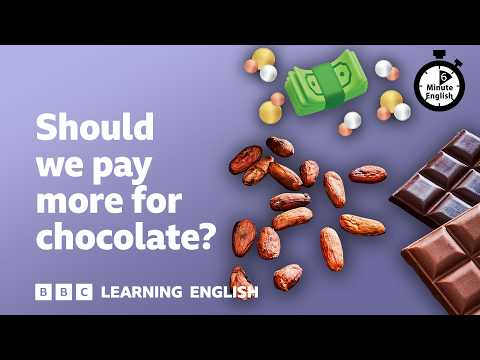
Should we pay more for chocolate? ⏲️ 6 Minute English
BBC Learning English
5m 50s946 words~5 min read
Auto-Generated
Watch on YouTube
Share
MORE TRANSCRIPTS