[0:00]This video is brought to you by Dashlane. Try Dashlane Premium for free on your first device. Just go to dashlane.com/geographics. Use the code Geographics to get 10% off. More on them in a bit.
[0:18]It's one of the world's most legendary routes in history. Stretching some 3,200 kilometers across the North American continent.
[0:26]The Oregon Trail was once the way to cross from coast to coast. First forged in the 1830s.
[0:32]It took travelers all the way from the agricultural lowlands of the Midwest to the fertile unsettled territory of Oregon, a place that then included both Washington State and British Columbia.
[0:43]Along the way, pioneers would cross the vast desert of the prairies, the wilderness of the Great Divide basin and the mist shrouded Blue Mountains.
[0:52]After six months battered by storms and ravaged by disease, the survivors would at last descend into a humid valley and claim their reward, a chance to start afresh in a land of their own.
[1:04]It was a powerful dream, one which drew an estimated 400,000 people into its embrace. In doing so, it utterly transformed the country, creating a USA that stretched from sea to shining sea.
[1:17]But what led to the construction of the Oregon Trail, and what was life like for those who braved it?
[1:23]Well, Geographics today, clambering into our covered wagon and setting out west to explore an American icon.
[1:38]In early 1837, the USA was walloped by one of the worst depressions in history.
[1:43]A crash in cotton and lands prices triggered bank runs that snowballed into an economic catastrophe.
[1:48]Across the lowlands of the Midwest, farms went bankrupt, people were thrown out of work, combined with recurring malaria epidemics, it created an atmosphere of permanent crisis.
[1:58]The panic of 1837 ultimately dragged on for seven years, seven years of misery, hardship, and unshakable pessimism.
[2:06]For those living through it, it must have seemed like a prison sentence, one they were desperate to escape.
[2:12]Luckily, in 1837, America, the escape hatch was just about to be opened. Its name was the Oregon Trail, and it would soon go down in history.
[2:22]Although it was the economic misery of 1837 that convinced many to head for Oregon, it wasn't the beginning of the trail story.
[2:30]For that, we need to go back in time, all the way back to the 19th century, to a time when the continent's interior wasn't seen as land to settle, but rather an inhospitable nightmare.
[2:41]As early as 1806, the magnificently named explorer Zebulon Montgomery Pike had declared the Great Plains a desert, and nobody was particularly inclined to disbelieve him.
[2:53]There were two groups of people loony enough or desperate enough to brave Zebulon's desert, trappers in need of animal fur to sell, and missionaries.
[3:03]Let's start off with the trappers. In 1824, Jedediah Smith and Thomas Fitzpatrick joined an expedition that saw them become the first Americans in history to enter California from the east.
[3:14]This was a big deal. At the time, going to California meant jumping on a boat and sailing 'round the Horn of South America, a journey as long as it was arduous.
[3:25]But a bigger deal was that to get to California, Smith and Fitzpatrick had to rediscover the South Pass. Situated in Wyoming, the South Pass was a 32-kilometer gap in the Rockies that doubled as the easiest way across the Continental Divide.
[3:40]Smith and Fitzpatrick weren't the first to discover it, but they were the first to tell people about it. It was their accounts that led to the continent's interior eventually being opened up.
[3:50]Over the next few years, a few hearty pioneers braved the new pass to forge a route west. Pioneers like Jason Lee and Nathaniel Wyeth, who basically laid the foundation for the Oregon Trail.
[4:03]But it wasn't until 1835 that the trail's big moment finally came. Then, missionary Marcus Whitman and his wife Narcissa teamed up with another missionary couple to head as far west as possible.
[4:15]As journeys go, this wasn't really quite up there with a first-class carriage on the Orient Express. It was grueling, difficult, and on several occasions, nearly fatal.
[4:25]But the group did it, at last reaching Fort Vancouver in Washington. From there, they sent word back east that the trail wasn't just for hearty woodsmen, but for regular God-fearing folk, too.
[4:37]That word arrived just as the panic of 1837 was starting to make people super susceptible to tales of faraway lands.
[4:45]Of course, this being olden times, things moved at a much slower pace. The first wagon train didn't depart on the Oregon Trail until 1841, and even then it only carried a few dozen pioneers.
[4:57]But by 1842, over 100 people were riding west. Marcus Whitman bumped into them on a mission back east and was astounded to see so many people following in his footsteps.
[5:07]But if Whitman thought 100 people was impressive, he'd seen nothing yet. The reports of the 1841 settlers were just starting to filter back, adding to the golden image of Oregon that was growing by the minute.
[5:20]Oregon Fever was now on its way, and when it hit, it would trigger the greatest migration the continent had ever seen.
[5:34]To us here and now, the explosion of Oregon Fever in the 1840s can seem kind of odd.
[5:41]Bad as the panic of 1837 was, it wasn't so bad that you can imagine it driving 400,000 people to undertake a little tested 3,200 km trail across the continent.
[5:52]And that's because it wasn't the panic alone that sparked Oregon Fever, it was the panic combined with an absolute tidal wave of propaganda.
[6:00]By 1842, the word flooding back from the west was that Oregon was an Eden-like paradise, too good to be true.
[6:07]It was said that Oregon soil could produce yields no farmer had ever dreamed of, that California down south was a land of endless sunshine.
[6:14]The federal government even got in on the act, offering people 2.5 square kilometers of land for free, just for heading to Oregon.
[6:21]And it's here that we get to the reason behind this propaganda drive. In 1842, the US government was absolutely desperate to get people settling in Oregon.
[6:30]So, here's something you might not know if you're not from America. At the time this video is set, Oregon isn't a state, but a hotly contested piece of real estate.
[6:42]Originally claimed by Spain, Russia, Great Britain, and the USA, Oregon had spent the 1800s through to the 1830s at the center of some very fancy diplomatic footwork.
[6:53]This was the era of American expansion, when taking over the Pacific Northwest and the Southwest was one of the defining political issues.
[7:00]That meant stuff like the Monroe Doctrine, warning the European powers that any attempts to establish new colonies would be treated as an act of war.
[7:08]It meant stuff like the treaties with Spain and Russia in 1819 and 1824, convincing them to surrender their claims on Oregon.
[7:16]But there was one country that, no matter what Washington tried, it just couldn't get to back off.
[7:23]In 1818, America and Britain had agreed to fix the US-Canadian border at the 49th parallel all the way to the Rocky Mountains.
[7:30]Over the years, the Americans tried to suggest expanding that border to the Pacific, but the British were always like, no.
[7:38]London felt the border should turn off the parallel and follow the course of the Columbia River, basically putting half of modern Washington state into Canada.
[7:47]Washington felt London could kiss its American ass. At first, the two countries were able to agree to disagree.
[7:54]In 1827, they signed a treaty opening Oregon up to joint occupation, but by the time the 1840s rolled into view, the tone had gotten much less agreeable.
[8:04]In Congress, the jingoistic faction was so fed up with Britain's Columbia River fixation that they demanded shifting the border way north, all the way up to the 54th parallel, effectively annexing British Columbia.
[8:16]But while the nationalists were itching for a fight, the governments of the day knew the war with the British would be miserable for everyone.
[8:22]People could still remember the War of 1812, from which neither side had gotten much of anything, except for mutual bad feelings.
[8:30]So, a different approach was needed, one that would reinforce America's claims to Oregon south of the 49th parallel, but without sparking a war.
[8:40]And what could stake Washington's claim better than hundreds of thousands of Americans settling that territory?
[8:52]By 1843, this perfect storm of economic misery and government propaganda had turned the Oregon Trail into something everyone wanted to travel.
[9:00]That April, the first pioneers began to assemble near Independence, Missouri for the summer crossing. By May 13th, nearly a thousand people were camped out on the prairie, ready to strike out west.
[9:12]It was the biggest migration the trail had yet seen, and it would soon change the fate of America.
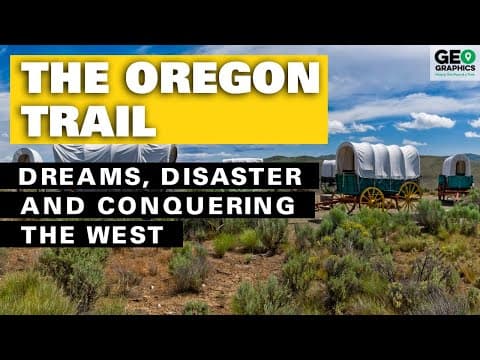
[9:17]The majority of those gathered were farming families. They didn't have much, but what they did have, they crammed into a single Murphy wagon, covered with canvas.
[9:27]Not that these were the wagons of the popular imagination. Those big family-sized wagons you picture riding the Oregon Trail, well, most immigrants couldn't afford them.
[9:36]Instead, they had narrow carts that bulged at the seams with the weight of their possessions. Known as "Prairie Schooners", they were so small that their owners walked alongside them, rather than riding in them.
[9:48]Their size also led to another issue, food supplies. As you'll recall from the tale of the Donner party, packing enough food for the four to six month journey was an impossible business.
[9:56]Not that most immigrants had to worry too much. After all, there were plenty of buffalo out there to provide a meal, should their supplies run out. I mean, it's not like you could hunt an entire species to near extinction, right?
[10:10]At last, on the 22nd of May, 1843, the vast group on the prairie decided it was time to leave. If they waited any longer, there was a chance they'd get trapped in the mountains by blizzards, and well, we all know how that can turn out.
[10:23]That same day, a thousand pioneers in well over 100 wagons drove out west, leaving Independence, Missouri behind for the great unknown.
[10:32]Accurate figures seem hard to come by, as we've read that they took with them anything from 700 oxen to over 5,000, but regardless of its true size, it was by far the biggest wagon train the Oregon Trail had ever seen.
[10:45]Unfortunately, this success led to some teething problems. The first day of travel was less a glorious departure, than it was a Three Stooges style farce.
[10:56]Barely had the train departed, than a bunch of oxen bolted, crashing through local lawns and trampling picket fences, while several mules not only refused to go forward, but started heading backwards towards Independence.
[11:08]On top of all that, a bunch of pioneers got into fist fights over stuff like their position in the train, which led to a minor brawl.
[11:15]But things eventually settled down, tempers subdued, mules were retrieved, and oxen were corralled back into line. Finally, the journey proper could begin.
[11:24]As the prairie schooners sailed out onto the Great Plains, the wagon train got its first taste of what was to come.
[11:31]Great storms whipped up, pinning the tiny helpless humans beneath a sky vaster and more violent than any of them had ever seen.
[11:38]Rain soaked through canvas coverings, gales bowled children over, and set the cattle stampeding. It was just the first of roughly a bazillion hardships all the pioneers on the Oregon Trail would encounter over the years.
[11:52]But they didn't turn back. This was it now, America's Manifest Destiny. These pioneers were going to make it to Oregon, even if it killed them.
[12:01]Now, you might not have to worry about making a dangerous trip across country, but you do have to worry about your online security, and that's where Dashlane comes in.
[12:08]Dashlane is a one-stop shop for all of your digital identity protection needs. If your passwords are all the same, bad idea by the way, you can use Dashlane's password manager to create and securely store complex and unique passwords, making it less likely that your accounts are going to get compromised.
[12:24]They also have a VPN as part of their service, meaning you can browse the internet securely and confidently, even on public Wi-Fi.
[12:31]But not just that, they also actively monitor the dark web to see if your information has been leaked somewhere, and that means that you can just go in and change your passwords before someone breaks into other accounts that share that same password.
[12:43]Plus, Dashlane does what it's always done. It stores your passwords, it keeps your personal data secure, it fills all of those annoying boxes for payment info or passwords for you.
[12:53]So, make your life easier, head to dashlane.com/geographics. Try Dashlane for free on your first device, and when you decide to upgrade, use my code Geographics, and you'll get premium for 10% off. How about that?
[13:08]And let's get back to the video.
[13:16]After the Great Migration of 1843, migrations each subsequent year kept getting even greater, until the trail was a cacophony of noise and life.
[13:26]In fact, it eventually got so crowded that the path was strewn with litter, ranging from the remnants of mules to piles of abandoned furniture.
[13:34]Yet, even as it got busier, reports of daily life on the trail remained remarkably consistent. Remarkable, especially because it doesn't sound all that bad.
[13:43]If you've played the classic educational game The Oregon Trail, your mental image of the trail might involve everyone dying in a whole bunch of horrible ways.
[13:53]But while 20,000 pioneers did die over the decades that the trail was in operation, they represented only about 5% of all of those people who traversed its length.
[14:02]No, the most common experience for pioneers heading west was simply a grand adventure. A day in a typical wagon train usually started early.
[14:10]Around 4:00 AM, rifles would be fired to wake everyone up, and then the long, arduous process of yoking the oxen would begin.
[14:17]While that was happening, others would be cooking breakfast over open fires, packing away their tents, or helping unhook the wagons from their protective circle.
[14:25]Finally, after two to three hours of chaos, someone would fire another rifle, and everyone would begin heading back across the plains.
[14:33]You can almost picture it. The sun breaking through the clouds, shining down on the pioneers, a few mere specs drifting across the endless landscape of the Great Plains.
[14:43]For most pioneers, these hours were equivalent to leisure time. While some men were needed to keep an eye on the livestock, the majority simply walked, exploring their new surroundings.
[14:52]When the weather was good, it must have been rather pleasant. Once the sun reached its noonday peak, the wagons would stop again, the oxen would be sent out to graze, while lunch was made, and people got a chance to sit and relax.
[15:05]Incidentally, it was usually during these lunchtime breaks that matters of criminal justice were taken care of. At this stage, the frontier was still lawless, is in literally lawless.
[15:15]There were no sheriffs, there was no legal code, but rather than descend into a free-for-all, the bigger wagon trains often wrote their own constitutions before setting out and elected elders to deal with misbehavior.
[15:28]This meant that when someone did go a little stir crazy on the trail, and say punch a neighbor, there was a basic justice system in place.
[15:36]Usually, it was lenient, coming down to little more than, okay, we've all agreed you were a bit of a dick. Apologize for being a dick, and we'll move on.
[15:46]Occasionally though, somebody might try to do something like steal a horse or assault a woman. When this happened, the judges would go all Old West on the guy responsible.
[15:56]The lunchtime break would end up with the prisoner being strung up from a tree. Generally though, there were no crimes to judge on any given day, and the lunch break concluded after an hour or so, with everyone returning to their wagons and heading on.
[16:08]Finally, after a full afternoon's travel, the train would come to a rest at a spot picked by the guide. There, supper would be made, games would be played, stories told, and plans laid for the life the pioneers were going to lead when they finally got to Oregon.
[16:23]The day might even end with singing around the campfire. Then, as the evening set in and the world turned dark, guard duty began, and everyone drifted off to sleep, intense or just under the stars.
[16:35]But while the Oregon Trail was a great adventure for many, it wasn't always campfires and sing-alongs. Bad stuff, although rare, really did happen, and some of it was downright terrifying.
[16:52]The trouble with being in the middle of nowhere is that when things go wrong, they can go really wrong. The pioneers who set out from Independence weren't idiots.
[17:02]They knew they were taking their lives in their hands on their 3,000-kilometer journey, but they were often naive about where the real danger lay.
[17:09]For example, Indian attacks were one of the settlers' greatest fears, but they were vanishingly rare. For the first decade of the trail's operation, Native Americans were more likely to guide the settlers than to attack them.
[17:21]Until 1849, only 34 whites and 25 Indians killed one another on the trail. Even when the Indian wars really got underway in the trail's later years, it was still estimated that fewer than 400 settlers were killed in Indian attacks, a mere 0.1% of all those who ventured west.
[17:38]No, the real danger wasn't the stuff of dime-store novels. It was the boring, everyday hazards. One of the grimmest was wagon accidents.
[17:46]With all those moving parts and crowds of people, it was inevitable that disaster would occur, and sadly, stories do exist of children falling under the wheels and being crushed to death.
[17:56]Adults too, suffered from the nature of their expedition. Dozens were killed simply tumbling from horses that tripped or reared at the wrong time.
[18:04]Then there was the problem that everyone was carrying guns, including people who were, let's just say, not exactly firearms experts.
[18:12]Accidental weapon discharges killed a surprising number of pioneers. By contrast, only 170 or so were actually murdered.
[18:20]So, lesson here, gun safety kids, take it seriously. But let's forget all the gunshots, all the wagon accidents, all the problems with animals.
[18:31]Because there was one killer on the Oregon Trail that ended far more lives than everything else put together. We're talking, of course, about disease.
[18:41]In the mid-19th century, sanitation was just a fancy pants word dreamed up by the French to make themselves seem clever.
[18:49]Cholera was therefore rampant, laying waste to pioneers by the thousands. It didn't help that medicine was still extremely primitive.
[18:55]Many responded to illness by simply giving themselves a gigantic dose of whatever was on hand. Since what was to hand was often laudanum, that gigantic dose not infrequently turned into a gigantic overdose.
[19:12]Lastly, there was the difficult terrain, especially at the trail's end. In the early days, many pioneers entering Oregon opted to tow their wagons, remove the wheels, and do the last 200 kilometers or so by river.
[19:24]The trouble was, most of them had never tried sailing before, and a river swollen by pre-winter rains was not the best place to learn on the job.
[19:31]Hundreds drowned in the years prior to 1860, their bodies often simply swept away. Those whose corpses were recovered were buried in just simple shallow graves.
[19:41]Yet, the vast majority of pioneers met none of these fates. On average, setting out on the Oregon Trail simply meant arriving several months later in either Oregon or California, tired and weather-beaten, but very much alive.
[19:54]And with the successful crossing behind you, that meant time to start a brand new life.
[20:06]Although the route west is known today as the Oregon Trail, the name was never really accurate.
[20:11]For one thing, there were so many shortcuts and alternative routes that it was really more a collection of trails moving through the same general area.
[20:19]For another, the vast majority who traveled the trails didn't actually end up in Oregon. Although it had been Oregon Fever that had kickstarted the Great Migration of 1843, before the decade was out, a whole other kind of fever had gripped the East, and that, of course, was gold fever.
[20:34]In 1848, gold was discovered in California, leading to the mother of all gold rushes. The following year, so many prospectors headed out west that they became known as the 49ers, hence the name of the football team.
[20:47]But since there was only one easy route across the Continental Divide, they wound up traveling the Oregon Trail most of the way before finally splitting off and heading for California.
[20:57]And just as an interesting aside, those California prospectors were basically the rednecks of the trail. They were the ones who dumped their junk alongside the road, tried to fight the natives, and basically made life miserable for everyone else.
[21:11]At one campsite in Wyoming, so many 49ers dumped their unwanted food haphazardly that it's been estimated nearly 10,000 kilos of bacon was just left to fester outside the walls.
[21:24]Another group who made use of the Oregon Trail were the Mormons. From 1846, several thousand Mormons followed the trail for most of the way before splitting off and heading for Salt Lake City in Utah.
[21:32]There, they founded a city, you've probably heard of, and it's still the Mormon center of the world. Overall, it's estimated only 80,000 of the 400,000 pioneers who used the Oregon Trail actually reached Oregon.
[21:45]So, really, we should probably call it the California Trail, or maybe the California, Utah, and occasionally Oregon Trail.
[21:52]Still, the trail had its desired effect. In 1846, still in the early days of the Great Migration, the Polk administration approached the British government, and essentially said, "Look guys, Oregon's basically American at this point.
[22:07]How about you just accept a border at the 49th parallel and we avoid another war, huh?" To sweeten the pot, Polk threw in Vancouver Island, and the British accepted.
[22:16]And that's why the US-Canada border today runs in a straight line west all the way from Southern Manitoba, before doing a bizarre little detour south when it reaches Vancouver.
[22:26]Yet, for all the Oregon Trail affected the way America developed, its heyday did not last all that long.
[22:32]In 1869, the first transcontinental railroad opened, creating a connection between East and West that took days to travel, rather than months.
[22:40]Although poorer families continued to use the Oregon Trail all the way up to the 1890s, its time was effectively over. Today, reminders of this pioneering trail still litter the Midwest.
[22:51]In certain places, the indentations made by thousands upon thousands of wagon wheels passing can still be seen. In others, graffiti scratched into the rocks by weary travelers remains visible.
[23:02]But the most visible reminder of the trail is America itself. Without the Oregon Trail, the Pacific Northwest, as we know it, wouldn't exist.
[23:10]Canada or even Russia could own that territory, while Utah's history would be completely different.
[23:18]The settlement of California too, may never have happened. Nor, on a darker note, the California Genocide, in which the original 49ers murdered up to 16,000 Native Americans.
[23:27]In the end, for better and for worse, the Oregon Trail created the modern US. Take away this one, 3,000 km track, and we'd all live in a very different world. The trail itself may be long gone, but its legacy is still very much alive.
[23:42]So I really hope you found that video interesting. If you did, please do hit that thumbs up button below. Do not forget to subscribe. We've got brand new videos just like this a couple of times a week. Also, support this show by supporting our fantastic sponsor Dashlane, who I'm linking to below, and thank you for watching.

![Thumbnail for 23- وظائف الجهاز العصبي المركزي [2] 1 || علوم بكالوريا 2025 by PIXEL EDUCATIONAL TEAM](/_next/image?url=https%3A%2F%2Fimg.youtube.com%2Fvi%2FNFXbYL91buY%2Fhqdefault.jpg&w=3840&q=75)