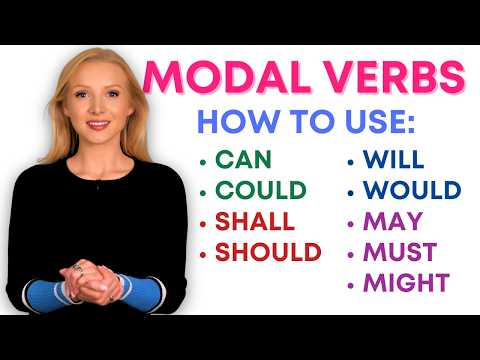
[0:00]There are nine words in the English language that cause my students so much grief, suffering, anxiety.
[0:13]They are modal verbs. They are can, could, may, might, must, shall, should, will, and would.
[0:24]The stress stops here. In this lesson, you are going to learn all about their different functions.
[0:31]You are going to see loads and loads of examples to help solidify your understanding. We are going to solve all the problems you have with these modal verbs once and for all. That's my promise to you.
[0:45]We're going to look at the theory, we're going to look at examples, and we're going to test your understanding with two quizzes that I've inserted into the video.
[0:54]And, if that wasn't enough, I've also created a PDF modal verbs study guide.
[1:02]You can download it for free. It contains all of the information we're going to cover together, plus lots of alternatives to these modal verbs like have to and be able to.
[1:16]But wait, there's more. This PDF study guide also contains a secret link to some interactive exercises for you to check your understanding.
[1:28]Yes, it's a lot. Yes, it's generous, and yes, you are very, very welcome.
[1:34]If you would like to download this PDF study guide, all you've got to do is click on the link in the description box, or scan that QR code there, enter your name, email address, and choose your English level, sign up to my mailing list, and then the PDF will arrive directly in your inbox.
[1:52]And then after that, you will have joined my PDF club. You'll automatically receive all of my free weekly PDFs, alongside all of my news, course updates and offers.
[2:05]It's a free service. You can unsubscribe at any time with just one click.
[2:10]Oh, I need to calm down, as you can tell, I am very excited about this topic.
[2:15]Let's get started by talking about form, and I have some really good news.
[2:22]The modals we're talking about in this video have one form. This is so rare in English.
[2:30]Just one form, nothing more. The base form that you see in the dictionary.
[2:35]We don't add -ing, so it's always could, never coulding. We don't add -ed, so it's always must, never musted. And we don't add -s in the third-person singular, so it is always should, never shoulds.
[2:54]These pure modals are followed by another verb, not a modal, in the base form. So they're not followed by a to-infinitive.
[3:04]For example, I might bake a cake later. Modals will sometimes appear alone when we don't want or need to repeat a previous verb.
[3:14]For example, I'm going to jump the queue. No, you can't jump the queue. Is there anything more British than that example? We love queues.
[3:25]We form questions by inverting the subject-modal verb word order. We don't use do or did.
[3:34]For example, can I help you? Or, should I dye my hair green?
[3:40]I bet you're thinking, no, you shouldn't, which brings me to negative forms.
[3:45]We form negatives by adding not. Could not, should not, et cetera.
[3:52]Cannot is different as it is one word in the negative. We often use contractions, can't, won't, but note that we don't usually contract may not. Mayn't, as great as it sounds, does exist, but it isn't common at all.
[4:11]Okay, are you ready to dive into our nine modal verbs? We're going to talk about the most typical and most useful ways we use these verbs. Let's start with can.
[4:22]We use can to talk about present ability. I can speak Spanish.
[4:29]Now, did you hear that I used the weak form, cən, with a schwa, not the strong form, can, with an a sound?
[4:38]We often use the weak form in statements and questions. I can speak Spanish.
[4:44]Here's an example using no ability. I can't speak Spanish.
[4:50]Notice the pronunciation difference between can, with a short a, which is the pronunciation we use in short answers, I can, and can't, with a long a sound. This is in my accent, modern RP.
[5:07]In other regional dialects or in North American English, it's different.
[5:12]Moving on, we use can to ask for and give permission. Can I have pizza for breakfast?
[5:20]And we use can't to refuse permission. No, you can't. We also use can to make requests. Can you make me a pizza?
[5:29]And we can use can to talk about general possibilities. For example, it can be cold and rainy in the UK in March.
[5:37]It's not always cold and rainy, but it is sometimes. We use can't to make deductions when we're sure something is not true or not happening.
[5:48]For example, Ellen can't be Tim's sister. He doesn't have a sister.
[5:53]Now, let's continue that thought with a different modal verb, could. Ellen could be Tim's cousin. He has about 10.
[6:01]Am I sure? No, but it's a decent guess based on some evidence I have. We use could to make deductions when we think something is possible, but we're not sure.
[6:13]How else do we use could? Well, it's pretty similar to can in many ways. You know that we use can to talk about present ability.
[6:23]We use could to express past ability. I could see perfectly when I was younger. Now, I'm as blind as a bat.
[6:31]That's a common simile, meaning you can't see very well. Could expresses general ability in the past.
[6:40]You can use was or were able to, or managed to, to talk about something that was possible on a specific occasion in the past. See the PDF for a couple more examples.
[6:53]We also use could to make requests. It's more formal and more polite than can. For example, excuse me, could you help me look for my glasses? I can't see a thing without them.
[7:06]And we use could to talk about things that are possible in the present or future. My glasses could be in my bag. It's like a black hole in there.
[7:16]Okay, another modal verb with similar functions, might. In formal language, we use might to make requests. Might I borrow your umbrella for a moment?
[7:29]Now, this isn't really common in everyday speech. Can or could are used much more often. We use might to make deductions when we're not sure.
[7:40]We can use all of our modals of deduction to talk about the past, as well as the present and future. The structure to talk about the past is modal + have + past participle.
[7:53]An example. Where's the fish we're having for dinner? Not sure, the cat might've eaten it.
[8:00]And we can use might + base verb to talk about things that are possible in the present or future. I might not go to Spain this summer, and I might head to Italy to practice my Italian instead. Okay, that sounds really nice.
[8:16]Brilliant. So, are there any other ways to talk about possibility? Yes.
[8:21]We may have to reschedule the meeting if the boss doesn't arrive soon.
[8:27]Now, do you think may is more or less formal than might or could? It is more formal.
[8:35]We also use may to ask for permission, and again, it's quite formal. An example, may I use the conference room to make a personal call?
[8:44]Even more formally, we use may to give and refuse permission. Yes, you may. No, you may not.
[8:53]And we use may to make deductions about things we think are probably true, but we're not sure.
[9:00]For example, oh dear, the boss looks annoyed. She may not be happy that we cancelled the meeting. Or she may just be annoyed that we ate all the doughnuts. Who knows?
[9:12]Note that we tend to use might more often in speech. Okay, that's clear, but what if we're sure something is true?
[9:20]We might say something like this, the boss must be annoyed that we cancelled the meeting because she came all the way from Berlin.
[9:29]We use must to make deductions when we are certain about something. And remember, when making deductions, the opposite of must is can't, not must not.
[9:42]When we're unsure, we use may, might and could. Now, are there any other ways we use must?
[9:47]Yes, we use must to talk about obligations, often things we think are important for us to do. And these are often called internal obligations because I think it's important to do it.
[10:02]I must call my dad later. It's his birthday. And we use must and mustn't.
[10:08]Notice the pronunciation there. I don't pronounce the first t. Mustn't to talk about rules and laws.
[10:19]Let's imagine we're going to the cinema. You must put your phone on silent mode while the film is playing. Or you mustn't talk loudly during the film.
[10:30]We can also use must to make strong suggestions. You must try the cheddar jalapeno popcorn. It's delicious.
[10:37]We stress the modal verb with this meaning. You must try it. The flappy hand is optional, but I like it for emphasis. You must try it.
[10:48]Note that we don't usually stress modals in the present. You must try it, is an exception. Okay, let's pause here for a moment and check what you've learnt so far with a little quiz.
[11:00]Complete the sentences with the modal verb that best fits the gap, and don't forget to conjugate it. Ah, that was a trick. We're not changing the modal verbs here. We use their base form.
[11:14]To make things even trickier, sometimes more than one verb is possible. Ready? One.
[11:19]When I was at school, I speak French fairly well. Have a little think.
[11:27]This is a past ability, so the answer is could. Number two, I'm sure it be difficult for English speakers to learn Mandarin. This is a deduction, and I'm sure it is true, so the answer is must.
[11:48]Number three, try watching your favorite K-dramas in Korean. You learn a bit of the language. Number three expresses a possibility, and three options could fit the gap. You could say might.
[12:08]You could also say may. And you could also say could. Number four, you teach me a few phrases in Arabic. This is a request, and there are two possibilities. You could say can, or could. Now, do you remember which one is more formal?
[12:33]It's could. Okay, last question now, and then we'll move on to the next part of the lesson. Number five, I really tidy the kitchen this afternoon. It's such a mess.
[12:48]This is something I think I really need to do, so it is an internal obligation. Must best completes the gap. How did you do?
[12:59]Keep a note of your score, as we're going to do another little quiz later, and then you can share it in the comment section. But for now, we have four more modal verbs to go. We're over halfway there.
[13:12]Before the quiz, we were talking about how to use must. Now we're looking at should, and it's used similarly to must in some ways, though it's less strong.
[13:24]We use should to talk about obligations and the right or wrong thing to do. For example, you should always wear your seatbelt on the plane. Or, we shouldn't call Sarah now. It's after midnight.
[13:39]We also use should to make suggestions and give and ask for advice. For example, you look exhausted. You should take a nap. Or, should we get a taxi to the airport?
[13:52]Another way we use should is to express expectations. For example, the flight should be on time. Or, shouldn't Alice be here by now? She said she'd be arriving an hour ago.
[14:04]We can also make suggestions using shall, and this modal verb is one that really tends to confuse my students.
[14:12]Don't worry, I'll sort it out for you. We usually use shall with I and we. For example, shall we go to the beach today? We can also ask for advice. What shall we do with all the sandwiches we didn't eat?
[14:28]And we use shall to make offers. Shall I help you with them? Now, here's an important note.
[14:36]Used like this, shall is fairly common in British English, but it's not that common in North American English. Speakers of that variety often use should or another verb instead.
[14:49]Let's stick with offers now, and look at our next verb, and also the name of my husband, will. An example, I'll drive tomorrow so you can enjoy the views. That is something Will would say, I hate driving.
[15:04]In spoken sentences, we almost always contract will to 'll, and will not to won't in spoken statements.
[15:13]We also use will or won't to make promises. I won't be late to pick you up, I promise. We use it to make statements and predictions about the future.
[15:24]The hike'll be stunning in this gorgeous sunshine. And what about this sentence here? What's the function? Will you pack us some snacks, please?
[15:35]Yep, this is a request. We use will to make requests. Okay, are you still with me? Can we talk about our final modal verb, would?
[15:47]Note the pronunciation there. I don't pronounce the l. Wud, would. Now, like will, we use would to make requests, but which one is more polite and less direct?
[16:03]Listen to these two examples. Will you pass me the map? Would you pass me the map? I might have given you a clue with my body language, would is more polite. We can also use would to give advice.
[16:15]For example, if I were you, I'd turn the map around. You've got it the wrong way up. Now, this sentence also demonstrates another use of would, expressing a hypothetical situation.
[16:28]We can use would to talk about hypothetical situations in the present, past, or future. An example, so what would you do if I said we were lost?
[16:40]And finally, would is used as the past form of will in indirect speech. For example, direct speech, we'll find the path again. I promise.
[16:51]In indirect speech, he promised that we would find the path again. Okay, shall we do one more short quiz? Just three questions this time, and then you can share your score in the comment section. You ready?
[17:05]What is the function of the modal verb in these sentences? One, are you coming for dinner tomorrow? I'll make sure there's a vegetarian option. Is it a request or a promise?
[17:21]It's a promise. Number two, I'd make a dessert if I had more time. What is the function of would here? To express a hypothetical situation or to make a request?
[17:36]Yes, it is a hypothetical situation. And finally, you should ask Pete to make his famous trifle. Is this advice or an expectation?
[17:50]It is advice. Trifle is always a classic. So, how did you do? Add your score from before and let me know in the comments.
[18:00]I really hope you feel more confident about using modals now, and remember, I have created your free PDF modals study guide. Just click on the link in the description box, or scan the QR code here if you'd like to download that. Remember, you get a link to a secret interactive exercise pack, too, so you can really practice what you've learned.
[18:24]Thank you so much for being my student today. It was a pleasure to teach you, and I'll see you in the next lesson. Mwah.


