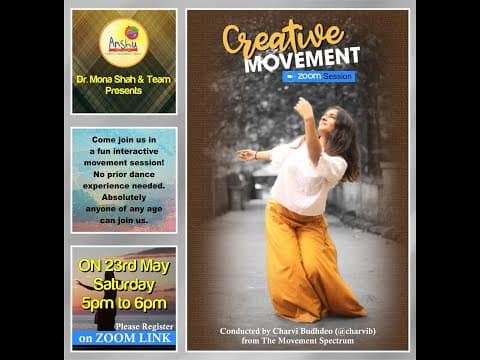
[0:00]thank you so much for accepting our invitation and joining us in our dance moment workshop. on behalf of Anchu, I am Manisha Mathew, a clinical psychologist, would like to welcome you all. And I'm sure you're going to have great. As we live in unprecedented times, team Anshu has come up with digital programs for you. Now we are reaching you at the convenience of your home. Anchu has also started taking digital sessions and online sessions for children. Let me tell you a little bit about Anchu. Anchu is an adult and child development center and urban extension of Kusapa health medical research center Wardha. Anchu is located at Vileparle West Mumbai. We provide early interventions to children and neuro which have who have neurodevelopmental delays, sensory processing disorder, learning disability, autism and children with various other emotional support. We cater to all age groups from infants to geriatric population. Team Anju comprises of professionals who are qualified as occupational therapists, physiotherapists, medical doctors, speech and language therapists, clinical psychologist, nutritionist, etc. Here at Anju we provide various services like adult and pediatric physiotherapy, occupational therapy, speech therapy, feeding therapy, counseling and mental health care behavior therapy and special education services and more. Anju strongly believe in building a strong community where people are healthy and happy. Our vision has always been to excel in service and to expand in love and advance in our knowledge. Retracting on the concept of fun with learning we have in our minds a very very special guest. Any guest who? Let's all give her a loud applause. That's our very young beautiful vibrant facilitator for this evening that is Miss Charo. She is a great dancer, a qualified DMPT professional who has converted her passion into a noble cause for serving the society. She works with children and adults from various walks of life and is and urgent believer that movement is so innate in all of us humans. Let's welcome her with a warm welcome. Hanging it over to Chavi. Chavi, just a minute, give it to me. Before we start with Chavi, I want to thank Manisha for that wonderful start. May request everyone to switch on their video so we can see you and the visual connection is very important. All of you will be muted from the host, but if anybody wants to have any question, they can just lift your thumb or write on the chat box. So I request once again, everyone to keep their video on and over to Chavi.
[3:22]Okay. Hi, hi guys. Can we all just wave at each other before we begin? Okay, great. Um, so today we're going to do a very fresh approach to movement. Uh, it's not a dance class. So it's not where I tell you right hand up and we'll play some Bollywood song. It's not that approach to movement. So I will be giving you some sets of instructions and you will interpret those instructions as per your will. Okay, so what I may do may be different from what Munati may do or what somebody else may choose to do. And what is brilliant about this space is that there is no right and wrong. So we don't have to worry about am I doing it correctly?Yeah, so we don't have to worry about am I doing it correctly?Yeah, so we don't have to worry about am I doing it correctly?Yeah, so we don't want to see that and if you feel like that's going to make you conscious then that's also okay, it's completely up to you. Just that, uh, I hope that you can guys can hear me. So just keep your speakers loud enough so that you can hear my instructions when we start moving, okay?
[4:47]Um, and second of all, if there are children with you, if you are with children, uh, you have two options. You can do it with your child. So you can make them move with you or you can mirror them. So mirroring them is just and them and to copy them or for them to copy you. There are two options. Okay? Everybody here? Everybody on the same page. Okay, great. Cool. Can we just begin get up first of all?
[5:18]Can you all see me? Even if I'm far?
[5:24]Okay, great. We're just going to start by walking around in the room. Can we just start walking wherever how much whatever space we have just walk in that room.
[5:39]And now just bring a big stretch to your body, wake up your body, give a big stretch like you're just getting out of bed and like you can make a sound also. And really stretch yourself like you've just woke up your if you have to wake your body up. Great. And now we're just going to shake our hands. Both our hands and shake them. We can see.
[6:08]Do you feel absolutely like jelly your hands should be like jelly there should be no bones so really shake your hands. Nice. Great. The same thing with your legs right leg one leg at a time. Right leg and really shake your leg. And then we have the leg. And in the full body and make a self-up and shake. Okay, great. Feeling active everybody, everybody's awake. Okay, cool. We're going to start with our activities then. All we have to do is we have to create shapes with our body, okay? So if I say that create a circle with your shoulder. So for example, if we are creating circles with our shoulder, it will look like this. Okay? And we have to keep creating circles till I tell you to move on. So think about creating a really small circle, think about creating a really big circle. Can we do that with our right shoulder?Can we create a circle? The air around you is a canvas, your shoulder is a pencil and you're creating circle. On the ceiling, on the floor. Really small one and really big one. And really try and concentrate on your shoulder, right shoulder. I'm just going to turn on some music for us. Continue doing it. Can we move on to our left shoulder and we're going to make a square now square. Great. Can we go to our feet? We're going to do it with our right feet, right foot, sorry, and we're going to make a triangle. So some of us who want to challenge ourselves, see what does it look like if we lift our feet up and do it. And if you have a bed or a surface maybe try and do it on a bed or a surface and see what that looks like. You can choose to do however you wish to do it. And really imagine that you're drawing a triangle with your feet and this color coming out. Can we move on to our left foot? Same thing, triangles. Left foot. And see how can you innovate? How can you bring variety? Great. Let's move on to our nose. We're going to make we're going to make a diamond with our nose. Yeah, so you can sit down and you can do it. You can get up and you can do it. What will I diamond look like?
[10:43]And another one. Maybe we can come a little closer to the screen and do it for all of us. What would a diamond look like? Great. And now we go back into the space and explore. See on the ceiling if you want to tilt your head and do it on the ceiling. All right, tilt your head and do it on the floor completely. Nice. Can we show our right finger index finger? With our right index finger we are now going to start writing our name. Okay, so we can choose English, Hindi, Gujarati, Marathi, Arabic, anything. And we have to start writing our name. Can we just show it here on the screen? Great. Now we're going to do this for about a minute or so and we're going to bring about as many variations as we can. Maybe really small handwriting, block letters. How would it look what would my name look like if it was block letters? So we're going to try and vary it with our finger and write our name. So we can now go and explore in the space. And let your body respond to that. Let your body respond to your finger. Right it's really big. Right it on the ceiling and imagine that you are actually writing it. There is ink coming out. And leave your mark everywhere on the room. What does it look like? What all have you made? How is it looking? Very relax. Very relax. Okay, great. I think I'm going to send it over to Moona now. Thank you so much. Thank you so much Manisha for that wonderful intro. Let me know what I have to do now.
[12:59]So Dr. Moona, many of our parents generally are you know in general ask us a lot of questions and today we will be looking at one segment that is sensory integration. So if any of you present here have any questions any parents have any questions regarding sensory integration there's a chat box down. Please mention your comments there and we will for you or for Dr. Mona we will make sure that we answer them. So Dr. Mona, many of the parents asked what is the sensory integration and they also wonder whether my child has sensory integration. So what does this all about? Can you just explain? So I think Manisha, that's the perfect question to answer about the special need of a child. As you mentioned about sensory processing disorder, earlier it has been said as a sensory integration disorder. We are thankful to Dr. Jin Aier, American Occupational therapist for giving us theory of sensory integration. Sensory integration, for us it happens automatically in you, me and most of us. We generally don't realize how we don't realize our heart beats or our food digestion. We don't even think how it happens. Normal sensory integration with everybody happens like this. Let me give you an example of peeling of banana. When you fill a banana or you fill and eat and orange. There are senses with which you work with. You look at with your eyes your eyes should like the color of banana or orange or a mango.
[15:10]Your hands, muscles, small muscles of the hand, fingers and the touch of the skin. This is very important for anything you touch any object you touch or for your well being. All these senses when work in coordination the is called sensory integration. When it comes to food just think of catching or throwing a ball and catching it. How many sequences of actions is required when you catch. So brain must organize all these sensations in a person if anybody has to work normally. Any act to learn to study in the school to be comfortable in the environment your all senses has to work normally with a network. When it comes to sensory integration disorder or a sensory processing disorder one thing I want all the parents to understand it is not some viral infection like covid. It is not a chemical imbalance or it's not any disease so which comes and it goes away with process. What is sensory integration is the integration or the organization of all these senses in your brain and it's the neurological condition where this organization has to be in channel with all your nervous system. Now coming back to your question of sensitive processing disorder or how I would come to know whether my child has any kind of sensitive processing issue. May request parent if you observe any particular unusual behavior or the behavior which is not that common with the same age group. unnatural anxiety you take your child to a party they are not ready. certain kind of clothes they are uncomfortable with. Hair cutting or nail cutting is an issue with your child. Any of such problem or a multiple problem. Sometimes some kids are over obsessed about cleanliness. The same time someone child is very messy. If you think any symptom which makes them uncomfortable which either makes them very calm they become dull in common language or either they become very hyper. There is no reason parents has to observe any of such behavior makes child uncomfortable. I repeat you need to understand why your child is uncomfortable or why is he not happy. What makes them unhappy just find out be observant to any of the behavior or what makes them unhappy there could be a sensory processing disorder. For parents sake we are going to keep sensory processing disorder checklist on our website only for parents. Parents can visit our website they can check whether any of such symptoms occur with their children and they can take expert opinion further on that. I think that makes I tried to simplify it to make everyone understand what is sensory processing disorder.
[19:15]I think that Dr. Mona, I think that was really really informative and helpful. Because I've come across if I famously remember, I think it was a three year old. She was very good with studies, she could recognize shapes, she could recognize colors. Very very intelligent but she was not able to wear different texture clothes also when there was loud noise she would just cover her ears. So I think now what you may you what you just said makes sense to me even more. You know how can we include a dance moment in our everyday everyday life and how can you give us a little bit more understanding about this. What is the movement? Sure. So dance movement therapy like I said is very innately present in us. Like all that we did right now we've we have it within us. It's not like we have to learn a concept or we have to learn a skill set to be able to do this. Like Eve that when we were born, almost our first language with our mother was movement and babbling. Words and everything else and walking came much later. So the normal the normal flailing of the hands, the moving of the head. The normal, the very basic movement of a child is innately present in all of us. So honestly, the dance and that movement in that way is so accessible to all of us. For the correct tools and for the correct practice, I would I would strongly suggest for all of us to take regular sessions with there are actually a lot of dance movement therapy practitioners now in our city. Also in all over India, if you're not in in Bombay, and we've become a very close with society of practitioners. And other than that, I feel like just integrating this normal movement. When you're walking like what we did with the walking observation of just just bringing our mindfulness to the fact that which part of the foot is touching the floor first. And just that brings us back into our body so immediately the thought we all know it's a heal. But if the observation of that that brings us back into our body so the more we start observing our body the more we're we're integrating movement therapy tools in our life. For example, if you are feeling really heavy and if you're not feeling okay in that day and sometimes words are not enough to put that in like you don't know how to express it. Like your family will ask you why are you looking so moodless and why are you looking so tired? You don't necessarily have the words for it but your body is already giving you a signal your body is telling you your back is hurting your eyes are droopy so the minute we start listening to our body the more mindfulness we start creating like that so it's dance movement therapy just works basically on this principle of connecting with the body. And I am also taking online classes and I think with Anchu center also we would love we are going to explore what that looks like bringing an online intervention. So whoever wishes to reach out can always reach out to Munanda or Monisha yourself.
[23:14]Thank you so much Dr. Monica, that was really helpful isn't it? May really think and really understand, I'm sure parents also loved it. Charvi, I have a question for you. So Charvi, I'm sure everybody over here is thinking of the same thing. Kaash aisa roz roz hota. So you know how can we include a dance moment in our everyday everyday life and how can you give us a little bit more understanding about this? What is the dance movement? Sure. So dance movement therapy like I said is very innately present in us. Like all that we did right now we've we have it within us. It's not like we have to learn a concept or we have to learn a skill set to be able to do this. Like Eve that when we were born, almost our first language with our mother was movement and babbling. Words and everything else and walking came much later. So the normal the normal flailing of the hands, the moving of the head. The normal, the very basic movement of a child is innately present in all of us. So honestly, the dance and that movement in that way is so accessible to all of us. For the correct tools and for the correct practice, I would I would strongly suggest for all of us to take regular sessions with there are actually a lot of dance movement therapy practitioners now in our city. Also in all over India, if you're not in in Mumbai, and we've become a very close with society of practitioners. And other than that, I feel like just integrating this normal movement. When you're walking like what we did with the walking observation of just just bringing our mindfulness to the fact that which part of the foot is touching the floor first. And just that brings us back into our body so immediately the thought we all know it's a heal. But if the observation of that that brings us back into our body so the more we start observing our body the more we're we're integrating movement therapy tools in our life. For example, if you are feeling really heavy and if you're not feeling okay in that day and sometimes words are not enough to put that in like you don't know how to express it. Like your family will ask you why are you looking so moodless and why are you looking so tired? You don't necessarily have the words for it but your body is already giving you a signal your body is telling you your back is hurting your eyes are droopy so the minute we start listening to our body the more mindfulness we start creating like that so it's dance movement therapy just works basically on this principle of connecting with the body. And I am also taking online classes and I think with Anchu center also we would love we are going to explore what that looks like bringing an online intervention. So whoever wishes to reach out can always reach out to Munanda or Monisha yourself.
[26:55]Thank you so much Dr. Monica, that was really helpful isn't it? May really think and really understand, I'm sure parents also loved it. Charvi, I have a question for you. So Charvi, I'm sure everybody over here is thinking of the same thing. Kaash aisa roz roz hota. So you know how can we include a dance moment in our everyday everyday life and how can you give us a little bit more understanding about this? What is the dance movement? Sure. So dance movement therapy like I said is very innately present in us. Like all that we did right now we've we have it within us. It's not like we have to learn a concept or we have to learn a skill set to be able to do this. Like Eve that when we were born, almost our first language with our mother was movement and babbling. Words and everything else and walking came much later. So the normal the normal flailing of the hands, the moving of the head. The normal, the very basic movement of a child is innately present in all of us. So honestly, the dance and that movement in that way is so accessible to all of us. For the correct tools and for the correct practice, I would I would strongly suggest for all of us to take regular sessions with there are actually a lot of dance movement therapy practitioners now in our city. Also in all over India, if you're not in in Mumbai, and we've become a very close with society of practitioners. And other than that, I feel like just integrating this normal movement. When you're walking like what we did with the walking observation of just just bringing our mindfulness to the fact that which part of the foot is touching the floor first. And just that brings us back into our body so immediately the thought we all know it's a heal. But if the observation of that that brings us back into our body so the more we start observing our body the more we're we're integrating movement therapy tools in our life. For example, if you are feeling really heavy and if you're not feeling okay in that day and sometimes words are not enough to put that in like you don't know how to express it. Like your family will ask you why are you looking so moodless and why are you looking so tired? You don't necessarily have the words for it but your body is already giving you a signal your body is telling you your back is hurting your eyes are droopy so the minute we start listening to our body the more mindfulness we start creating like that so it's dance movement therapy just works basically on this principle of connecting with the body. And I am also taking online classes and I think with Anchu center also we would love we are going to explore what that looks like bringing an online intervention. So whoever wishes to reach out can always reach out to Munanda or Monisha yourself.
[30:37]Thank you so much Dr. Monica, that was really helpful isn't it? May really think and really understand, I'm sure parents also loved it. Charvi, I have a question for you. So Charvi, I'm sure everybody over here is thinking of the same thing. Kaash aisa roz roz hota. So you know how can we include a dance moment in our everyday everyday life and how can you give us a little bit more understanding about this? What is the dance movement? Sure. So dance movement therapy like I said is very innately present in us. Like all that we did right now we've we have it within us. It's not like we have to learn a concept or we have to learn a skill set to be able to do this. Like Eve that when we were born, almost our first language with our mother was movement and babbling. Words and everything else and walking came much later. So the normal the normal flailing of the hands, the moving of the head. The normal, the very basic movement of a child is innately present in all of us. So honestly, the dance and that movement in that way is so accessible to all of us. For the correct tools and for the correct practice, I would I would strongly suggest for all of us to take regular sessions with there are actually a lot of dance movement therapy practitioners now in our city. Also in all over India, if you're not in in Mumbai, and we've become a very close with society of practitioners. And other than that, I feel like just integrating this normal movement. When you're walking like what we did with the walking observation of just just bringing our mindfulness to the fact that which part of the foot is touching the floor first. And just that brings us back into our body so immediately the thought we all know it's a heal. But if the observation of that that brings us back into our body so the more we start observing our body the more we're we're integrating movement therapy tools in our life. For example, if you are feeling really heavy and if you're not feeling okay in that day and sometimes words are not enough to put that in like you don't know how to express it. Like your family will ask you why are you looking so moodless and why are you looking so tired? You don't necessarily have the words for it but your body is already giving you a signal your body is telling you your back is hurting your eyes are droopy so the minute we start listening to our body the more mindfulness we start creating like that so it's dance movement therapy just works basically on this principle of connecting with the body. And I am also taking online classes and I think with Anchu center also we would love we are going to explore what that looks like bringing an online intervention. So whoever wishes to reach out can always reach out to Munanda or Monisha yourself.
[34:20]Thank you so much Dr. Monica, that was really helpful isn't it? May really think and really understand, I'm sure parents also loved it. Charvi, I have a question for you. So Charvi, I'm sure everybody over here is thinking of the same thing. Kaash aisa roz roz hota. So you know how can we include a dance moment in our everyday everyday life and how can you give us a little bit more understanding about this? What is the dance movement? Sure. So dance movement therapy like I said is very innately present in us. Like all that we did right now we've we have it within us. It's not like we have to learn a concept or we have to learn a skill set to be able to do this. Like Eve that when we were born, almost our first language with our mother was movement and babbling. Words and everything else and walking came much later. So the normal the normal flailing of the hands, the moving of the head. The normal, the very basic movement of a child is innately present in all of us. So honestly, the dance and that movement in that way is so accessible to all of us. For the correct tools and for the correct practice, I would I would strongly suggest for all of us to take regular sessions with there are actually a lot of dance movement therapy practitioners now in our city. Also in all over India, if you're not in in Mumbai, and we've become a very close with society of practitioners. And other than that, I feel like just integrating this normal movement. When you're walking like what we did with the walking observation of just just bringing our mindfulness to the fact that which part of the foot is touching the floor first. And just that brings us back into our body so immediately the thought we all know it's a heal. But if the observation of that that brings us back into our body so the more we start observing our body the more we're we're integrating movement therapy tools in our life. For example, if you are feeling really heavy and if you're not feeling okay in that day and sometimes words are not enough to put that in like you don't know how to express it. Like your family will ask you why are you looking so moodless and why are you looking so tired? You don't necessarily have the words for it but your body is already giving you a signal your body is telling you your back is hurting your eyes are droopy so the minute we start listening to our body the more mindfulness we start creating like that so it's dance movement therapy just works basically on this principle of connecting with the body. And I am also taking online classes and I think with Anchu center also we would love we are going to explore what that looks like bringing an online intervention. So whoever wishes to reach out can always reach out to Munanda or Monisha yourself.
[38:03]Thank you so much Dr. Monica, that was really helpful isn't it? May really think and really understand, I'm sure parents also loved it. Charvi, I have a question for you. So Charvi, I'm sure everybody over here is thinking of the same thing. Kaash aisa roz roz hota. So you know how can we include a dance moment in our everyday everyday life and how can you give us a little bit more understanding about this? What is the dance movement? Sure. So dance movement therapy like I said is very innately present in us. Like all that we did right now we've we have it within us. It's not like we have to learn a concept or we have to learn a skill set to be able to do this. Like Eve that when we were born, almost our first language with our mother was movement and babbling. Words and everything else and walking came much later. So the normal the normal flailing of the hands, the moving of the head. The normal, the very basic movement of a child is innately present in all of us. So honestly, the dance and that movement in that way is so accessible to all of us. For the correct tools and for the correct practice, I would I would strongly suggest for all of us to take regular sessions with there are actually a lot of dance movement therapy practitioners now in our city. Also in all over India, if you're not in in Mumbai, and we've become a very close with society of practitioners. And other than that, I feel like just integrating this normal movement. When you're walking like what we did with the walking observation of just just bringing our mindfulness to the fact that which part of the foot is touching the floor first. And just that brings us back into our body so immediately the thought we all know it's a heal. But if the observation of that that brings us back into our body so the more we start observing our body the more we're we're integrating movement therapy tools in our life. For example, if you are feeling really heavy and if you're not feeling okay in that day and sometimes words are not enough to put that in like you don't know how to express it. Like your family will ask you why are you looking so moodless and why are you looking so tired? You don't necessarily have the words for it but your body is already giving you a signal your body is telling you your back is hurting your eyes are droopy so the minute we start listening to our body the more mindfulness we start creating like that so it's dance movement therapy just works basically on this principle of connecting with the body. And I am also taking online classes and I think with Anchu center also we would love we are going to explore what that looks like bringing an online intervention. So whoever wishes to reach out can always reach out to Munanda or Monisha yourself.
[41:46]Thank you so much Dr. Monica, that was really helpful isn't it? May really think and really understand, I'm sure parents also loved it. Charvi, I have a question for you. So Charvi, I'm sure everybody over here is thinking of the same thing. Kaash aisa roz roz hota. So you know how can we include a dance moment in our everyday everyday life and how can you give us a little bit more understanding about this? What is the dance moment? Sure. So dance movement therapy like I said is very innately present in us. Like all that we did right now we've we have it within us. It's not like we have to learn a concept or we have to learn a skill set to be able to do this. Like Eve that when we were born, almost our first language with our mother was movement and babbling. Words and everything else and walking came much later. So the normal the normal flailing of the hands, the moving of the head. The normal, the very basic movement of a child is innately present in all of us. So honestly, the dance and that movement in that way is so accessible to all of us. For the correct tools and for the correct practice, I would I would strongly suggest for all of us to take regular sessions with there are actually a lot of dance movement therapy practitioners now in our city. Also in all over India, if you're not in in Mumbai, and we've become a very close with society of practitioners. And other than that, I feel like just integrating this normal movement. When you're walking like what we did with the walking observation of just just bringing our mindfulness to the fact that which part of the foot is touching the floor first. And just that brings us back into our body so immediately the thought we all know it's a heal. But if the observation of that that brings us back into our body so the more we start observing our body the more we're we're integrating movement therapy tools in our life. For example, if you are feeling really heavy and if you're not feeling okay in that day and sometimes words are not enough to put that in like you don't know how to express it. Like your family will ask you why are you looking so moodless and why are you looking so tired? You don't necessarily have the words for it but your body is already giving you a signal your body is telling you your back is hurting your eyes are droopy so the minute we start listening to our body the more mindfulness we start creating like that so it's dance movement therapy just works basically on this principle of connecting with the body. And I am also taking online classes and I think with Anchu center also we would love we are going to explore what that looks like bringing an online intervention. So whoever wishes to reach out can always reach out to Munanda or Monisha yourself.
[45:29]Thank you so much Dr. Monica, that was really helpful isn't it? May really think and really understand, I'm sure parents also loved it. Charvi, I have a question for you. So Charvi, I'm sure everybody over here is thinking of the same thing. Kaash aisa roz roz hota. So you know how can we include a dance moment in our everyday everyday life and how can you give us a little bit more understanding about this? What is the dance movement? Sure. So dance movement therapy like I said is very innately present in us. Like all that we did right now we've we have it within us. It's not like we have to learn a concept or we have to learn a skill set to be able to do this. Like Eve that when we were born, almost our first language with our mother was movement and babbling. Words and everything else and walking came much later. So the normal the normal flailing of the hands, the moving of the head. The normal, the very basic movement of a child is innately present in all of us. So honestly, the dance and that movement in that way is so accessible to all of us. For the correct tools and for the correct practice, I would I would strongly suggest for all of us to take regular sessions with there are actually a lot of dance movement therapy practitioners now in our city. Also in all over India, if you're not in in Mumbai, and we've become a very close with society of practitioners. And other than that, I feel like just integrating this normal movement. When you're walking like what we did with the walking observation of just just bringing our mindfulness to the fact that which part of the foot is touching the floor first. And just that brings us back into our body so immediately the thought we all know it's a heal. But if the observation of that that brings us back into our body so the more we start observing our body the more we're we're integrating movement therapy tools in our life. For example, if you are feeling really heavy and if you're not feeling okay in that day and sometimes words are not enough to put that in like you don't know how to express it. Like your family will ask you why are you looking so moodless and why are you looking so tired? You don't necessarily have the words for it but your body is already giving you a signal your body is telling you your back is hurting your eyes are droopy so the minute we start listening to our body the more mindfulness we start creating like that so it's dance movement therapy just works basically on this principle of connecting with the body. And I am also taking online classes and I think with Anchu center also we would love we are going to explore what that looks like bringing an online intervention. So whoever wishes to reach out can always reach out to Munanda or Monisha yourself.
[49:12]Thank you so much Dr. Monica, that was really helpful isn't it? May really think and really understand, I'm sure parents also loved it. Charvi, I have a question for you. So Charvi, I'm sure everybody over here is thinking of the same thing. Kaash aisa roz roz hota. So you know how can we include a dance moment in our everyday everyday life and how can you give us a little bit more understanding about this? What is the dance movement? Sure. So dance movement therapy like I said is very innately present in us. Like all that we did right now we've we have it within us. It's not like we have to learn a concept or we have to learn a skill set to be able to do this. Like Eve that when we were born, almost our first language with our mother was movement and babbling. Words and everything else and walking came much later. So the normal the normal flailing of the hands, the moving of the head. The normal, the very basic movement of a child is innately present in all of us. So honestly, the dance and that movement in that way is so accessible to all of us. For the correct tools and for the correct practice, I would I would strongly suggest for all of us to take regular sessions with there are actually a lot of dance movement therapy practitioners now in our city. Also in all over India, if you're not in in Mumbai, and we've become a very close with society of practitioners. And other than that, I feel like just integrating this normal movement. When you're walking like what we did with the walking observation of just just bringing our mindfulness to the fact that which part of the foot is touching the floor first. And just that brings us back into our body so immediately the thought we all know it's a heal. But if the observation of that that brings us back into our body so the more we start observing our body the more we're we're integrating movement therapy tools in our life. For example, if you are feeling really heavy and if you're not feeling okay in that day and sometimes words are not enough to put that in like you don't know how to express it. Like your family will ask you why are you looking so moodless and why are you looking so tired? You don't necessarily have the words for it but your body is already giving you a signal your body is telling you your back is hurting your eyes are droopy so the minute we start listening to our body the more mindfulness we start creating like that so it's dance movement therapy just works basically on this principle of connecting with the body. And I am also taking online classes and I think with Anchu center also we would love we are going to explore what that looks like bringing an online intervention. So whoever wishes to reach out can always reach out to Munanda or Monisha yourself.
[52:55]Thank you so much Dr. Monica, that was really helpful isn't it? May really think and really understand, I'm sure parents also loved it. Charvi, I have a question for you. So Charvi, I'm sure everybody over here is thinking of the same thing. Kaash aisa roz roz hota. So you know how can we include a dance moment in our everyday everyday life and how can you give us a little bit more understanding about this? What is the dance movement? Sure. So dance movement therapy like I said is very innately present in us. Like all that we did right now we've we have it within us. It's not like we have to learn a concept or we have to learn a skill set to be able to do this. Like Eve that when we were born, almost our first language with our mother was movement and babbling. Words and everything else and walking came much later. So the normal the normal flailing of the hands, the moving of the head. The normal, the very basic movement of a child is innately present in all of us. So honestly, the dance and that movement in that way is so accessible to all of us. For the correct tools and for the correct practice, I would I would strongly suggest for all of us to take regular sessions with there are actually a lot of dance movement therapy practitioners now in our city. Also in all over India, if you're not in in Mumbai, and we've become a very close with society of practitioners. And other than that, I feel like just integrating this normal movement. When you're walking like what we did with the walking observation of just just bringing our mindfulness to the fact that which part of the foot is touching the floor first. And just that brings us back into our body so immediately the thought we all know it's a heal. But if the observation of that that brings us back into our body so the more we start observing our body the more we're we're integrating movement therapy tools in our life. For example, if you are feeling really heavy and if you're not feeling okay in that day and sometimes words are not enough to put that in like you don't know how to express it. Like your family will ask you why are you looking so moodless and why are you looking so tired? You don't necessarily have the words for it but your body is already giving you a signal your body is telling you your back is hurting your eyes are droopy so the minute we start listening to our body the more mindfulness we start creating like that so it's dance movement therapy just works basically on this principle of connecting with the body. And I am also taking online classes and I think with Anchu center also we would love we are going to explore what that looks like bringing an online intervention. So whoever wishes to reach out can always reach out to Munanda or Monisha yourself.
[56:38]Thank you so much Dr. Monica, that was really helpful isn't it? May really think and really understand, I'm sure parents also loved it. Charvi, I have a question for you. So Charvi, I'm sure everybody over here is thinking of the same thing. Kaash aisa roz roz hota. So you know how can we include a dance moment in our everyday everyday life and how can you give us a little bit more understanding about this? What is the dance movement? Sure. So dance movement therapy like I said is very innately present in us. Like all that we did right now we've we have it within us. It's not like we have to learn a concept or we have to learn a skill set to be able to do this. Like Eve that when we were born, almost our first language with our mother was movement and babbling. Words and everything else and walking came much later. So the normal the normal flailing of the hands, the moving of the head. The normal, the very basic movement of a child is innately present in all of us. So honestly, the dance and that movement in that way is so accessible to all of us. For the correct tools and for the correct practice, I would I would strongly suggest for all of us to take regular sessions with there are actually a lot of dance movement therapy practitioners now in our city. Also in all over India, if you're not in in Mumbai, and we've become a very close with society of practitioners. And other than that, I feel like just integrating this normal movement. When you're walking like what we did with the walking observation of just just bringing our mindfulness to the fact that which part of the foot is touching the floor first. And just that brings us back into our body so immediately the thought we all know it's a heal. But if the observation of that that brings us back into our body so the more we start observing our body the more we're we're integrating movement therapy tools in our life. For example, if you are feeling really heavy and if you're not feeling okay in that day and sometimes words are not enough to put that in like you don't know how to express it. Like your family will ask you why are you looking so moodless and why are you looking so tired? You don't necessarily have the words for it but your body is already giving you a signal your body is telling you your back is hurting your eyes are droopy so the minute we start listening to our body the more mindfulness we start creating like that so it's dance movement therapy just works basically on this principle of connecting with the body. And I am also taking online classes and I think with Anchu center also we would love we are going to explore what that looks like bringing an online intervention. So whoever wishes to reach out can always reach out to Munanda or Monisha yourself.
[1:00:21]Thank you so much Dr. Monica, that was really helpful isn't it? May really think and really understand, I'm sure parents also loved it. Charvi, I have a question for you. So Charvi, I'm sure everybody over here is thinking of the same thing. Kaash aisa roz roz hota. So you know how can we include a dance moment in our everyday everyday life and how can you give us a little bit more understanding about this? What is the dance movement? Sure. So dance movement therapy like I said is very innately present in us. Like all that we did right now we've we have it within us. It's not like we have to learn a concept or we have to learn a skill set to be able to do this. Like Eve that when we were born, almost our first language with our mother was movement and babbling. Words and everything else and walking came much later. So the normal the normal flailing of the hands, the moving of the head. The normal, the very basic movement of a child is innately present in all of us. So honestly, the dance and that movement in that way is so accessible to all of us. For the correct tools and for the correct practice, I would I would strongly suggest for all of us to take regular sessions with there are actually a lot of dance movement therapy practitioners now in our city. Also in all over India, if you're not in in Mumbai, and we've become a very close with society of practitioners. And other than that, I feel like just integrating this normal movement. When you're walking like what we did with the walking observation of just just bringing our mindfulness to the fact that which part of the foot is touching the floor first. And just that brings us back into our body so immediately the thought we all know it's a heal. But if the observation of that that brings us back into our body so the more we start observing our body the more we're we're integrating movement therapy tools in our life. For example, if you are feeling really heavy and if you're not feeling okay in that day and sometimes words are not enough to put that in like you don't know how to express it. Like your family will ask you why are you looking so moodless and why are you looking so tired? You don't necessarily have the words for it but your body is already giving you a signal your body is telling you your back is hurting your eyes are droopy so the minute we start listening to our body the more mindfulness we start creating like that so it's dance movement therapy just works basically on this principle of connecting with the body.
[1:03:49]And I am also taking online classes and I think with Anchu center also we would love we are going to explore what that looks like bringing an online intervention. So whoever wishes to reach out can always reach out to Munanda or Monisha yourself.
[1:04:24]Thank you so much Dr. Monica, that was really helpful isn't it? May really think and really understand, I'm sure parents also loved it. Charvi, I have a question for you. So Charvi, I'm sure everybody over here is thinking of the same thing. Kaash aisa roz roz hota. So you know how can we include a dance moment in our everyday everyday life and how can you give us a little bit more understanding about this? What is the dance movement? Sure. So dance movement therapy like I said is very innately present in us. Like all that we did right now we've we have it within us. It's not like we have to learn a concept or we have to learn a skill set to be able to do this. Like Eve that when we were born, almost our first language with our mother was movement and babbling. Words and everything else and walking came much later. So the normal the normal flailing of the hands, the moving of the head. The normal, the very basic movement of a child is innately present in all of us. So honestly, the dance and that movement in that way is so accessible to all of us. For the correct tools and for the correct practice, I would I would strongly suggest for all of us to take regular sessions with there are actually a lot of dance movement therapy practitioners now in our city. Also in all over India, if you're not in in Mumbai, and we've become a very close with society of practitioners. And other than that, I feel like just integrating this normal movement. When you're walking like what we did with the walking observation of just just bringing our mindfulness to the fact that which part of the foot is touching the floor first. And just that brings us back into our body so immediately the thought we all know it's a heal. But if the observation of that that brings us back into our body so the more we start observing our body the more we're we're integrating movement therapy tools in our life. For example, if you are feeling really heavy and if you're not feeling okay in that day and sometimes words are not enough to put that in like you don't know how to express it. Like your family will ask you why are you looking so moodless and why are you looking so tired? You don't necessarily have the words for it but your body is already giving you a signal your body is telling you your back is hurting your eyes are droopy so the minute we start listening to our body the more mindfulness we start creating like that so it's dance movement therapy just works basically on this principle of connecting with the body.
[1:07:52]And I am also taking online classes and I think with Anchu center also we would love we are going to explore what that looks like bringing an online intervention. So whoever wishes to reach out can always reach out to Munanda or Monisha yourself.
[1:08:27]Thank you so much Dr. Monica, that was really helpful isn't it? May really think and really understand, I'm sure parents also loved it. Charvi, I have a question for you. So Charvi, I'm sure everybody over here is thinking of the same thing. Kaash aisa roz roz hota. So you know how can we include a dance moment in our everyday everyday life and how can you give us a little bit more understanding about this? What is the dance movement? Sure. So dance movement therapy like I said is very innately present in us. Like all that we did right now we've we have it within us. It's not like we have to learn a concept or we have to learn a skill set to be able to do this.