[0:07]This film is a project of the Leonore Annenberg Institute for Civics, of the Annenberg Public Policy Center of the University of Pennsylvania, in partnership with the Annenberg Foundation Trust at Sunnylands. Citizenship is every person's highest calling.
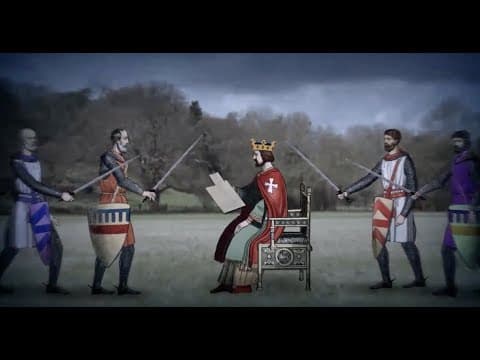
[0:32]Okay, so how many of you already know this story? A king starts acting like a tyrant, taxing people without giving them any say in how they're governed, and throwing them in jail without fair trials. Some of the most important men of the land come together, fight back, and declare that they won't be ruled arbitrarily by the king, but by laws that govern everyone. Now, if you were thinking of the framers and the founding of the United States, you're close. You were only off by about 560 years, an ocean, and a king. Because the event is actually the approval of the original Magna Carta, which began in 1215 on this very field just outside of London. And the king, John, not George, continued to reign because he agreed to play by the rules of law. Magna Carta matters because it set forth a basic principle 800 years ago. Among other things, it said that the King, who is the most powerful person in England, could not imprison a person, and he wouldn't take their property, and he wouldn't hurt them, except according to law. Magna Carta said, the law comes from the people to the king. This was revolutionary. And that idea that we all live according to laws and that not even a king is above them, that began with Magna Carta. Magna Carta is the starting point for the English tradition of the rule of law. Magna Carta is an assertion really of the rule of law. The idea that there is a set of limits on government power. Now that's a very basic, very fundamental idea. And that idea became a fundamental principle in America.
[2:35]King John might just be one of the world's most famous tyrants. Think of Robin Hood, that was King John, that was the John that we're talking about in 1215, Magna Carta times. You shall hang by your clumsy thumbs if you cut me again. King John's behavior was, if he saw you had some money, he would think, well, why shouldn't I have it? He really was the worst king in English history by quite a long way. He'd taken the taxes, he'd demanded the money that went with making war overseas, but he'd been defeated in his wars in France. And at home, he'd taken taxes probably at a higher level than any king in the past. Well, the barons didn't like that. Why were the barons upset with King John? It boils down to money. He was abusing them with taxes, taking their land. The barons were fed up with King John taking their money and property whenever he felt like it. They united, formed an army and threatened the king, either start acting like a good king and protect us or we'll find a new king who will. It truly is the start of some notion that the king does not have divine right and absolute power. The paper said he wouldn't put them in jail and he wouldn't take their property, and he wouldn't hurt them, except according to law. Now, the barons didn't like King John and they weren't going to take him at his word, so they made sure the agreement was written down. 63 different clauses, all in Latin, and it was 1215, people. Their paper was sheep skin. To fit this document onto one piece of parchment, onto one piece of animal skin, sheep skin, you've got to merge all that and you would have to write in very, very small writing on what is effectively the back of a sheep. This must be the only great constitutional document in world history that is limited in its scope by the size of a medieval sheep. It became known as Magna Carta, which literally means the Great Charter. But this is not a We the People moment. The barons were perfectly happy to keep the king. The barons wanted to say in power. They wanted a share of power. This first Magna Carta is full of little things that only a baron would want. He's got some very strange things in it. Clause 33 forbids the building of fish wears on the River Thames and the River Medway. What on earth have fish wears got to do with yours or my liberties? The idea that you couldn't take corn or wood without paying for it, became the government cannot take property without just compensation. So narrow clauses that were written were focused on a particular problem,
[5:29]but they had a meaning that was elaborated over time that became greater than the writing. Then there's this. No free man shall be arrested or imprisoned, or Disceized. That means having his property taken away. Or outlawed or exiled or in any way victimized. This is King John speaking. Neither will we attack him or send anyone to attack him, except by the lawful judgment of his peers or by the Law of the Land. Now, that was a rather radical idea there. In other words, the king, who up until that moment on this field ruled as if he had powers given to him by God, the king was agreeing to have his power limited by the law of the land. Now what is the law of the land? Magna Carta doesn't specify what the law of the land is, but it does lead to the expectation that there is something called law, that is customary, that other people, justices and judges can actually impose. And this is how, way back in 1215, this document set in motion an idea that informed the way Americans built their own constitution and lived today. See here. Rule of law means that the law, not anyone person, but the law is ultimately in charge. We obey the laws as they're written and everyone has to obey the laws equally. No one is above the law. The idea behind the rule of law is simply, it's the law that is the ruler. We don't have a person whose arbitrary will tells us what's permissible and what's not. We have a system of laws. Arbitrary behavior. Do whatever you want behavior. Wouldn't it be nice if what's mine is mine and what's yours is mine too. And this phrase right here, Law of the Land, came to be the idea we know today as Due Process. They cannot take, the government, your Liberty. They cannot take your property, except according to Fair Law. Due process means fair, not just law, but fair law. In a country governed by the rule of law, due process is the pathway we take to get to a place where we can say yes, the rule of law was honored here. You can't have one without the other. Pretty much the minute the king and the barons left the field, King John, living up to the reputation of worst King ever, went straight to the Pope and had Magna Carta annulled, canceled. Magna Carta was successful for about 10 weeks. But a funny thing happened on the way to constitutional democracy. Turns out it's really hard to annul a good idea once it's been written down. After John died, future Kings agreed to be bound by Magna Carta, at first to keep their peace with the barons. But gradually it became a tool for all the people to remind the King he wasn't above the law. So it became part of the customary law of England. In a sense, the issuing of Magna Carta is a statement of power.
[8:37]It's a statement that there's enough power in the people to make certain that the King will agree to it. that gained immediate acceptance from the people. The people insisted that the successors to King John sign on to this Magna Carta. This continued for hundreds of years, was nearly forgotten, then Magna Carta was brought back to life, just as Britain was forming colonies in the New World by Sir Edward Coke. Edward Coke was one of the most important jurists in British history. Edward Coke, even though it looks like it's spelled Coke, is Coke. As attorney general, he prosecuted Sir Walter Raleigh and was eventually promoted to Chief Justice of the Court of Common Please, where he became known as a champion of common law. The British Constitution is not written. It's this collection of precedents that the common law and Statute law, it's what's accumulated. Coke argues that the English people have fundamental rights under an ancient constitution, rights that no king can take away. Coke says, these constitutional rights are grounded in Magna Carta and safeguarded by the elected representatives of the people, Parliament. Edward Coke is tremendously important in the invention of this idea that there was this ancient constitution that defended the liberties of Englishmen as freeborn, free people. And Parliament is the thing that protects the freeborn English against these potentially tyrannical Kings. Coke wants a world where there are things the Crown is not allowed to do. That's our modern notion of constitutionalism, but because the British don't have a written constitution, that's hard to point to. He really is fundamental to the rediscovery of Magna Carta. Coke said the King is under no man but he's under God and law. Lex Facet Regem, The Law Makes the King. He argued that Magna Carta limited the King's power, that because of Magna Carta, all free Englishmen, not just barons, had rights a king had to respect. And with that argument, Coke went on to write British laws asserting rights that are very familiar to Americans. Sir Edward Coke is one of Britain's champions of the rule of law and due process, and he argued that those ideas came from Magna Carta. A lot of our understanding of the areas where government ought to be limited, come out of this early battle in the 17th century with the Crown in England. And in a world where many people were beginning to think that Magna Carta was part of those laws and liberties, it would have meant that, in essence, Magna Carta sailed with the colonists as they sailed across the Atlantic. Remember, they called it the New World. Most of the people leaving England were determined to establish new lives and new ways of doing things. They saw themselves as loyal subjects of the Crown, but they hoped for enough independence and ocean away to practice different religions and economic independence, so they could have more control over their lives. Edward Coke actually helps write the charter of Virginia and Magna Carta is cited in colonial laws. And when King George tramples the rights of the colonists, they look to Magna Carta. The American framers certainly would have used Sir Edward Coke's legal text as part of their legal education. And so they would have been influenced by that thought as well. Coke's writings later became of immense importance for the colonies. Magna Carta becomes a rallying point for the colonists. It becomes an icon. It's reproduced on currency. It's put up there on the state capital buildings across America. So as King George starts to impose new taxes on the colonists, imprison them without fair trials, and invade their homes for no reason, the colonists begin to realize that maybe the way they're governing themselves is what they really wanted all along. That maybe they should stop claiming English rights and write their own. The idea that a king doesn't have absolute power turns into we don't need a king. We'll live by the laws that we make ourselves. Magna Carta is the starting point of an idea that the Americans come to believe they are the fruition of it. I mean, they're very proud that they have gone one step further than the British Constitution, that people are sovereign. If you look at the complaints against King George that are set out in the Declaration of Independence, there are some that relate to just bad things that King George has done to people. But the end goal of the American Revolution is really what's set out in the Declaration of Independence, it's the right to govern ourselves. So when Americans win that right by winning a long and bloody war, the framers draw on the old English law but they invent something new. They will govern themselves. So limiting the power of a king becomes limiting the power of our own government. Probably the biggest conceptual break that the American Constitution makes from the existing British system is that no single branch of government has the ultimate authority. Our Constitution sets itself up as the supreme authority in our system of government. The framers don't discuss Magna Carta as they write the Constitution, but they still borrow from it. Economic protections like no taxation without representation, even standard weights and measures, a phrase taken directly from the original Magna Carta. And some really important ideas that evolve from centuries of Magna Carta and Coke's interpretation of it, become fundamental rights written into our Constitution. Fair trials, Habeas Corpus, and an independent judiciary to protect those rights. And the connection is even stronger in the Bill of Rights. You see its influence more with the Bill of Rights, where we get these limits on the government that has been created. Because the idea is, here's this government, perhaps it's going to be dangerous, perhaps it has too much power, we want to put down in writing certain limits. And we're going to have an independent judiciary that will enforce those limits. The phrase in Magna Carta, Article 39, is Law of the Land. Uh, within just about 50 years, uh, some commentators were calling it due process, and so it became a synonym. The language of the Fifth Amendment, due process, comes from all of those colonial charters that were heavily inspired by Magna Carta. It's the foundation for jury trials in criminal procedures and the rule of law. And it's written down for everyone to see. In 1215, Magna Carta was written and then sealed. Declaration of Independence and the Constitution and the Bill of Rights, they were all written documents, and that is a very, very strong history, at least from the United States of America to have these written documents that symbolize our rights. And in the case of our Constitution, protects those rights. The fact that it's written means that a lot of people who don't necessarily have the same upbringing and cultural differences can all refer to the same thing. So people all over America can hold up this document. And they do. And when the rule of law broke down as it did during the Civil War, the Constitution had to be amended to make sure fundamental rights like due process were protected equally and for everyone. So due process actually appears in the Constitution twice. You say why twice? Because it's so important, we want to write it down twice. Well, when they wrote this document, the Constitution, they were creating the Federal Government. With the Bill of Rights, the framers wanted to limit the power of the new national government. So the Fifth Amendment protects against federal power. After the Civil War, to protect the rights of 4 million new citizens, former slaves, Congress expanded due process and put it in the 14th Amendment. This time, to protect those rights against the states. And that's why that 14th Amendment says no state shall deprive any person of life, liberty, or property without due process of law, nor shall any state deny a person equal protection of the laws. So now, say it twice. Feds, you can't infringe our liberty. You must follow a rule of law. And states echoes for you too. But even a Civil War didn't result in the protection of due process or the rule of law for everyone. We've often had to rely on our independent judiciary to guarantee these rights. One such case is Powell versus Alabama from 1932. A case to determine the due process rights of the Scottsboro Boys. We all know that after slavery ended, that did not mean that discrimination ended and there was segregation in the South. And black people were treated terribly. They found themselves not given a trial at all, no fair process at all. Mobs would take the law into their own hands. Between 1880 and the late 1940s, there were some 4,000 black Americans lynched. And these lynchings weren't random violence, they were terror. But when nine black boys, the youngest only 13, were pulled off a train and jailed in Scottsboro, Alabama, people around the country were demanding that lynching be stopped. Accused of raping two white women, instead of being lynched in the town square, the Scottsboro Boys were taken inside a courtroom. It was sort of an indoor lynching versus an outdoor lynching. There was no commitment to due process. So there they were in this Alabama courtroom on trial for their lives because this was a capital offense. They hadn't seen a lawyer until the day of trial. They faced the death penalty with no lawyer until just hours before their trial began. All nine men were given one lawyer, a real estate attorney from Chattanooga, Tennessee, the only lawyer in the region who would take the case. The judge, jury, court officers and everyone in their line of sight was white. The Scottsboro case was a terrible situation. Many years later it was determined they had nothing to do with it. But at the time, they were convicted in a court of rape and sentenced to death. The case went to the Supreme Court and for the first time since the inception of the 14th Amendment, the Court insisted that black Southerners had a right to due process with real legal representation. It says, you cannot deprive a person state of life without due process of law. that you have to have a lawyer, and that's an elementary part of a process of a fair process, a particular process that could end up with your death. The court said, wait a minute, you can't just bring them in and have a sham trial and and pretend as if you're protecting their rights when you're not. Powell is an example of protecting vulnerable citizens with due process and restoring the rule of law, or what the barons would have called the law of the land. But what about the idea that no one is above the law? Limiting the power of a president. Perhaps the most noteworthy case of the court telling a sitting president he had to follow the rule of law was US versus Nixon. When five burglars were caught breaking into the Watergate Hotel offices of the Democratic Party during the presidential campaign of 1972, the FBI started to investigate. The people who broke in had cash in their pockets, many thousands of dollars. It didn't take long for the FBI to determine that these burglars had been paid with cash from President Richard M. Nixon's reelection committee. The question that everybody was asking about the President is, what did the President know and when did he know it. The big question of the Watergate scandal was, had the President put himself above the law? Then, in the summer of 1973, the nation was shocked to learn that the President had installed a secret taping system inside the White House. Every conversation in the presidential office, every telephone conversation that the President had was being taped. Nixon is having conversations with his top aides in which President Nixon is trying to use the CIA to stop an investigation the FBI is conducting
[21:44]as to whether people who work for Nixon had committed crimes. And when Special Prosecutor Archibald Cox issues a subpoena ordering the President to turn over the tapes because they might contain important evidence, the President orders his attorney general to fire the prosecutor.
[22:08]The attorney general refuses and resigns in protest. President Nixon then orders the next in command, the Deputy Attorney General to fire Cox, and he refuses and resigns. President Nixon then orders the Solicitor General to do it, and he does. This is known as the Saturday Night Massacre. And at that point, the House of Representatives sprung into action. Mean it had refused to do anything for month after month after month. But after the Saturday Night Massacre, when the American people said we are not a banana republic and we cannot have the President picking his prosecutor. That's when the House Judiciary Committee decided to commence impeachment proceedings against Richard Nixon. It turned out he was wrong in thinking that he was above the law. The case went to the United States Supreme Court, which issued a unanimous decision against the President on July 24th, 1974. Even the President could not withhold evidence in a criminal investigation. Just 16 days later, rather than face impeachment, the President resigned. Therefore, I shall resign the presidency effective that noon tomorrow. The Nixon decision affirms rule of law by saying even the highest person in the country isn't outside of the rule of law. We're all bound by the rule of law. We are a government of laws and not of men, and our concept of due process and our concept of law being superior to the President goes back to Sir Edward Coke, back to Magna Carta. The government is bound by the law. And of course this is Magna Carta. And in the end, President Nixon complied with the law and handed over the tapes. A fair and transparent process led to the rule of law, and not even the President is above it. You have to follow the law. That's what the rule of law means.
[24:12]No individual person is so pure that we can trust them with arbitrary power. You have to have laws that they cannot rise above. And that's the essence of the Magna Carta and that's the essence, really of the Constitution. Before Magna Carta, it took 800 years to come up with the idea that the people are in charge, not the ruler. That Magna Carta is part of the mindset of a free people. 800 years ago, barons and a king met on this field and agreed for the first time that a king is not above the law and has to respect certain rights of his subjects. They wrote it down and Americans took those ideas, expanded them, and made them bedrock principles that we live by today. No one is above the law and we all have rights our government must protect. The best way to see the Magna Carta is the first time that efforts were made to constrain and restrict absolute power. It's a sort of starting point that leads all the way to We the People.


