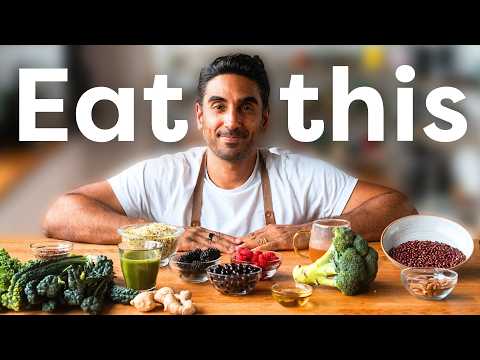
[0:00]If I could suggest one thing for you to do to boost your energy, slow your aging, and massively cut your risk of disease, it's reducing inflammation. And the good thing is, you can do it naturally with food. I'm going to show you my top 10 evidence-based foods, as well as the hack I personally use to eat them every single day. Berries. A handful of berries a day can fight inflammation more than most supplements. When people eat them regularly, about a cup or two most days, studies show better cholesterol levels, healthier blood vessels, and a lower risk of overall heart disease. And the highest sources of these anthocyanins are actually super accessible, things like blackcurrants, blackberries, and blueberries, but you can also get them in things like raspberries. And the funky ones, like Haskap berries, for example, if you can get your hands on them, are super impressive as well. Each of these different berries have their own unique blend, so by mixing them all up, you get a real wide spectrum of benefits. I keep frozen berries in the freezer, so I can just throw them into things like overnight oats or yogurt bowls. If you prefer getting your berries in a powder form, make sure you're getting freeze-dried berries. That is the best preservation method to ensure that you're getting a wide spectrum of their nutrients. Berries are such an easy way to get your daily dose of anti-inflammatory benefits. Greens. Dark leafy greens, like spinach, kale, chard, rocket, I like nature's multivitamin. They give you fiber, folate, vitamin K, vitamin C. They also have a special power called carotenoids, like lutein. And once in your body, lutein sort of acts like a shield against oxidative stress, one of the main sparks of inflammation. People who eat a carotenoid-rich diet show lower levels of inflammatory signals. And just one portion a day, around 80 grams or so, was linked to a slower brain decline, equivalent to being 11 years younger. So if you're looking for longevity benefits, get your greens in. The darker the green, the richer it tends to be in these compounds. I usually go for kale, cavolo nero, spinach or chard. And a special trick is to also rotate between cooked as well as raw greens to preserve a full spectrum of all their nutrients. This is nothing new. Every culture seems to have its own version of daily greens, collards called sukuma wiki in Eastern African countries, saag in India, one of my personal favorites. Edible wild greens called quillettes in Mexico, the list goes on. I personally just add them to whatever I'm eating, a salad, soup, a stir fry or a smoothie, or just simply having it sautéed with garlic and olive oil side of a meal. Just remember, don't forget your daily greens. Sprouts. A handful of broccoli sprouts can contain 50 times more anti-inflammatory compounds than fully grown broccoli. Now if you haven't tried sprouts in general, they're basically plants at their very first stage of life, and they are super, super concentrated in nutrients. And honestly, you can sprout almost anything, radish, lentils, alfalfa, mung beans, they all bring something different. But the A-lister of all the sprouts are broccoli sprouts. When you chew them, they release sulforaphane that flips on a switch in your cells called Nrf2. And this is like hitting go on your body's detoxification system to clear out oxidative stress and reduce inflammation. It was actually a really cool trial where 40 healthy overweight adults ate just 30 grams of raw broccoli sprouts that were fresh, every single day, and after 10 weeks, their inflammatory markers like IL-6 and CRP, dropped by up to 59%. That's super, super impressive. And since chatting to Doug Evans, I've been trying to eat so much more, and I try and grow them as well using this very simple sprouting system. If you just soak seeds, rinse them twice a day, after about five days, they're ready to throw into fresh salads, pile them on top of avocado toast, or just put them through a warm grain bowl just before serving so they keep their crunch and their potency. One of my first videos on YouTube was me putting some sprouts on the top of an egg Florentine back when I used to live in Sydney. I think sprouts are completely underrated. These should really be a cornerstone of a healthy diet, not just a garnish. Extra virgin olive oil. Quality extra virgin olive oil, just like this, is not just for cooking. It's liquid anti-inflammatory. It's such a big part of the Mediterranean way of eating, which is one of the best-studied diets for lowering inflammation. And the secret here isn't just the healthy mono-unsaturated fatty acids, it's also the polyphenols from the olive, like oleocanthal and oleuropein. They act on the same inflammatory pathways as things like ibuprofen by inhibiting something called a COX enzyme, and that lowers inflammatory messages like prostaglandins. Now, of course, it's not the same as taking a painkiller, it's much gentler in its effect, and it works kind of like in the background, but it all adds up over time. And you're getting it in the context of whole food, again, packaged with all their anti-inflammatory properties as well. The benefits of this stack up fast, just a drizzle around 7 grams a day was linked to around 28% lower risk of dying from dementia-related causes. That is staggering. But to get the most benefit, you really need quality extra virgin olive oil. First, you want to look for cold pressed, ideally, in a dark glass bottle to protect those delicate compounds from light. Second, freshness is also super important because the polyphenols that make olive oil so powerful actually decline over time. Check the harvest or the press date and aim to use it within a year. And third, a taste test, when you try extra virgin olive oil, it should have a strong peppery hit at the back of your throat. Woo! That's a really good sign that you have a bottle that's high in polyphenols, which is exactly what you're looking for if you want to lower inflammation. And for extra points, bonus for the manufacturers, they will actually lab test their olive oil for polyphenols, and you want to be aiming for a minimum of 250 mg per liter. I go for at least 2 to 3 tablespoons of good quality extra virgin olive oil every single day with lots of other polyphenol-rich foods to get those combined benefits. You've probably heard that you can't cook with olive oil. That is completely false. The polyphenols in olive oil actually protect it from heat degradation, plus the smoke point is around 180° C, so as long as you're not deep frying with olive oil and you're using it for low to medium cooking, it's great for everyday use. I used extra virgin olive oil in so many different ways, to dress salads, to finish a meal. You can use it anywhere you like, tastes delicious. Nuts. People worry about nuts because they're high in fat and therefore high in calories. But these are not empty calories. These are nutrient-dense, powerhouse ingredients that you should not be scared of. Nuts contain healthy unsaturated fatty acids like alpha-linolenic acid. And they also come packaged with antioxidants and anti-inflammatory compounds. They're full of minerals like selenium, magnesium, zinc, these are things that are lacking in many people's diets. They also have fiber that's going to be great for your guts, as well as phytosterols, but they also contain these polyphenols that are anti-inflammatory. They are way more than just healthy fats, and judging them by their calories is the wrong way to look at these ingredients. And you don't actually need a lot, just a handful a day, about 28 grams, is linked to lower inflammation, better cholesterol, and a 19% lower risk of heart disease. All from these impressive little jewels. Some of these nuts really stand out for their polyphenols, like walnuts, pecans, almonds, and even chestnuts, that I was really surprised to learn about. But every nut has its own superpower, so I love to mix them all up. I keep a jar of unsalted nuts on the counter, and most days, I'll just grab a handful, throw them over oats or into salads. Just a handful a day is such an easy habit, and it pays off big time for lowering inflammation. Seeds. Just like nuts, seeds are not just to sprinkle on top. They're little capsules of anti-inflammatory compounds, they're rich in plant protein. Some of them, like hemp seeds, can contain as much as 10 grams per handful. Plus, they have fiber, omega-3, phytosterols, polyphenols, lignans, the list goes on and on and on and on. And they all work together to lower inflammatory markers like CRP and TNF-alpha. Each seed has its own superpower, and here are three of my favorites. Behind every spoonful of flax is a powerful compound called SDG. Don't ask me to pronounce the full name. Secoisolariciresinol diglucoside. Oh wow, she smashed it, but I can tell you it's surprisingly well researched for its anti-inflammatory benefits.
[9:28]And when you look at big reviews, it shows that you only need to eat around 10 to 30 grams per day. And I definitely get that in my personal diet. I use ground flax every day in things like oats, smoothies, or in a version of my Doctor's Daily Bread. I always recommend that you grind flax into the milled version. And if you do have a pre-milled one, keep it in the fridge to preserve a lot of those different nutrients. Sesame seeds. The star compound in sesame seeds are sesamin, and this helps protect blood vessels and lower inflammation. I use it in so many different ways, like tahini, which is basically pureed sesame. You can put that into dressings, sprinkle toasted sesame seeds over stir fries and salads, and that way, you're getting flavor as well as those functional benefits. But look, you don't need to go fancy. Sunflower seeds are actually a really good everyday hero. They're cheap, super easy to find, and they're full of things like vitamin E, polyunsaturated fatty acids that also protect your heart, and particularly, they're rich in linoleic acid as well. But just grab a handful straight from the jar whenever I need to snack. Now there aren't too many big reviews on sunflower seeds, but I wouldn't underestimate these very cheap, accessible seeds. What's amazing is that you don't need a lot. Even one or two tablespoons a day shows anti-inflammatory benefits. Personally, I aim for a handful and mix them up so I get the benefits of every single seed. Legumes. Beans and lentils are a daily anti-inflammatory. They're high in fiber, and what this does is that it feeds your gut microbes, these microbes that live in your large intestine. And what those microbes do is that they create something called short-chain fatty acids. These are essential for keeping your gut barrier strong, and ultimately, when you have a strong gut barrier, it lowers inflammation in your body. But that's not all. Beans also keep blood sugars nice and steady, so they don't give you those big spikes that can drive up inflammation over time. And most people don't realize that just like berries, beans and lentils are packed with polyphenols that are anti-inflammatory. And if you look at this diagram from this paper, you'll know why I'm such a fan of getting legumes in every day. To achieve these benefits, studies show you only need around 400 grams of cooked legumes every single week, or about 3 to 4 heaped tablespoons a day. If you're not already eating beans, I would actually advise you to start small, with just a couple of spoonfuls here and there, and allow your gut to adjust the increase in fiber. The easiest way to include some of these powerhouse ingredients is to sneak them into your go-to meals. So, for example, if you're making a salad, toss in a handful of chickpeas straight from the tin. If you're making a pasta, swap half the meat you're using for lentils in the sauce. The research is super clear, beans feed your gut and help keep inflammation in check. Whole grains. Grains get written off as just carbs, but there's a big difference between refined grains that we consume way too much of and whole grains that are actually a rich source of anti-inflammatory compounds. I'm not talking about just opting for brown bread over white because it's basically just white flour in disguise. I mean real whole grains like buckwheat, black rice, and barley, and even some you might not have tried yet. What's different about these is that they keep the bran and the germ, which is like the grain's protective shell and powerful core. That's where you're going to find fiber, phenolic acids, flavonoids, and ultimately, these are the things that reduce inflammation. One of the grains I find most interesting is something called sorghum. Now, you don't see it much in kitchens, but the darker varieties, the red and the brown types, are absolute gems. They're rich in a unique compound called luteolinidin and something called apigeninidin, and it sets them apart from other grains. In fact, there was this really cool study where people ate pasta made with red sorghum, white sorghum, or just regular wheat on different days, and just two hours later, they found that the red sorghum pasta increased polyphenol levels in the blood and improved antioxidant defenses. So you want to go for as much color in your whole grain as possible. Now, if sorghum feels a bit out of reach, there are two other grains I think are worth looking for. One is buckwheat because it's high in rutin. You can find it roasted as the whole grain and in things like buckwheat pastas. And the other one is black rice, which gets its dark color from anthocyanins, the same polyphenol that we find in berries. Try swapping your refined grains, things like white rice, for a whole grain of your choice. You only need about 200 grams of a cooked whole grain per day to get the benefits. It's a really easy way to just boost your level of anti-inflammatory food without really changing much. Spices. All spices are phenomenal for inflammation. We only eat a little bit, but because they're concentrated sources of these anti-inflammatory plant chemicals, they support your gut microbes and they lower inflammation. And three really stand out: ginger. Its flavor comes from compounds called gingerols and shogaols, and those are the same compounds that are shown in trials to lower inflammation markers like CRP, TNF-alpha. You don't actually need loads, about a thumb of fresh ginger or a teaspoon of concentrated ginger powder a day. Don't spend money on unnecessary ginger tea bags or supplements, use the fresh stuff instead. Turmeric. This golden color is because of curcumin and all the other curcuminoids. It's been shown in clinical trials to ease pain and stiffness almost as well as ibuprofen. I cook with it all the time, the color alone is the reason why you'd want to use this. As well as lowering inflammation, it has been shown in some studies to lower the risk of cancer as well, all the more reason to get this regularly into your diet. And a fun one to try is nigella, also referred to as black cumin. Its star compound is something called thymoquinone, and it's got some of the strongest evidence for lowering inflammation in people within just a few weeks. It has a really lovely flavor, so if you haven't used nigella, honestly, you can pound it in the pestle and mortar, and it gives a sort of aromatic lift to any meal. But quality is super important. You want bright color, strong smell, and opt for whole spices. That way you know you're getting more anti-inflammatory compounds and there's been less degradation. You don't actually need that much either. Studies show benefits for as little as 1 to 3 grams per day across multiple different spices, which is about a teaspoon. And that's why on the Doctor's Kitchen app, we always use spices. It's almost like every meal has a pre-requisite to use some type of herb or spice. Keep it spicy, guys. Anti-inflammatory drinks. You can sip your way to anti-inflammatory benefits. We don't often think of drinks as anti-inflammatory, but they can be really rich sources of polyphenols with that benefit. Green tea or matcha is packed with something called EGCG (Epigallocatechin Gallate). And that's been shown in multiple studies to lower inflammation and improve the functioning of your blood vessels, which is really good for your heart health. Now you're seeing matcha being used in so many different ways, popped in smoothies, in cakes, usually added with tons of added sugar. You want to avoid those products. I think the best way to enjoy the subtle bitterness of matcha is as it's intended in a tea. Use water that's off the boil around 80 degrees centigrade, so you don't damage those delicate polyphenols. And simply sip it in the same way you would enjoy a coffee. These are actually cacao nibs that you can use in a tea. But if you want to use cacao powder in its raw form, add some hot water to that and use a little whisk to make a hot chocolate that's actually good for you. And the daddy of them all, coffee. If it's made from good quality beans, it's abundant in something called chlorogenic acid. And with over 20,000 studies that show its benefit, it is known for its strong antioxidant properties. Now if you can tolerate caffeine, great. I recommend you consume this before 11:00 AM. When you look at the studies, it seems you only need 2 to 3 cups a day for those maximum benefits. And if you're sensitive to caffeine, you can opt for a mountain water process decaffeination method where it preserves a lot of those polyphenols that give coffee its benefits. But there's also pomegranate juice, hibiscus tea, blueberry and blackcurrant juice, black tea, they're all full of polyphenols. But the one thing I would say is make sure to watch out for added sugar or sweeteners that can cancel out those benefits. So make your own at home without the sugar if you can. I like to rotate them throughout the week, drink my way to those anti-inflammatory benefits. Now look, if this long list of foods sounds like way too much to keep track of, here is the simple hack I use every single day. It's called BBGS. Beans, berries, greens, seeds and nuts. I simply ask myself at the end of each day, have I had my BBGS? You don't have to eat all four at every meal, just weave them into your day, and over a week, the consistent hit of these nutrient powerhouses keeps my inflammation in check. But lowering inflammation doesn't need to come at the expense of protein. Here are my three favorite breakfasts that make sure you get anti-inflammatory ingredients in and enough protein for your needs.