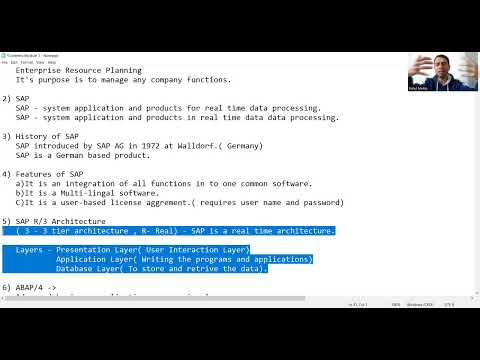
[0:03]Hello everyone. My name is Rahul Mehta. In this video, we will start with the overview of ERP, SAP, and then we will jump on to ABAP. Firstly, we'll start what is ERP. ERP stands for Enterprise Resource Planning. What is the purpose of ERP? Its purpose is to manage any company functions or its purpose is to manage any organization functions. Suppose we'll take an example. Suppose we have a manufacturing company. What are the various functions of that manufacturing company? It has to take raw material, with the help of that raw material, it has to develop the product. It has to sell that product inside the market. Then whenever they will sell the product, they will earn money by selling that product. So these are the various functions of an manufacturing organization. I'll say main functions of any manufacturing organization. If we are managing all those functions or we can manage those functions with the help of ERP. So the purpose of ERP is to manage any enterprise resources or to manage any company functions, organization functions. Now, the next question comes, what is SAP? SAP is an ERP and SAP is the one of the best ERP available in the market. So, what is the full form of SAP? Generally, whenever we will ask the maximum people will give the full form system application and products. But it is never the full form of SAP. The full form of SAP is system application and products for real time data processing. So whenever someone asks the full form of SAP, the full form of SAP is system application and products for real time data processing or system application and products in real time data data processing.
[3:03]Because with the help of SAP ERP, we will process the data in real time, in real time we will process that data. So the full form of SAP is system application and products for real time data processing or system application and products in real time data processing. Now, whenever we have to learn a topic or we have to understood a topic, we'll start with the history of that particular topic. So what is the history of SAP? So SAP introduced by SAP AG in 1972 at Walldorf, Germany. SAP AG is the name of the organization who introduced this SAP product. It introduced in 1972 at Walldorf. So Walldorf is a place where this SAP product evolved and Walldorf is a place, it is in Germany itself. So maximum time we are always saying, SAP is a German based product. Now, never say it as SAP. Because SAP is a German based product and in the German language, SAP stands for 'pick'. So we are never saying it as 'SAP', we are always saying it as S.A.P. So the history of SAP is SAP introduced by SAP AG in 1972 and Walldorf is a place, it is in Germany, where this product has been evolved. Now, we will come on to the features of SAP. Means what are the features of SAP? We'll go for the first feature. SAP has lots of features. Once we'll proceed further in the lectures, you will automatically recognize that this SAP has lots of features. But we'll cover some important features at this point of time. What are the features of SAP? The first feature is, it is an integration of all functions in to one common software. We'll just go by the example. When we started the lecture, we took an example of manufacturing company. So what is, what are the functions of a manufacturing company? Taking the raw material, one function. Developing the product, second function. Sell the product in the market, third function. Earn the money by selling that product, fourth function. So we can manage those functions into one ERP itself. And all those functions are integrated with each other and in one ERP we can achieve all the functions.
[6:48]Now, what is the second important feature of SAP? It is a multi-lingual software. Now what is multi-lingual? Multi-lingual stands for multiple languages. This software is available in more than 40 languages as of now.
[7:13]We'll take an example. Suppose I'm from India, I know English. Suppose we have a person from Germany, he knows German language. So it is not the case that if we have a customer from India, because he will not understand other language. He can understand English language itself. Suppose I'll say suppose we have a customer, he knows only a particular language. So it is not the case that we cannot, we cannot give the product to that customer. No, because this software is available in more than 40 languages as of now. So it is a multi-lingual software.
[8:08]It can support the customers of any countries who knows a dedicated language. Now, we'll come on to the third important feature. It is a user based license agreement.
[8:26]Now what is the meaning of this feature? User based license agreement. Whenever, when once we'll proceed further, I will show you how we will log in into SAP software. So whenever we will log in into SAP software, we have to pass the user name and password. Means whenever you want to work in SAP, you require a valid username and password. Suppose simple example. Today I want to learn Java. I'll simply install Eclipse and I can start learning Java. But it is not the case with SAP. Suppose if you have SAP, but if you want to work in SAP, you must require a valid username and password.
[9:27]Means authorized users are working into that SAP software. Now we will come on to next important topic and this topic will create a base because in the future we will go for the ABAP programming language.
[9:54]So this will create a base. Now, what is this SAP R/3 Architecture? Whenever we want to learn the first thing, we should understand the architecture of that particular thing.
[10:17]In the college curriculum, we learned OSI architecture, TCP IP model, OSI model. So we have various layers in the architecture. So SAP architecture is called as SAP R/3 Architecture. Now, what is this R stands for? R is real and three stands for three layers. So in SAP architecture, we have three layers and it is a real time architecture. In the full form of SAP, we also discussed that system application and products for real time data processing. So SAP architecture is a real time architecture. Now, what are those three layers in the SAP architecture?
[11:24]First one is presentation layer, second one is application layer and the third one is database layer. Presentation layer is also called as user interaction layer. Application layer, in this layer, we will write the code, we will develop the applications on to the application layer.
[11:54]And the purpose of database layer is to store and retrieve the data. In SAP architecture we have three layers. Presentation layer, application layer, database layer. We'll go for the example to understand this architecture. Suppose 50 associates join an organization on a specific date. So suppose that organization is using SAP. And they want to put the details of those 50 employees into SAP. Suppose that organization is using SAP and they want to put the data of those 50 employees into SAP software. How they will do? Firstly, on the desktop SAP will be there. HR will log in into SAP with the help of which layer? Presentation layer. Because presentation layer is a user interaction layer. User will interact with the SAP software with the help of presentation layer.
[13:17]So HR will log in into SAP software with the help of presentation layer. Now, whenever the HR will log in into SAP software. On the application layer, suppose one program will be there, which will help to put the details of those 50 employees. So HR will simply put employee ID, employee name, and when the HR will click on the save button, that data will store on to the database layer. But it is not the case that we can the control always goes from presentation to application to database. No, vice versa is also there because it is a bidirectional architecture. Suppose, after four to five days, HR wants to check. What are the employees who joined the organization on that particular date? So again, HR will log in into SAP with the help of presentation layer. On the application layer, some program will be there, which will retrieve the, which will, whenever HR will run the program and pass that date, that particular date. System will pick the data of those 50 employees from database layer. Data will come on the application layer and it will be visible to us with the help of presentation layer.
[15:11]So SAP R/3 Architecture is a bidirectional architecture. So in this first video, what we learned, we learned what is ERP, what is SAP? What is the history of SAP, what are the features of SAP and what is SAP R/3 architecture? Rest, we will continue in the next video. Thank you very much, thank you.