[0:12]All right, greetings everybody and welcome to my uh lecture series on themes of the 20th century. Uh today we are going to be looking at one of my, one of my favorite topics.
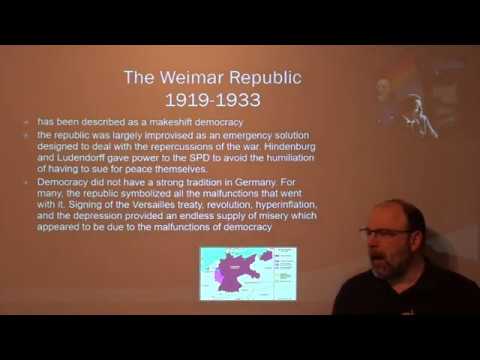
[0:27]Uh, a remarkable period of German history from 1919 to 1933. And right off the bat, I should note that what makes this 14-year period so interesting is the fact that it's sort of landlocked between on one side, the end of Imperial Germany. Essentially an absolutist type of monarchy, and then on the other side, a fascist dictatorship. So, uh, for 14 years democratic forces in Germany grappled with dealing with the end of World War I, the consequences of the Treaty of Versailles. Economic chaos, the rise of fascism and communism in Germany, so, uh, Germany was an incredibly dynamic place in the 19, in the, rather, 14-year period known as the Weimar Republic. You know, uh, one of the obvious questions people have, and I'm surprised people don't ask it more often, is why is it called the Weimar Republic? Um, and that is simply for the fact that uh during the time that they were writing their constitution, uh the new Democratic government that is, uh, they had to flee Berlin because Berlin was in a state of chaos, and they headed to the town of Weimar, W's are pronounced like V's, when you're speaking German, so hence Weimar as opposed to Weimar. Either is fine, though, potato, potahto, whatever you like, I've just gotten used to saying Weimar. But, Weimar was a small town, and that's where the government headed to, uh, to, to write up their constitution, because very little was left in place for the organization of, uh, Democratic government when the Kaiser abdicated, and that system fell apart at the end of World War I. Um, and just a reminder, if you are interested in, in kind of getting a sense of what Germany confronted, I would have a look at my, uh, Paris Peace Conference lecture, which goes into great detail about the Treaty of Versailles, and, uh, the consequences of that, what was taken away, how much they had to pay, so on and so forth. I may touch on those components throughout this lecture, but if you watch that one before, it'll really give you an idea of the, uh, the, the challenges that Germany was going to face as a result of the Treaty of Versailles. One of the things, I think you can see this map here, this used to be the greater Germany, the outside of all this. Now you have East Prussia, cut in two by the Polish Corridor, which becomes part of the New Poland. You have the demilitarized zone here, uh, which had fallen under, um, well, I guess, uh, you did have Belgian troops and in the Ruhr and up in that way, too, and French troops, but this was demilitarized, as well. So, uh, a significant amount of land was taken. But for our purposes, we are going to jump, sort of, right into the Weimar Republic and talk about, uh, um, that remarkable period. And of course, during the Weimar Republic, we see, more or less, the birth and the rise of fascism and more, more particularly, in Nazism as well. So, and of course, that would continue to cast a very long, dark shadow in German history right up until the end, uh, of the war in May of 1945. So, all right. So, let's begin. The Weimar Republic has been described as a makeshift democracy because it was, it was put together during, um, a very, uh, difficult time. They were passed the torch from Imperial forces, if you will, the Kaiser and the military command, very, very quickly and told, okay, you are now in charge. So, it was very much something that, uh, the, the leading Social Democratic Party had to contend with and deal with very, very quickly, and I'm going to go into all these details, as well, as we move through this. This new Republic was largely improvised as an emergency solution designed to deal with the repercussions of the war. Hindenburg and Ludendorff gave power to the SPD to avoid the humiliation of having to sue for peace themselves. And in German starts for, start, um, stands for, rather, social-Democratic or the Social Democratic Party. Um, so the two main military commanders of World War I gave power to these guys to avoid the humiliation of having to sue for peace themselves. And as I said, we'll look at the step-by-step, um, period that results in this. I always kind of think that the, the, the early transition from Imperial Germany to the Weimar Republic is like something out of a Shakespearean tragedy that, uh, you know, there's loads of revenge and loads of honor and, and betrayal and all those kinds of rich themes. There's such a key moment that November, December 1918 period, which we will go through, as I said, step-by-step. Democracy, though, did not have a strong tradition in Germany. For many people who lived during the Weimar Republic in Germany, the Republic symbolized all the malfunctions that went with it. So everything that went wrong, hyperinflation, economic chaos, the depression of 1929, because people had not experienced democracy before, they could only assume that this has something to do with democracy.
[6:13]It must be Democracy's fault, because we never experienced anything like this during the reign of the Kaiser. So there was that link, signing of the Versailles Treaty, revolution, hyperinflation, and the depression provided an endless supply of misery, which appeared to be due to the malfunctions of democracy. Um, obviously, if the Kaiser had, uh, stayed in power and Imperial Germany had continued, they would have faced all these economic challenges, as well. But, um, because, uh, this was new, the experiment with democracy, people could only imagine that this might be the problem. And certainly the Nazis would really, really play that card very, very well, and, uh, and, and in many ways, economic chaos in Germany, uh, plus the stab in the back myth, which we will talk about, really contributed to the rise and popularity of the Nazis. World War I was now over, uh, but Germany's problems were just beginning, so, um, lots on the horizon for this young Republic to face. Okay. So, the period of 1918, late 1918, sort of, October, November, December period, is, is often referred to as the Revolution of 1918. But I would argue that it, it is not a revolution in the sense that everybody's out in the streets with, uh, pitchforks and torches and, uh, down with the old system and chaos and mutiny and, you know, like a storming of the Bastille or the storming of the Winter Palace in Russia, kind of scenario. But what it is, is a significant, vocal resistance to the policies of the current government. There were significant cracks, and the Kaiser didn't know how to deal with this, and he decided, of course, as a result of these sweeping changes that were beginning, to cut and run, rather than stick around to, to, to take the blame, in other words, for everything that had gone wrong.
[8:35]So, certainly for signing of the armistice of November 11th, and later the signing of the Treaty of Versailles. So, I'm going to outline the steps that lead to the transition from a Imperial government under the Kaiser to a, uh, a constitutional government. All right. The Revolution is often regarded as beginning on October 30th, in the North Port of Kiel, sailors refused to attack British navy. That was the first sign of major discontent when the Navy said, enough. Our families are starving at home, we're short of supplies, this war has gone on too long, we've had it, we're not attacking anymore. Spread to cities where people demanded peace ASAP, allied blockade had worked well. Once people in the cities heard what the, what the, uh, Navy was doing in Kiel, I believe in also in Lubec, which is in the north as well.
[9:36]Um, it spread from there and basically, these were feelings and thoughts, I think, that German civilians were already beginning to feel, and all it took was, sort of, something to happen to make them say, oh, good, I feel this way, too. So it, it spread very quickly. People were demanding peace as soon as possible. The Allied blockade had worked very well. One of the remarkable victories, if you will, of the Allied forces during World War I, was the fact that they had put a very, very strong and effective embargo. They had quarantined Germany basically, so nothing could get in and out. And because their only trading partner, technically, I guess, would be the Austro-Hungarian Empire through their shared border, um, Austrian Hungary was in terrible shape, too, so both those central powers were beginning to feel the tremendous pressure of this blockade. And, you know, people were starving, hundreds of thousands of Germans, uh, died in the latter part of World War I, as they consumed whatever they could. I believe, you know, uh, the last winter was referred to as Turnip Winter when people basically lived on grass and turnip. So it, it was extremely desperate, people were anxious for this blockade to come to an end. Germans in 1918 were not talking fascism, and they were not talking Bolshevism. Uh, they were talking, um, about better food supplies. They were talking about democracy, some type of constitutional system, a free press, which they've been denied through the course of the war, and a Parliament with real power. So, most Germans really were just craving something new, something to escape from the yoke, if you will, of the Imperial legacy of the Kaiser and, and Prussia's history, which really dominated the new Germany of 1871 and beyond. And I think it was time for a significant change. Here's the series of events, and, and I think you'll be quite surprised at how quickly things happened. Basically, on November 9th, uh, the Kaiser abdicates, okay? He quits, that's it. Now, he had been told by his military, his two key military, uh, individuals, Paul von Hindenburg and Erich Ludendorff, they will figure quite predominantly in the Weimar Republic, as well. Um, but, um, uh, so, November 9th, he's given a choice. He's got to either sue for peace or he's got to cut and run and have somebody else do it. Well, as you might know, if you've watched my, um, Causes of World War I lecture where I talked quite a bit about Kaiser Wilhelm, he was far too, uh, vain and arrogant to ever be held accountable for signing any type of armistice, let alone a peace treaty of any kind. So he abdicates on, uh, the next day. November 10th, a republic was set up under Friedrich Ebert, leader of the SDP.
[12:51]How they came about having this party be responsible was simply for the fact that they were the largest political party in Germany's Parliament at the time. Now, of course, Germany had had political parties for years. Parties could meet and convene in Parliament, they could make suggestions, they could come to some consensus and draw up some sort of article of, whatever it may be, and, uh, but the problem was, is, of course, the Kaiser could veto anything and, uh, it wasn't really a democracy at all. But at least it gave those democratic elements an opportunity to convene and to talk about policy. So, because the SPD, or the SPD, whichever you prefer, um, was, uh, was the largest party, they are given the golden ticket of running the show. But think about the date here, November 10th. Now, it should be noted as well that when they were handed power, there was kind of a gradual transition towards a civilian government that had kind of begun in the late summer of 1918. But, uh, I don't think they were totally prepared for this rather sudden passing of the torch, and when they were given this, um, this responsibility, you know, they were told, look, the Kaiser's gone, he's quit. You're in charge now. And, oh, by the way, tomorrow at 11:00 a.m., you're signing an armistice. So, it had already been set up for them to do so. November 11th, and armistice, rather, was signed in a railway carriage at Compiegne, to the north of Paris. So, then, who signed the armistice? The government of Germany that was less than 24 hours old. Now, here's the interesting thing. Who takes blame for how the war ended? Who takes blame for the loss of the war and the signing of the armistice? Not the Kaiser, not Hindenburg, not Ludendorff, but these guys. So, you know, in many ways they'd kind of been thrown under the bus, because I think the Kaiser and certainly his military staff knew that by giving these guys the responsibility of signing the armistice, they would make, they would have to accept the responsibility for it, as well. So, some say, the Weimar Republic was kind of set up, in a way, for failure. All right.
[15:24]Well, there is so much that this government has to do very, very quickly. And, uh, they are working under tremendous duress. You have to keep in mind that the majority of people who were part of the Social Democratic Party were relatively high-minded, um, uh, bright, capable, democratically inclined citizens that any of us in a democratic society could, could appreciate and understand. Um, but they were fighting against some pretty vicious elements that began to crop up, actually even began to crop up before, before the war ended, but by the time the war ends, things get really, really ugly, and, uh, uh, when you get the infighting and the rebellions and so on and so forth. And we'll talk about the Spartacists and we will talk about the Freikorps shortly. What happens, uh, very soon after they take power was in February 1919, a Constituent Assembly met at Weimar to work out a new constitution, because Berlin was in chaos. They had to flee Berlin, because they were fighting in the streets, there were labor strikes, there were shootings and, and, you know, it was really, it was a pretty nasty place to be in 1919.
[16:42]Elections to be held every four years to elect the Reichstag. One of the thing I should mention that these, this new government poured over all the major constitutions. They looked at the Declaration of Independence in the United States, they looked at the Bill of Rights or the, you know, they looked at the Declaration of Rights and Man and Citizen, and the French Revolutionary document. They basically went to every major document they could get their hands on for democratic societies or at least societies that were moving towards democracy, and, sort of, poured over these documents and came up with this. So, you're going to have elections every four years to elect Germany's Parliament, the Reichstag, it's called. Every seven years, though, the people would elect the president as head of state. I was always a little bit perplexed as to why they opted to have a president because they didn't really need it, and it seemed kind of superfluous. But I think that it was part of this, sort of, legacy hangover of having a strong central figure to represent the nation, maybe, you know, like, in terms of a monarch, in terms of the Kaiser. So, maybe it was a bit of a compromise, so you elect this one individual every seven years, in addition to electing members of Parliament every four years. Now, what does the president do, then? The president would be responsible to appoint a chancellor who would be responsible to the Parliament or Reichstag and therefore require support from the majority of the House. Okay, you might recall when we talked about Imperial Germany, you had the monarch, and the monarch, the Kaiser, appointed the chancellor, right? Wilhelm I appointed Otto von Bismarck. The chancellor really does the work. He, he or she is the one that does domestic policy, that organizes foreign policy, really does the nuts and bolts work of government, um, but the president has the power to appoint. Now, if you're going to appoint a chancellor, you're going to want to make sure that that individual can get along with and cooperate with political parties in Parliament because those two things have to kind of work together, right? The chancellor needs a consensus from Parliament. Once he, once he gets that consensus, then he can begin to implement policies. So, the chancellor can't just do what he wants, there, uh, until, of course, Adolf Hitler becomes chancellor, then he abolishes, uh, everything and we'll get to that later. But, um, uh, so, essentially, you've got this chancellor appointed by a president who works with Parliament, who begins to get the wheels of government going. The constitution contained guarantees of basic human rights and freedoms. If you look at the Weimar Constitution, you, you'd see a lot of familiar, uh, ideas in there, from the Declaration of Independence, from the Canadian Charter of Rights and Freedoms, and so on and so forth. You know, a lot of familiar overtures in this document. Um, and the success of the system required on the chancellor obtaining a clear majority in the Reichstag. So you do need a team player to be a chancellor.