[0:07]In this animation, we'll see the remarkable way our DNA is tightly packed up so that six feet of this long molecule fits into the microscopic nucleus of every cell. The process starts when DNA is wrapped around special protein molecules called histones. The combined loop of DNA and protein is called a nucleosome.
[0:35]Next, the nucleosomes are packaged into a thread. The end result is a fiber known as chromatin.
[0:48]This fiber is then looped and coiled yet again.
[1:10]leading finally to the familiar shapes known as chromosomes, which can be seen in the nucleus of dividing cells. Chromosomes are not always present. They form around the time cells divide, when the two copies of the cell's DNA need to be separated.
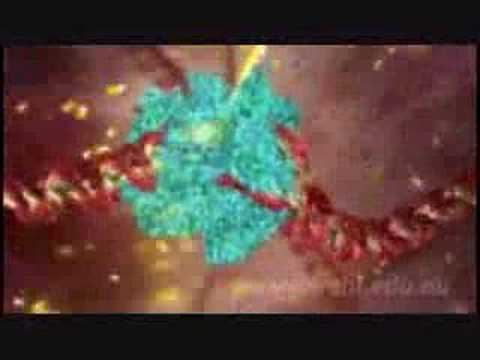
[1:45]Using computer animation based on molecular research, we are now able to see how DNA is actually copied in living cells. You are looking at an assembly line of amazing miniature biochemical machines that are pulling apart the DNA double helix and cranking out a copy of each strand. The DNA to be copied enters the production line from bottom left. The whirling blue molecular machine is called helicase. It spins the DNA as fast as a jet engine as it unwinds the double helix into two strands. One strand is copied continuously and can be seen spooling off to the right. Things are not so simple for the other strand, because it must be copied backwards. It is drawn out repeatedly in loops and copied one section at a time. The end result is two new DNA molecules.
[2:57]What you are about to see is DNA's most extraordinary secret. How a simple code is turned into flesh and blood. It begins with a bundle of factors assembling at the start of a gene. A gene is simply a length of DNA instruction stretching away to the left. The assembled factors trigger the first phase of the process, reading off the information that will be needed to make the protein. Everything is ready to roll. 3, 2, 1, go. The blue molecule racing along the DNA is reading the gene. It's unzipping the double helix and copying one of the two strands. The yellow chain snaking out of the top is a copy of the genetic message, and it's made of a close chemical cousin of DNA, called RNA. The building blocks to make the RNA enter through an intake hole. They are matched to the DNA, letter by letter, to copy the A's, C's, T's, and G's of the gene. The only difference is that in the RNA copy, the letter T is replaced with a closely related building block known as U.
[4:37]You are watching this process, called transcription, in real time. It's happening right now in almost every cell in your body.
[4:52]When the RNA copy is complete, it snakes out into the outer part of the cell. Then, in a dazzling display of choreography, all the components of a molecular machine lock together around the RNA to form a miniature factory called a ribosome. It translates the genetic information in the RNA into a string of amino acids that will become a protein. Special transfer molecules, the green triangles, bring each amino acid to the ribosome. The amino acids are the small red tips attached to the transfer molecules. There are different transfer molecules for each of the 20 amino acids. Each transfer molecule carries a three-letter code that is matched with the RNA in the machine. Now we come to the heart of the process. Inside the ribosome, the RNA is pulled through like a tape. The code for each amino acid is read off, three letters at a time, and matched to three corresponding letters on the transfer molecules. When the right transfer molecule plugs in, the amino acid it carries is added to the growing protein chain. Again, you are watching this in real time. And after a few seconds, the assembled protein starts to emerge from the ribosome. Ribosomes can make any kind of protein. It just depends what genetic message you feed in on the RNA. In this case, the end product is hemoglobin. The cells in our bone marrow churn out 100 trillion molecules of it per second. And as a result, our muscles, brain, and all the vital organs in our body receive the oxygen they need.
[7:07]that a single base change has occurred in the genetic instructions for hemoglobin.
[7:22]Instead of coding for glutamic acid, the DNA now codes for valine.
[7:38]The replacement of just one amino acid in hemoglobin's structure means that the molecules stick together and deform the red blood cells.