[0:00]What's the role of money, of finance, of our international trade system and especially how does it link to what we are seeing in Iran? There is universal demands for US dollars because that's the currency in which oil is traded. That this means the US can print money and purchase real goods from the rest of the world effectively for free. That, of course, uh, you know, Iran and any other sovereign seeking movements in in West Asia rejects this arrangement. They want to be able to sell their their oil and other resources in whatever currency they choose. But this is a very serious threat to to to US imperial privilege.
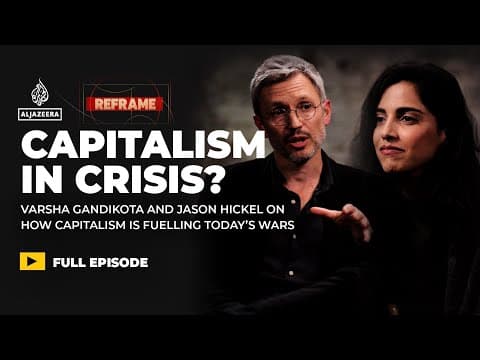
[0:43]With Donald Trump and Benjamin Netanyahu partnering in wars across the Middle East. Could the root cause of today's conflicts lie in capitalism itself? And are these wars in fact the continuation of centuries of colonialism and economic policies that favor the interests of the richest and most powerful nations. I'm Varsha Gandikota-Nellutla. I lead the Progressive International, and I also serve as the Executive Secretary for the Hague Group. A forum for governments coordinating legal and diplomatic action for Palestine. This week on Reframe, I'll be speaking to Jason Hickel, a political economist and prominent critic of capitalist imperialism. Author of two books, Less is More, and The Divide. He explores what it would mean, politically and economically, to redistribute the world's wealth and save the planet. Jason, welcome to Al Jazeera Reframe. Thanks very much. Nice to be with you. I want to begin by asking, in the first few months of 2026, the United States government has kidnapped Venezuelan president Nicolas Maduro, blockaded Cuba from receiving a single drop of oil, threatened to invade Greenland, proposed luxury towers to be built on the rubble of Gaza, and now began a catastrophic war in Iran. To most people watching this looks like utter chaos. Some might argue it's a sudden, dramatic escalation of imperialist violence. How do you see it? What's actually happening? Now, I think that the key thing to understand is that this is not just like random violence. Uh, it appears to be chaotic, but I think we have to understand the, you know, the key structural determinants that drive this kind of expression of violence. And, and to me, this it's very clear. This comes this is an expression of particular dimensions of the capitalist world system, right? Now, the thing about capitalism is that it's always been structured as a world economy, uh, with uh, with capital accumulation and growth and consumption in the core states, what we call the West or the Global North, uh, relying very heavily on on cheap nature, cheap resources and cheap labor from the global South on a really massive scale. I mean, billions of tons of materials and hundreds of billions of hours of human labor and trillions of dollars of value net appropriated from the global South each year. And this has been going on for for uh, for the entire history of capitalism, 500 years. But what about West Asia, particularly? For me it plays geographically the role of being the center of the world, connecting Europe to Asia, the North to the South. What role does it play in this kind of structural explanation of the core being threatened by the periphery as you say? Yeah, so the crucial thing I think to understand is the fact that um, is that the, uh, the imperial core has to intervene constantly in the global South to maintain subordination among global South states. Why is West Asia so important in the world system? It's as you said, literally it's the center of the world at the hinge of Asia and Africa and Europe. Um, where 25% of, you know, of, uh, of sea traded oil goes through the straight of Hormuz and 25% of, uh, of container shipping goes through the Red Sea. I mean, this is a it's a crucial node in the world system. And if we imagine a scenario where West Asia is liberated and has democratic control over their own resources and their own production and can sell their own oil outside the US dollar and can determine control over their own trade routes and can uh, can produce and consume for themselves, right? I mean, imagine this is fundamentally incompatible with the interests of US capital. And so, for our entire lives, they've, I mean since the middle of the 20th century, they've made every effort to intervene to shape the political uh, landscape of that region to prevent any real sovereign uh, development or any real liberation in in West Asia, and that's exactly what's happening today with uh, with Iran. I want to ask you about something else. I think most of our viewers watching this would not be surprised about the people of the global South being punished for liberation attempts. We've certainly seen it throughout history, the violence that was meted out to anti-colonial uprisings, whether by the French Empire in Algeria, the British Empire in my country, in India, the Spanish Empire in Latin America. But I think the key difference is that we see these dynamics as things of the past, that we now live in a new post-colonial world order where nation states more or less are left alone, or that their sovereignty is respected. So how new or not new is this logic really? I mean, I think it's new for anyone who hasn't been paying attention, but if you, but for people that pay attention to history at all, I think it's very clear this is a continuation of a very long-standing, standing pattern. So in the middle of the 20th century, there was an extraordinary uh, you know, resurgence of anti-colonial, uh, um, movements in the global South that succeeded in overthrowing their colonial occupiers. And went about setting up, uh, you know, sovereign, uh, states, uh, you know, building economic sovereignty. This is a profound threat to capital accumulation in, uh, in the West. And they went about intervening immediately, uh, in the mid-20th century to destroy these movements. So we saw, for example, uh, you know, with, uh, Patrice Lumumba, who set about to nationalize his country's mineral resources for the benefit of the Congolese people. He was deposed, he was assassinated in a in a coup backed by the US and Belgium. His body cut up and burned and burned in a in a barrel. Um, or take Sukarno, uh, the first independent president of Indonesia, who was deposed in a US-backed coup in 1967. replaced with a brutal dictator, um, backed by the US who went on to to murder more than 1 million people who were the who were his political opponents. We saw the same thing with the US invasion of Vietnam, uh, and the, uh, you know, the obliteration of North Korea in the middle of the 20th century. uh, the invasions and regime change operations against, you know, Iraq and Libya and Syria. Every time there's a state that exhibits any kind of sovereign seeking potential, uh, seeks to break out of, you know, US-led global supply chains. There's this kind of uh, intervention. Yeah, so it's not just punishment for political independence, which I think majority of the world understands, but punishment for economic independence. We're seeing that now, in fact, Zambia, in this very moment as a leaked report to the New York Times says, the United States is leveraging the HIV AIDS funding to the Zambian health authorities in order to ensure that they submit to a deal that gives the United States access to copper. And Zambia is one of the largest copper producing nations in the world and this is a source of great frustration for the United States, because that market currently is mainly accessed by China. But I want to ask you about this logic of punishment. It's not just the global South states, is it? It's really even to their own friends if they threaten this logic. Yeah, it's interesting. Um, so, I mean, in terms of the, you know, what the US does to other Western states is quite is quite enlightening, I think. The past half century or more is full of examples of the US intervening in in in elections in European states to prevent the rise of socialist or other or communist or other left-wing parties to power, right? Uh, this is very clear in the case of Greece, of in the case of Italy. I mean, there was even there were plans for US invasion of of Portuguese territory, you know, you know, in the case of a communist government coming to power in Portugal. We have to remember there was a time when uh, when socialism was a very popular idea and there's an extraordinary attempt to prevent that because the US needs Western Europe to be aligned with its with its broader imperial project, uh, not because it wants allies as such, but because it wants to use Western Europe as effectively a bridgehead to West Asia, right? Or and to the rest of Asia. And so the US requires, you know, access to the territories of of Western Europe in order to establish military bases and, uh, and project power. And this is effectively actually what NATO was about, in fact. Um, you know, we have this idea that NATO is some kind of defensive alliance for the West, but it doesn't function that way in in decades now. Uh, so I think we have to understand very clearly, you know, what these institutions are actually for. But why is the US able to do this? Sorry to sound naive, but we of course know that the United States is the largest military power in the world. But all of its assaults aren't purely militaristic. All of its assaults aren't purely through NATO. So what's the role of money, of finance, of our international trade system and especially how does it link to what we are seeing in Iran at the moment as we're speaking? I think one of the key elements is, of course, the petrodollar. Uh, and so, if you think about the, I mean, the the crazy imperial privilege that the US uh, you know, achieves from the fact that there is universal demands for US dollars because that's the currency in which oil is traded. And everybody needs oil, everyone needs energy, right? Um, and so there's there's perpetual demand for the US dollar. What this means is that the US can effectively, can effectively print money and purchase real goods from the rest of the world effectively for free. Basically, the the agreement is, you know, you all have to sell your oil in US dollars, um, and we're going to establish US military bases in your territory, which will protect you. Of course, this turns out to be a complete lie, as, uh, as we've been seeing, uh, in the current conflagration. Uh, but what's interesting is that, of course, uh, you know, Iran and any other sovereign seeking movement in in West Asia, uh, rejects this arrangement. They want to be able to sell their their oil and other resources in whatever currency they choose without being forced to to sell in the US dollar. Um, but this is a very serious threat to to to US imperial privilege. Uh, I mean, it would dramatically reduce effectively the purchasing power of the United States and the rest of the world's products, uh, you know, slowing down growth and capital accumulation in the US. There's of course also the Swift system, which is the international banking system that's uh, that governs all, almost all transactions in international trade. The US has a tremendous amount of power in the Swift over the Swift system. And any country that the US, you know, wants to harm or crush or punish, for any reason whatsoever, um, it can effectively sanction them and remove them from Swift, making it very difficult for them to conduct transactions. And this is exactly what they've done to Iran. It's what they've also done to Russia. I think this highlights the urgent need that we have for global South countries to begin developing their own alternatives. We need a more democratic payment system run by and for global South states. Uh, we need, uh, oil and other commodities to be able to be traded outside of the US and other core currencies. This is crucial for the sovereignty of global South countries. I don't know if you believe that there are any exceptions to this, if the US ever steps back. My experience of dealing with this is through the COVID-19 pandemic. Where, of course, countries like Cuba couldn't access materials like syringes to give out vaccines and doses for their own population. Countries like Venezuela and Iran were requesting a temporary waiver on sanctions, not even for them to be rolled back, but just for the moment, for the duration of the pandemic, so they could buy medicines in the market, which the World Health Organization also referred to as adding to an already strained system. And yet the United States refused. So how bloodless are these non-militaristic wars really for the people in these sanctioned countries? The way that the US tries to portray it is that sanctions are some some kind of alternative to war, like some kind of soft power, right? Like we're not going to invade you, we're not going to destroy you, but, uh, we're going to, we're going to punish you lightly with economic sanctions. This is, this couldn't be further from the truth. There was a study published recently, um, in the Lancet Global Health that found that since 1971, uh, unilateral sanctions imposed by the US and the European Union, on global South countries, have killed 38 million people in the global South. Uh, that's over half a million people every year. This is the defining elements of warfare, uh, in the modern world economy, because this is absolutely crucial to the success of Western capitalism. Uh, and I, and if you when you, when you begin to consider the, the scale of the violence and damage that is inflicted as a result of this system, then it becomes clear that it's it's not something that we can continue to accept. Well, let's talk about what's happening in the US itself. All of this is unfolding against the revelations of the Epstein files. Even as we, you know, struggle to reckon with the incredible harm that's been meted out to the survivors of sexual assault, another darker picture comes into view. That of a small group of global elites seemingly operating with complete impunity. What does that tell you about how power really operates in this system? I mean, I think that the the revelations in the Epstein files happening exactly the same time as the genocide against Palestine, I think is very, very telling because this is the effectively the the transatlantic ruling class, um, who are willing to inflict absolutely extraordinary violence against, uh, children, right? Who they've basically trafficked for sex, um, in elite circles. The very same people are the ones who inflicted extraordinary genocidal violence against the people of Palestine. They're the same people who have been covertly bombing Iran. And so I think it's it's quite striking to realize like the like the depravity of the transatlantic ruling classes. But the other key element of the Epstein Files revelations is simply that, um, it it does, it gives us a picture of this elite that's, uh, that makes decisions in completely unaccountable ways. Like there's no democratic transparency or accountability to the decisions that they're making. They make them entirely in their own interests. They don't care about the working class whatsoever. I mean, they they demonstrate their willingness to absolutely abuse people. This should be a wake-up call to realize that, uh, you know, we say we say we live in these political democratic systems, but fundamentally, they're deeply corrupt. Uh, and what we need is a real democratic system that can actually, uh, use democracy to subordinate the interests of the current ruling class because they're destructive to us and to our societies. Uh, and something fundamentally different is required. Yes. Incredible to watch, uh, Joe Kent, who's a former head of the counterterrorism intelligence unit of the United States, quit his job announcing just this that in fact Iran did not pose any credible military threat to the United States, but that it was Israel that made the case for the strikes to begin. I mean, anyone who thinks that Iran posed a legitimate threat, like wanted to attack the USA, the territory of the United States or Europe, is this is absolutely crazy. Why would Iran want to do that? Uh, and and the idea that that Iran or other global South countries pose some kind of military threats to the West. I mean, this is is complete propaganda. Take Iran's military budget. It is 0.5% that of the United States. 0.5%. Uh, and that's the only the US, forget its NATO allies. Uh, or look at China. I mean, China is one that they're always talking about major, you know, military threat to the USA. Again, China's, uh, military spending per capita is below the global average. Uh, so, I mean, the the real threats to peace and stability in the world are the imperial powers who have massive overdeveloped military capacity, uh, with the capacity to inflict their will anywhere on the planet. These are the people, uh, that are responsible for for chaos and instability in our world. At the beginning of March, P. Tet sits the US Defense Secretary, criticized Iran for their military spending. He came out to say the Iranian people are upset with their government for spending all their money on missiles and launchers as opposed to spending it on healthcare and education. And I find this incredible for, because there are two ironies in there, right? One, of course, as you say, the United States is the largest defense spender in the world. But in addition, exactly, as you're saying, it's the global South countries that are constantly under threat and being pushed into more and more of a security state logic, forcing being forced to arm and defend themselves with greater and greater military budgets. But let's bring it back to the global North. Based on what you're telling us today, it seems that some of the most advanced economies of the world are, in fact, the greatest autocracies, not necessarily in the political sphere where we get to vote, but in the economic sphere where we don't. What does this mean for the quality of life for the people living in these countries in the global North? Yeah, I think this is an important one. So, uh, when people think of capitalism, they often think of things like markets and businesses and trade, right? But this is not what capitalism is. These things existed for thousands of years before capitalism, and they've taken many different forms. So what is capitalism is it's when production in the economy is controlled by a small faction of the society. So the richest 1%, the large commercial banks, the large corporations, etc., who get to determine, this is capital, right? Get to determine the direction of production, what gets produced and so on. And the result is that we get really perverse forms of production. We get massive investments of production in production of things like SUVs and fast fashion and uh, you know, cruise ships and, uh, you know, the military-industrial complex. Uh, which are highly profitable to to capital. Uh, but we get chronic underproduction of obviously necessary things like, you know, affordable housing, uh, renewable energy, uh, you know, agro-ecological food production, etcetera, etcetera. Um, you know, things that we obviously need for our well-being are actually underproduced. And so the result is that we have this crazy system where we have, uh, you know, overproduction to the point of blowing past planetary boundaries, causing ecological crisis on a world scale, and yet we have mass human deprivation at the same time. Even in the core states in in the US and and Europe, there's actually substantial human deprivation. I was just reading recently that over 100 million people in the imperial core are food insecure. They cannot access something as basic as stable, secure access to food. Think about this. Can we really say we live in a democracy when we will go to the streets to to denounce these wars that are being conducted by our ruling classes, and they just don't care? They just keep doing it, right? There's no accountability. I think that has to be this really has to be like a reckoning for people, right? If the opposite of capitalism is for you genuine economic democracy, is there anywhere in the world that you see this happening where people actually determine what their government spends their money on? That capital is being redirected towards social good, not towards profit, but for what people actually need, like you say, food and healthcare. I think there's lots of interesting examples of this. So, if we talk about economic democracy, this is when when production is organized around around, uh, you know, meeting human needs. For example, in China. China has very robust industrial policy, uh, including a very robust public finance system. And this means that China can organize investment and production around achieving the kinds of development that are necessary for the national development plans. Uh, they're the leading producer of renewable technologies and also installer of renewable capacity. Um, they also undertook a targeted poverty alleviation campaign which lifted, you know, hundreds of millions of people out of out of poverty. Um, in a fairly short period of time as a result of targeted policy around around this objective. But China's a bit of an exception in the current day system, isn't it? The scale and the size of the country which does give it much more autonomy than some of the smaller countries that we're talking about, which do find themselves subordinated in the global South system. Do, do we still have any way out? Well, another interesting example is Cuba, I think, which is which is worth talking about now. You know, I think that we have to recognize the gains that Cuba has been able to achieve, uh, by being able to direct what resources it does have towards social objectives. with, uh, efforts to organize production around human needs, they've been able to achieve really really astonishing social outcomes even so. But look, I think that that's that ultimately, liberation for the South is going to have to be more than just, um, you know, individual countries doing what they can in terms of domestic policy. I think it is going to require coordination and collaboration across global South states. Let's talk about that. I mean, you've talked earlier about essentially the labor of the global South, the labor of the developing countries of the world being the engine that produces everything in the world today. Let's flip that on its head. What would it take for the people of the global South to actually coordinate collectively and really halt this machine? 90% of the labor that powers the world economy and international trade is performed in the global South. 90% of the world's resources are in the territories of the global South. Uh, the world economy depends fundamentally on the lands and labor of of the global South. And so, you know, with a realization of the potential political power that lies in in South-South cooperation and integration, uh, there's extraordinary things that can be achieved. This was attempted with the formation of the New International Economic Order, which was passed in the Halls of the UN General Assembly in the early 1970s. Which was an attempt by global South states to say, look, we have a right to economic sovereignty and to cooperate in our own interests, and we and we will do so. This was, of course, uh, deeply threatening to the interests of capital in the core states, and they, uh, sought to and succeeded in effectively crushing the principles of the NIIO. Today, there's actually an effort, um, by many in the global South to kind of revive the principles of the NIIO, uh, through South-South cooperation. Um, and we see this also, I think, to some extent in the form of the Hague group as well. Um, and I know you've been involved with both the new NIIO and the Hague Group, and I'd be interested in hearing your reflections on this. I think it's really interesting that you bring up the New International Economic Order because the general myth around, which of course has died, it no longer exists, and like you say, there are now new attempts to revive it. But the often repeated refrain is that it was bound to die, not that it died due to specific historical reasons. As you say, it was killed, in fact, with many of its leaders assassinated at that time precisely to prevent this from coming about. Um, and that often slides into perhaps racist phenomenon, which is essentially they say, oh, these African-Asian countries, they could never possibly get along and actually work together. And as for the Hague Group, I think there's something even more powerful at the core of it. The Hague Group is a coalition of countries that work together to essentially, uh, perform state action, legal and diplomatic to uphold international law. But they're saying something else, which is we will not use our land and our labor. We will not allow our arms to go through ports. We will not allow our factories to produce, you know, these weapons that then kill Palestinians. You talked about the Strait of Hormuz and the petrodollar and West Asia being the central node of the world. Something extraordinary has happened in March of this year, which is Iran, like you said, announcing to the world that it will allow safe passage, but only if countries buy its oil in Chinese yuan in the Remenbi, as opposed to the United States dollar.
[23:07]Do you see this as a kind of circuit breaking moment, will it mark a before and after in its week? I think this is a major historical development. Um, I think around is effectively announced to the world that we understand, uh, you know, how this current world economy works. We understand the key choke points, um, and we want something different. There's that, but also furthermore, uh, the very fact that one of Iran's, uh, objectives and their demands is the removal of US military bases from West Asia. Because I mean, right now, there are over 800 US military bases around the world that the US uses to police, uh, um, any country that seeks any kind of departure from US economic interests or geopolitical interests. There any other country that comes close to that number of military bases around the world? Not even close. I I think that China, you know, China is an is an enormous country. Uh, 1.4 billion people has one foreign military base. Uh, I mean, it's just it's uh, I mean, this is imperial power. And I think that's, you know, for every person that watched the the the genocide live stream through their phones, this is a realization they've had in their hearts that this cannot go on. It's fundamentally against humanity. There is no humanity, and we must build it. We must build a reality where all are treated equally, where all have equal rights under international law. And that reality does not exist right now, and it will not exist as long as we have this arrangement of geopolitical power in the world. And it's precisely that that must be overcome before we can realize our potential as as humanity. Jason Hickel, thank you so much for joining us today, and it's been a pleasure having you in Al Jazeera Reframe.