[0:00]My agency runs hundreds of tests after each Google update. And the businesses that fix these eight things right now, are getting cited by AI, paying less for every click and showing up everywhere their competitors are disappearing. I'm Neil Patel, I'm the co-founder of NP Digital, which just won performance marketing Agency of the year by Ad Age. And in this video, I'm going to show you exactly what change, what is affecting both your SEO, your ad costs, and the step-by-step fixes to get ahead of it. Step one, make your website fast. But first, I need to tell you why this matters more than ever. Because Google just changed something big. For 25 years, Google treated your website as a one-way for organic search and completely different way for ads. Two separate systems. Your SEO people did their thing and your ad people did their thing. That separation is no longer viable. Nikki Lam, she's our VP of SEO at NP Digital, put it best. She said the biggest lever for improving your PMax and AI Max performance and ROAS is not a budget tweak; it's strategic website optimization guided by your SEO team. Because Google's AI now relies heavily on your website to create ads, determine relevance, and choose landing pages. Your website isn't just where people land anymore. It's the source material that Google's AI pulls from to run your campaigns. And the very first thing that AI evaluates, whether your site actually works. Google's smart bidding uses your conversion rate as one of its most important signals. If your page takes four or five seconds to load, people bounce before they convert. The AI sees that low conversion rate and it's less likely to spend budget sending people to that page. And here's the bigger picture. A fast clean landing page can improve your conversion rate, which helps both your organic visibility and your ad efficiency. A slow page hurts both. So here's what you do. Go to Google page speed insights, it's free. Test your top landing pages, fix the slow ones. One fix, two systems benefit. Now, most people stop here. They fix the speed and they think they're done. But speed is just where Google's AI can get to your website. Step two, is about what it finds when it gets there. Step two, clean up words on your website. Because Google's AI is pulling from your headlines to help build your ads. PMax takes the text on your website, your headlines, your title tags, your descriptions and uses that as a source of material to generate ad copy. AI Max does something similar with its text customization feature dynamically writing ads based on what's on your pages. So, whatever your homepage headline says right now, Google's AI might be using that to create ads for your business. If your headline is vague, our solutions or welcome to our website, the AI has bad raw material to work with, and it builds ads that nobody wants to click. But you still pay for their impressions. The mistake, writing title tags for search spots instead of humans. Keyword stuffing, vague, zero conversion intent. The fix is simple. Go through your most important pages and ask one question. If this headline showed up as a Google ad, would someone click it? If the answer is no, rewrite it. Make it specific. Make it about what you actually do for people and why they should care. Your website copy is now source material for your ad copy. Every headline matters. But words are only part of what the AI pulls from your site. It also grabs your images and videos. If you don't have good ones, you might not like what it creates instead. Step three, add real images and videos to your key pages. Here's why. PMax needs video assets to run effectively across YouTube, Display, and Discover. If you don't provide them, the system can auto-generate low-quality videos to fill the gap, and those run with your brand name attached. Same thing happens with images. No good photos on your landing pages, the AI works with whatever it finds, stock images, random graphics, whatever's there. The fix? You don't need fancy production. Get a clean, well-lit 15 to 30 second video on your pages. Use real photos, your product, your team, your results, not stock. That gets PMax quality material to work across every channel. And it future-proofs your site for multimodal search, where Google can show video results directly in AI-powered answers. Now, if you sell products online, the next step is huge for your shopping ads. If you don't, skip it to step five. Step four, this is for anyone selling products online. Your product feed, the data you sent to Google Merchant Center about what you sell, is the foundation of shopping ads within PMax. Rich data drastically improves ad relevance and quality score. And most brands are only filling out half the fields. The fix? Add everything, brand name, color, size, materials. The more detail you give Google about each product, the better it can match the right product to the right buyer, including hyper-specific long-tail searches. Thin product data means the AI has less to work with, and that shows up in your results. Now, here's where the playbook shifts. Step one through four fixes what's broken. Step five through eight builds real competitive advantages. The gap between businesses doing one versus the other is where the money is. Now, if you don't have time to implement any of these steps, or you just want help with a few of them, check out my ad agency NP Digital, where we help companies grow. And we've done so well that we were named performance marketing agency of the year by Ad Age because of the results we're driving to our clients. Step five, help Google's AI understand what your website actually does. Right now, Google's AI is reading your site to try to figure out what each page is about. But without the right signals, it's making its best guess. And when it guesses wrong, it can show the wrong page in results or build less relevant ads. There's a way to give it much clearer signals. It's called schema markup. Think of it as labels you add behind the scenes that tells Google exactly what is on each page. When you add these labels, something valuable happens. Google can use that data to generate richer ad extensions. Things like star rating, pricing info and FAQ answers that show up right in your ad. Those extras can boost your click-through rates, which means more clicks for the same budget. The fix, ask your developer on your SEO team to add schema markup to your top five conversion pages. Now, everything up to this point helps make your website visible and understandable to Google's AI. The next two steps are what helps build trust. And trust is where the real separation happens. Step six, stop creating a bunch of small pages on similar topics. Instead, build one deep page that covers everything. Here's what happens at a lot of businesses. They create 20 or 30 separate blog posts on slightly different versions of the same topic. Best CRMs for small businesses, Best CRMs for startups, Best CRMs for sales teams. All different pages. That used to be the move. But now, Google's AI has a harder time figuring out which page to best match for a given search. Especially when PMax uses URL expansion to choose where to send your paid traffic. If it can't identify a clear winner, it might pick the wrong page or a weaker one. The fix, take your most important topic and build one deep comprehensive page. Cover every angle, organize it with clear sections and a table of contents. Make it the definitive source. When Google's AI sees a strong pillar page, it's more likely to map broad search intent to the right landing page in organic and in your ad campaigns. One strong page tends to outperform 15 scattered ones. And for AI Max, deep topical content helps the system expands your reach into complex conversational searches that don't match any specific keyword. Those are some of the fastest growing query types right now. Build depth in a topic and both systems can reward you. But there's a level above topical depth, and it's the hardest thing for competitors to copy. Step seven, show Google and your customers that real people trust you. Google doesn't just read content. It looks to see whether your site demonstrates genuine expertise, experience, and trustworthiness. They call this EAT. And it influences how Google's system evaluates the quality of your content. Think about it from Google's perspective. If the AI is going to use your website as a source material for ads or feature it in search results, it wants to know your credible just like a person would. The more of these signals your site has, the more Google systems can work in your favor. The article from our team found that these trust signals help build what they call implicit brand trust signals, the kind that can lead to higher ad quality and better conversions over time. The mistake that most people make, they try to shortcut this with spammy backlinks from whatever domain will link to them. That's the old game. The new game is real credibility, real reviews, real expertise, real people behind the content. You can't fake it. But most of your competitors haven't even started building it yet. That's the window. One more step, and the last one turns all seven fixes into a system that gets better every single month. Step eight, get your SEO team and your paid team in the same room. Every step in this video works on its own, but there's one thing that makes all of them compound, and almost no marketing teams do it. Here's a problem. Most companies have their SEO team looking at one set of data and their ad team looking at a completely different set. They never compare notes. They never share what they're learning. But Google's AI treats your entire website as one system. It doesn't know your teams are separate, it doesn't care. The fix, once a month get both teams together. Look at what searches are driving paid conversions. Then have your SEO team build content around those topics. Those pages feed back into the ad system as stronger landing pages. Costs can go down, results can go up, and the cycle repeats. At the same time, your SEO team can spot irrelevant searches that are wasting ad budget, flagging them for the paid team. Exclude them, budget saved immediately. This is how you turn eight one-time fixes into a self-improving machine. The website gets better, the ads get more efficient, the data feeds back, and the whole thing accelerates. That's a new playbook. Eight fixes, one system, and it works for your organic and paid. If you want to see how Google's AI mode is changing the entire search landscape, watch this video next.
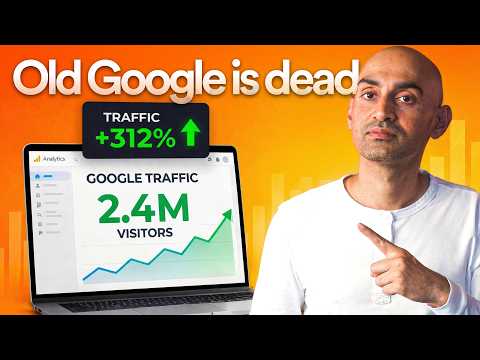
The New Google Playbook: 8 Things You Must Fix Right Now
Neil Patel
11m 24s1,869 words~10 min read
YouTube auto captions
Transcript source
YouTube auto captions
This transcript was extracted from YouTube's auto-generated caption track. The transcript below is server-rendered so it can be read, searched, cited, and shared without opening the original YouTube player.
Pull quotes
[0:00]And the businesses that fix these eight things right now, are getting cited by AI, paying less for every click and showing up everywhere their competitors are disappearing.
[0:00]I'm Neil Patel, I'm the co-founder of NP Digital, which just won performance marketing Agency of the year by Ad Age.
[0:00]And in this video, I'm going to show you exactly what change, what is affecting both your SEO, your ad costs, and the step-by-step fixes to get ahead of it.
[0:00]For 25 years, Google treated your website as a one-way for organic search and completely different way for ads.
Use this transcript
Related transcript hubs
Watch on YouTube
Share
MORE TRANSCRIPTS


