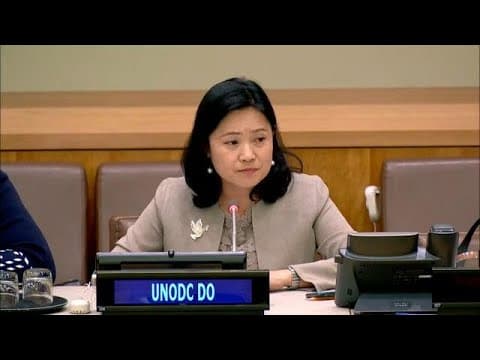
[0:00]And now it is my pleasure to give the floor to my friend Dr. Miwa Kato, UNODC's Director for Operations, who will deliver opening remarks.
[0:11]Dr. Kato oversees field-based technical assistance and policy advice across the globe in over 70 countries and before her current assignment, she served as UN Women's Regional Director for Asia Pacific and before that as UN Women's Country Director for Egypt.
[0:27]Her service with UN Women followed 12 years of work with UNODC in various capacities including working on Afghanistan counter narcotics operations.
[0:35]Miwa, so nice to have you with us here today. You have the floor.
[0:39]Thank you very much, Simone. Excellencies, distinguished delegates, ladies and gentlemen.
[0:48]A very warm welcome to the launch of the 2019 World Drug Report. It is a great honor for me to be with you here today, where we talk about the latest key findings of the state of illicit drugs facing humanity, as we commemorate also the International Day against Drug Abuse and illicit trafficking.
[1:10]Illicit drugs and its trade are the single largest source of organized crime groups funding around the world, and in many country context, the scale of funding is such that it has the ability to negatively influence development of the whole society.
[1:29]Harmful impact of illicit drugs and other associated criminality is a common concern to all of us, not only because it creates tremendous human suffering to the individuals and their families and communities, but also because it arrests healthy and sustainable development and causes instability and security challenges, bringing people's lives into a chain of misery.
[1:58]The findings of contained in the report that's being presented today, provides a detailed picture of global drug challenges.
[2:08]This year, we're very grateful that the availability of new drug-related data from two highly populated countries, namely India and Nigeria, has very much sharpened our regional and global estimates for which UNODC is very grateful.
[2:27]According to new estimates, some 35 million people in the world suffer from drug use disorders and require urgent services.
[2:37]Drug use has caused some 585,000 death in 2017.
[2:49]That's more than half a million mostly young men and women. More than half of these deaths are attributed to untreated hepatitis C among people who use drugs.
[2:59]Gaps in terms of prevention and treatment, therefore, are an important dimension of the challenges we face.
[3:07]Drug associated disorders are particularly prevalent in prison settings.
[3:13]Those incarcerated face higher risk of HIV and hepatitis C transmission, yet they are severely underserved by treatment programs.
[3:26]In 2017, North America saw the number of overdose death resulting from the use of opioids rise by some 14%.
[3:37]I am sure I do not have to emphasize to the audience here the grave impact of this phenomena to the whole society.
[3:47]Being here with you today in the US, where 47,600 people died from opium overdoses in 2017, accounting for 68% of total overdose death.
[4:05]Meanwhile, what has been called the other opioid crisis is affecting Africa, especially West, Central and North Africa.
[4:15]This is attributed to Tramadol, which has been used as a painkiller for decades and to this day remains outside international control.
[4:26]New data that you will be seeing today, suggests that the misuse of Tramadol represents an even greater problem than we previously believed.
[4:36]In many country context, therefore, there is an urgent requirement for new approaches to containing this particular problem.
[4:45]The trafficking of synthetic opioids has also been expanding in Europe and elsewhere.
[4:52]While just four countries reported fentanyl seizures to UNODC in 2013, this time, 16 countries did so in 2017.
[5:03]On the other hand, there is a very different kind of opioid crisis, experienced by majority of the world population, lacking access to legitimate pain relief medication.
[5:17]Therefore, as much as we need to act on the opioid crisis as discussed in US type context, the removing barriers which limit the availability and accessibility of controlled drugs for their medical use around the world is another urgent priority.
[5:35]Needless to say, such increased accessibility needs to be accompanied by action combating the diversion of prescription drugs for non-medical use.
[5:46]And it is true that many countries struggle to create such capacity.
[5:52]But this should not be a reason that more than 80% of the world population lack access to legitimate pain medication.
[6:03]Global opium and cocaine production have remained high. At the same time, both opiate and cocaine seizures have increased to record levels in 2017.
[6:16]Growing at a pace even faster than opium and cocaine production over the last decade.
[6:24]This indicates that greater effectiveness of law enforcement efforts are in place in many parts of the world.
[6:31]Strengthened international cooperation helps to increase interception rates.
[6:38]For example, for this year's world drug report, it is evident that a decline in opiate trafficking from Afghanistan along the northern route through Central Asia to Russia is highlighted.
[6:54]While in 2008, so over a decade ago, some 10% of global interceptions of morphine and heroin produced in Afghanistan was made in the countries along the northern route, by 2017, this number was brought down to mere 1%.
[7:15]And beyond seizures per se, coordination among national, regional and international institutions should aim to further strengthen law enforcement capacities in order to effectively dismantle drug trafficking organizations and transnational organized criminal groups.
[7:35]Joint responses are also crucial to address linkages between terrorist and criminal networks, and to counter terrorist groups engaging directly or benefiting indirectly from criminal activities including drug trafficking.
[7:54]International efforts to counter the growth of the new psychoactive substances or NPS, have also shown effectiveness.
[8:05]NPS are a particularly insidious threat given the fluidity of the particular market.
[8:13]At the global level, the UNODC early warning warning advisory on NPS monitors new substances, helps keep countries up to date on new developments, and provides a platform for information sharing.
[8:30]The international community, through the Commission on Narcotic Drugs, has moved quickly in recent years to act upon such warnings and address emerging threats.
[8:40]At its session in March this year, the CND put a number of additional new substances under international control.
[8:50]At the same March session of the CND and its high level, segment, it reaffirmed its commitment to a balanced rights-based action to counter the world drug problem, based on international drug control conventions.
[9:07]The ministerial declaration adopted by the CND states, and I quote, We commit to safeguarding our future and ensuring that no one affected by the world drug problem is left behind.
[9:20]UNODC supports countries in implementing this approach.
[9:25]We provide tailored technical assistance through our field offices and global programs and through toolkits and research that all contributes to reducing the problem.
[9:37]We also work with partners to develop and help implement international standards on prevention, on and treatment of drug use disorders and HIV, as well as standards and norms on the administration of justice and treatment of prisoners.
[9:54]But to tackle the world's drug problem, we need a much more comprehensive, and the whole of UN system approach to help protect people of the world, denounce and disassociate with illicit drugs.
[10:11]UN reform spirit, especially in the field implementation setting, is opening many new doors to orient us to this direction.
[10:21]And we appeal to member states and partners to join hands in this effort.
[10:28]Ladies and gentlemen, for the world to truly advance balanced, health and rights-based approaches to drug supply and demand, reduction, in full compliance with international conventions, and thus move forward towards achieving the sustainable development goals.
[10:46]Fair, humane and efficient criminal justice institutions are an essential part of the equation.
[10:53]The UN family has increased its focus on justice and the rule of law issues, especially around SDG 16.
[11:03]Ahead of the high level political forum held here next month, and also uh in the context of international community gearing up for the SDG summit in September, as well as possible other venues such as the UN Crime Congress to be held next April in Kyoto, Japan.
[11:25]Health and justice need to work hand in hand to effectively address the world drug problem and be on track towards achieving all the things we talk about under the sustainable development goals.
[11:38]That is also why we have selected the theme of today's International Day against Drug Abuse and illicit drug trafficking to highlight the linkage between health and justice.
[11:51]In its recommendations, the report puts forward a range of actions which include scaling up evidence-based prevention and treatment interventions related to drug use, HIV and hepatitis C.
[12:04]They also include improving access to prevention and treatment services in prison populations, which suffer from a much higher rate of drug use disorders and infectious disease.
[12:17]Effective solutions can also involve promoting alternatives to incarceration, in line with the conventions, by providing people with drug use disorders, who have committed minor drug-related offenses with the option of voluntarily entering drug treatment services.
[12:36]In so many countries, prisons are filled with many such prisoners or detainees awaiting trial for minor drug-related charges.
[12:45]Governments and people around the world have choices to make about this angle, and more discussion on this topic would be highly encouraged.
[12:55]In fact, drug abuse and other harmful behaviors, as well as radicalization, in prison settings are of growing concern in many countries.
[13:06]And this is the reason why we will also be spotlighting this particular angle of prisons in a dedicated high-level dialogue held this afternoon, on the need for prevention of radicalization in violence to violence in prisons, which is hosted by Norway, Belgium, Burkina Faso and Indonesia from 3 p.m. today at the Norwegian Mission.
[13:30]I hope many of you can join us.
[13:34]Finally, there is a continuing and persistent need to improve data and analysis, given the evolving complexity of global challenges linked to drugs.
[13:46]Sustainable and impartial research enables our understanding of the problems we face and help inform policy decisions.
[13:55]So that we can accelerate concrete action on the ground necessary to protect people of the world from illicit drugs and associated criminality.
[14:06]This is an essential dimension of the balanced, integrated, comprehensive, multidisciplinary and scientific evidence-based approach to the world drug problem for which the CND's ministerial declaration has called.
[14:23]I hope the findings presented today and the discussion it generates will contribute to our further collaborative thinking and action.
[14:33]Thank you once again for your interest in this very important topic, and allow me please to now give the floor to my colleague Chloe Carpenter, UNODC's Chief of Research Section, who will elaborate on the key findings of the World Drug Report 2019.
[14:49]Thank you.


