[0:10]In unit two, we will familiarize ourselves with the principles of academic writing. This unit is divided into five sections. Section one, the language of science.
[0:29]At the beginning, let us try to define the language of science. There are several means to state information within a research paper. Language, symbols, formulas, figures and sometimes pictures. The language used to present a research project is academic language. Academic language has to follow comprehensively and generally defined rules of formality and structure. It differs widely from non-academic language, which is characterized by undefined or inconsistently defined levels of formality. Do not use non-academic language in academic writing.
[1:22]Section two, examples of non-academic language.
[1:30]Non-academic language with its different levels of formality occurs in many different areas. Common speech, jargon is a special language used by a special group, printed or e-correspondence, journalism in its various forms, advertising, bureaucracy, the non-fictional literature that is not academic, and of course fictional literature. A young language is the so-called space limited language that has developed along with the use of electronic media, respectively the transmission of electronic messages. It is characterized by reduced, condensed and coded elements. Obviously, it is the non-academic language that is predominant and spoken and printed communication. That is why we have to put special emphasis on identifying and mastering scientific language.
[2:35]Section three, academic and literary writing.
[2:43]A good way to define academic writing is to differentiate it from its counterpart literary writing by analyzing the characteristics of the different writing styles. What is academic writing? What is literary writing? Let us have a look at the main differences. A good criterion for recognizing and applying academic writing is to follow the scientific principles. Remember, the scientific principles are accuracy, completeness, clarity, comparability and materiality. Accordingly, the academically written content of a research project is always comprehensible, clear, complete, and stringent. In distinct contrast, literary written content may provide surprising, unexpected information, may allow individual interpretations, may be redundant due to stylistic reasons, and may even end without a final result or conclusion. Whereas an academic perspective has to be objective and factual, dealing with real life phenomena, the author of a literary piece writes from a subjective and imaginative perspective, about subject matters that are either real, fictional or a mix of both. A research project has to be accurately documented and based on traceable sources. Whereas literary writing does not state its source of information and inspiration, or at least not in a systematic way. Likewise, literary writing is characterized by a total freedom in writing style, text structure and sometimes grammar. Whereas in the contrary, academic writing should strictly observe the rules and norms of scientific structuring and language. Consequently, the academic piece is characterized by a pure, unadorned and formal language, whereas literary writing can use every kind of language, metaphorical descriptions and expressions, colloquial speech, et cetera. Please note, there are of course research-based publications that address a broad public beyond the research community. These are typically presented in a mix of academic and literary writing. This approach is called popular science and considered inappropriate in scientific work.
[5:23]Section four, academic writing styles.
[5:30]As explained, the criteria of academic writing can be sharply distinguished from those of literary writing. However, within the area of academic writing, the writing style or mode of expression that is common and expected, may differ across different academic disciplines, if either a more concise, factual tone or a more expansive, lively tone is appropriate, may sometimes depend on the approach, be it quantitative or qualitative,
[6:02]and it may depend on the conventions of the broad academic disciplines, reaching from natural sciences, engineering sciences to humanities. Generally, regarding writing styles, the area of business and social sciences can be placed somewhere in between. A good way to familiarize yourself with the appropriate writing style in your field of study is reading high quality journal publications. While doing so, pay attention not only to the thematic focus of the articles, but also to the structure and length of sentences, the choice of words and the article's general tonality.
[6:48]Section five, principles of accuracy and clarity.
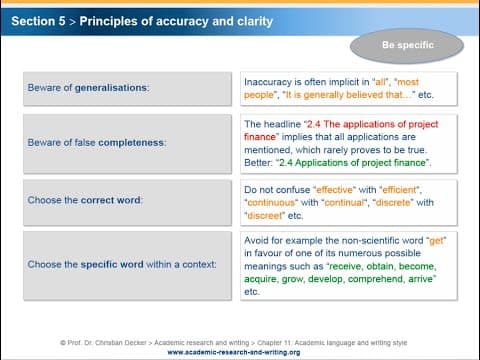
[6:58]Above all, it is the principles of accuracy and clarity that should guide your scientific writing. Apart from obvious writing mistakes that might be rarely made by students and researchers, there are rules that seem less obvious, but lead to inaccuracy and lack of clarity when disregarded. Some of these rules can be bundled under the imperative, be specific. A typical source of inaccuracy is making generalizations. Because of the implicit inaccuracy, be careful with generalizing words and statements such as all, most people, it is generally believed that, and so on. A frequently made mistake is creating false completeness by using the definite article and headlines. Example, if you write the applications of project finance, it implies that all applications are mentioned, which will probably not be the case. Therefore, omit the article. The better headline is, Applications of project finance. Similar sounding words often have a different meaning, make sure to choose the correct word. Here are some examples. Do not confuse the adjectives effective and efficient, continuous and continual, as well as discrete and discrete.
[8:33]Accurate clear writing also means using the full range of vocabulary and choosing the specific, most suitable word within a context. For instance, avoid the unspecific word get, which is considered inappropriate style in formal English. Replace it with one of its numerous possible synonyms, such as receive, obtain, become, acquire, grow, develop, comprehend, arrive, et cetera, depending on the context.
[9:10]Another general rule in favor of accurate and comprehensible writing is, omit the needless. Double negatives, for example, turn arguments into unnecessarily complicated sentences such as, it is not clear if there is no change. It is advisable to avoid negative sentences wherever possible, since positive sentences are generally more comprehensible. The use of unnecessary foreign words as well as unexplained jargon is considered inappropriate in academic writing. Just two examples. Better use keen supporter instead of a foreign word like aficionado. The wording spreads have decreased should be preferred to the jargon expression spreads have tightened. While writing or proofreading your text, check carefully whether there are any redundancies in structure, argumentation and wording. Avoid unnecessary repetition in any form.
[10:16]However, repetition of words is sometimes appropriate or even necessary. For example, the repetition of keywords is used to generate cohesion within the text. Furthermore, certain words have to be repeated if the use of synonyms does not make sense, or would even be misleading. This applies especially to names of persons, organizations, geographic locations and so on. More information on repetition is given in Unit 3, Section 2. Enhance the quality of your writing by avoiding hidden redundancies, such as pleonasms and tautologies. A pleonasm is an expression in which the additional word is implicit, as in plan forward, first introduction, repeat again. Tautology means saying the same word in other words. Examples are forever and ever, or daily exercise every day. Writing is not about piling up numerous words. In the contrary, needless words pollute your writing. Therefore, identify and omit needless words in your text. With a sharpened eye you will find surprisingly many words that are simply superfluous. A good start to purify your text is to omit filling adverbs such as now, somehow, no doubt, and so on.
[11:55]An additional prerequisite for accurate and clear writing is the careful handling of adjectives. Beware of the general rule that numerous adjectives should be omitted. Adjectives are often superfluous, since they do not provide additional information. Therefore, adjectives always deserve special attention during your writing or proofreading. A typical source of inaccuracy are adjectives of a measuring nature. Measuring adjectives, such as weak, strong, good, poor, big, small, etc and their degrees, weaker, weakest, stronger, strongest, better, best, etc are vague. They imply a judgment that has to be proved by adding a reference.
[12:42]Exaggerating adjectives and expressions such as huge, incredible, et cetera are not only vague, but also considered poor style in academic writing. A further rule regarding the proper handling of adjectives is recognizing whether they are incomparable. A non-gradable or incomparable adjective describes an attribute that cannot be graded or compared. This is obvious in adjectives such as pregnant, dead, empty, full, et cetera. Other incomparable adjectives are not as easily identified. Here is a range of examples.
[13:27]Never write very unique, totally perfect, completely false, too ineffective, straighter, more vertical, most independent, less general. All these adjectives are often absolute nature and must not be combined with a grading adverb. Accordingly, whenever you apply a grading adverb, such as very, rather, too, totally, more, less, and so on, examine carefully if the following adjective can be meaningfully graded or compared.
[14:11]Academic writing should not contain statements of a subjective nature. Accordingly, avoid personalized writing, and the use of words related to the first person such as I, we, myself, me, us, my, mine, I, personally, our, ours. As well as words related to the second person, such as you, your, yours, yourself, including you as a generic pronoun. From time to time you will find academics who favor the use of personalized writing. However, you should keep in mind that a pure and traditional academic writing style avoids personalized writing in order to appear as objective as possible. Be sure to avoid biased language and stereotypes by stating unqualified opinions such as Germans are and so forth. Additionally, it is advisable to avoid humor and cynicism in academic writing. Of course, humor, especially if derogatory, and cynicism are considered inappropriate in academic writing.
[15:39]In accordance to maintaining an objective perspective, a scientific author should apply a factual tonality. Absolutely avoid colloquial language in all its manifestations. For example, avoid contractions such as it isn't, he doesn't, et cetera. Furthermore, do not write incomplete sentences. Each sentence must include a verb. Exceptions are titles, captions, and figure descriptions. Figurative language, for example, metaphors and analogies, is a sophisticated way of writing, however, not always considered appropriate in academic writing. Therefore, be careful with adopting or creating metaphors and analogies in your texts. Figurative language is definitely inappropriate when consisting of overused cliches such as the expression, this hits the nail on the head. Exceptionally, metaphors, expressions in the figurative sense, or plays of words may be applied in titles, for example, EEG, Blowing in the wind. In favor of a factual tone, do not address your reader directly. Accordingly, do not formulate chapter headlines or sentences within the main body as questions. Example, if your chapter describes the definition of project finance, the chapter headline should not be a question such as, what is the definition of project finance? It should be remarked that from time to time you will find headlines in academic writing, which are posed as questions. This is especially true for academic textbooks and working papers. Nevertheless, you should keep in mind that a substantial part of the recipients will consider this inappropriate.
[17:44]If you want to write down your thinking in a comprehensible way, focus on clear phrasing. Above all, avoid long and complicated sentences that disturb the intersubjective comprehensibility and might even require repeated reading. Therefore, try to balance your text. A paragraph should consist of a mix of short main clauses including subject and verb and somewhat longer sentences with additionally one or two subordinate clauses at the most. Whenever possible, avoid sentences in the passive voice. Typically, active sentences are shorter and less complicated. Example, the active wording popper explained that should be preferred to the passive, it was explained by popper. However, using a passive construction is a reliable way of avoiding personal style and formulations in the first person.