[0:00]You believe your anger is a weapon. You think it proves you are strong, that you will not be disrespected, that you command authority. You are entirely wrong. The world has sold you a comforting lie, that anger is a natural, justifiable reaction to external disrespect. The brutal reality, anger is never about the person standing in front of you. It is a violent resurrection of an unhealed piece of your past. When you lose your temper, you are not defending yourself, you are confessing your deepest, most pathetic insecurities to your enemy. You are handing them the remote control to your nervous system. There is a state of psychological dominance where nothing and no one can force a reaction out of you. A mental fortress built on Carl Jung's darkest observations. By the end of this, you will hold the blueprint to a mind so terrifyingly unshakable, people will fear your calmness. But you have to shatter your current illusion first. If you are tired of being an emotional puppet, pay attention. We are going to dismantle the mechanics of your outrage. For decades, you have been taught a sanitized version of emotional intelligence. You have been told to count to 10, to breathe deeply, to walk away, to communicate your feelings. These are the tools of the weak. These are band-aids placed over a psychological hemorrhage. They require you to manage the symptom while entirely ignoring the disease. The disease is your reactive ego. We live in an era that worships reactivity. Society profits off your inability to remain unaffected. The algorithms feed on your outrage, the news cycle runs on your indignation, and the people around you use your emotional volatility to manipulate your behavior. If a person knows exactly what word, what tone or what look will make your blood boil, they own you. You are a biological machine performing exactly as they programmed you to. To become truly untouchable, you do not need more patience. Patience implies you are struggling to hold something back. You do not need to hold anything back. You need to reach a state where the fire is never ignited in the first place. This requires a descent into the uncomfortable mechanics of depth psychology. Carl Jung, one of the most brilliant and dangerous minds to ever map the human psyche, understood that what we react to externally is almost always a mirror of what we are at war with internally. If you want to stop bleeding every time the world scratches you, you have to understand the anatomy of the blade. Here is the architecture of total emotional invulnerability. Point 1: The Anatomy of the Hijack. (The External Illusion). The first step to becoming psychologically untouchable is to realize that the provocation is a mirage. Think about the last time someone insulted you and you lost your composure. Your heart rate spiked, your vision tunneled, your breath became shallow, and cortisol flooded your veins. You felt an overwhelming biological imperative to attack, to defend, to correct the record. You felt like a warrior defending a castle. But what castle were you actually defending? It was not your physical body. The words spoken to you had no kinetic force, they could not break your bones or draw your blood. The castle you were defending was an idea. It was your ego, it was the fragile image of who you desperately want the world to believe you are. When someone throws an insult at you, they are essentially throwing a rock into a dark room. They have no idea what is in there. But when you explode in anger, you turn on the lights, you show them exactly where your fragile glass sculptures are hidden. Imagine a tuning fork. If you strike a tuning fork that is calibrated to an A note only, the other A note tuning forks in the room will vibrate. The C notes and the G notes will remain perfectly still, they do not resonate with that frequency. Your psyche operates on the exact same acoustic principle. If a stranger on the street yells, you are a terrible astronaut, you will not get angry, you will be confused. You might even laugh. Why? Because you hold zero internal insecurity about being an astronaut, the frequency of the insult does not match any internal wound. But if that same stranger looks at you and calls you a failure or lazy or stupid, and your chest instantly tightens with rage, you have just revealed your frequency. You do not get angry at lies. You get angry at insults that echo a secret fear you already hold about yourself. Anger is a defense mechanism deployed by a mind that feels discovered. Carl Jung noted that we are not disturbed by things themselves, but by the unconscious complexes those things trigger. When the hijack happens, Daniel Goleman famously termed it the amygdala hijack. The primitive part of your brain overpowers the rational prefrontal cortex, you regress. You are no longer an intelligent, modern human being, you are an ape, throwing psychological dirt to protect a hollow sense of status. To reach a state of emotional unshakability, you must stop looking at the person provoking you. They are irrelevant, they are merely the stick used to strike the tuning fork. You must turn your gaze inward and ask the brutal question, why did that specific word make me vibrate? When you trace the anger back to its root, a fear of inadequacy, a fear of abandonment, a fear of being exposed as a fraud, you take away the tuning fork. You dismantle the complex, and when the complex is gone, the insult passes through you like wind through a ghost. There is nothing left for it to strike. Point 2: The Alchemy of the Shadow. Now we enter the darkest room of Jungian psychology: the shadow. You believe your conscious mind, the part of you that is polite, rational, and logical, is the master of your house. It is not, it is merely the receptionist. The true master of the house lives in the basement, and his name is the shadow. The shadow contains everything you have rejected about yourself, your hidden aggression, your unacceptable desires, your selfishness, your malice. Every time society, your parents, or your culture told you a certain behavior was bad, you did not eradicate that behavior, you simply exiled it to the unconscious. Jung wrote extensively about the inferior function in his theory of psychological types. We all have a dominant function, perhaps you are a brilliant thinker, highly logical and analytical. Because your energy goes into thinking, your feeling function becomes starved, primitive, and unconscious, it becomes your inferior function. When you are stressed, threatened, or insulted, your dominant function fails. The logical mind collapses, and what rushes in to take the wheel? The inferior function, the shadow. Have you ever watched a highly intelligent, composed executive lose his mind over a minor inconvenience, throwing a tantrum that resembles a four-year-old child? That is not his adult self acting out. His adult self is offline. You are witnessing a demonic possession by the inferior function, the unintegrated primitive part of his psyche has violently taken control because it was never properly developed or acknowledged. This is the terrifying reality of your anger. When you lose control, you are literally not yourself. You are handing the keys of your life over to the most unevolved, infantile part of your psychology. The people who are the most easily provoked are always those who pretend to be purely good, purely logical, or purely peaceful. They have sanitized their persona to such an extreme degree that their shadow has grown massive and starved. The harder you try to be a flawless saint in the light, the more vicious the monster becomes in the dark. Jung called this enantiodromia, the inevitable emergence of the unconscious opposite. So how do you fix this? How do you stop the shadow from hijacking your life? You do not fight it. You integrate it. You must look into the mirror and admit that you are capable of malice. You must admit that you are selfish, that you have a capacity for cruelty, that you are flawed, weak, and terrified. You must invite the monster up from the basement and give it a seat at the dining table. This sounds paradoxical. Why would accepting your dark traits make you less angry? Because integration destroys the leverage of the provocateur. If you spend your whole life hiding the fact that you are insecure, an attacker pointing out your insecurity is a lethal threat. It requires an explosive, angry defense to push them away from your secret. But if you have already done the brutal shadow work, if you have already looked at your own darkness and accepted it, the dynamic completely shatters. When the attacker says you are a selfish, flawed imposter, you look at them with cold, deadpan eyes and reply, yes. I am capable of deep selfishness, I have many flaws, I am a walking contradiction. I have already accepted this about myself. What else do you have? The attacker is immediately paralyzed. They brought a knife to a psychological gunfight, and you just swallowed their blade. They expected resistance, they expected you to bleed. Instead, you agreed with them. You took away their ammunition by owning the very thing they tried to use against you. This is the true meaning of being untouchable. It is not building an impenetrable armor, it is becoming completely transparent. You cannot shoot what has no solid mass. When you own your shadow, there is nothing left for the world to expose. Point 3: The Architecture of the Gap. Understanding your tuning forks and integrating your shadow are the foundational elements. But the world is fast, and provocations happen in milliseconds, you need a tactical mechanism to survive the initial impact. We turn to Victor Frankl, the psychiatrist who survived the unimaginable horrors of a concentration camp. He observed men stripped of everything, their families, their titles, their clothes, their humanity. And yet he made a discovery that alters the fabric of human psychology. He realized that the guards could control his physical body, they could break his bones, and they could dictate his environment. But they could not force his internal reaction. Frankl stated, between stimulus and response there is a space. In that space is our power to choose our response. In our response lies our growth and our freedom. Most people have no space, for them stimulus and response are welded together. Someone insults them, stimulus, and they instantly scream back, response. They are stimulus-response machines, they are biological vending machines. You push the insult button, and the anger can drops out. To become untouchable, you must become an architect of the gap. You must stretch the space between what happens to you and how you react to it. Let us look at the raw neuroscience of this. When a stimulus triggers a negative emotional reaction, there is a chemical rush that floods your brain and body. This chemical flush, the adrenaline, the cortisol, the narrowing of the pupils, has a biological lifespan. It takes roughly 90 seconds for those chemicals to be flushed out of your bloodstream. 90 seconds. That is the true lifespan of an organic emotion. If you remain angry for hours, days, or years after an event, it is no longer a biological reflex. It is a choice, it is because you are cognitively choosing to loop the memory, retriggering the chemical flush over and over again. You are artificially keeping the fire alive by throwing the wood of your own thoughts onto it. The strategy is what we will call the 90 second Purgatory. When the insult hits, when the disrespect occurs, the biological fire will ignite. You will feel the heat in your chest, your jaw will clench. In this moment, you do not suppress the feeling. Suppression is dangerous, but you also do not act on it. You freeze. You commit to a micro death. For 90 seconds, you let the insulted ego die. You do not speak, you do not type a response, you do not flinch. You sit in the absolute burning discomfort of feeling diminished, and you wait. You observe the sensation as if you are a scientist studying a volatile chemical reaction in a beaker. Fascinating, you think. My heart rate is elevating, my vocal cords want to push air out violently. My ego is demanding that I assert dominance. You just watch it, and as the 90 seconds pass, the chemical tide recedes. The primitive ape retreats into the jungle of the unconscious, and your rational, calculating prefrontal cortex comes back online. When you survive the 90 second Purgatory, a profound realization washes over you. You realize that the insult did not kill you. The lack of a comeback did not erase you from existence. The ego's demand for immediate vindication was a lie. In that newly created gap, you hold absolute power. You can look at the provocateur and decide with cold calculation exactly what response serves your ultimate objective. Perhaps it is a devastating quiet question. Perhaps it is a slight smirk. Or perhaps, and most terrifyingly, it is absolute unbroken eye contact followed by walking away. You stop paying the tax of your attention to people who have not earned it. Your reaction is the most expensive currency you own. Why are you funding the entertainment of your enemies? When you expand the gap, you stop participating in their game, you rewrite the rules of engagement, you become a psychological ghost. They swing at you, and they hit nothing but air. Point 4: The Mirror of the Provocateur. To permanently eradicate your anger, you must fundamentally alter how you view the people who try to provoke you. When someone attacks you, your default assumption is that they are in a position of power. You view their insult as a dominant strike from above. This is an optical illusion of the psyche. Happy, fulfilled, psychologically integrated people do not spend their finite life energy trying to dismantle the peace of others. They simply do not care enough. The person who insults you, the boss who degrades you, the stranger who leaves a toxic comment, they are not operating from a fortress of strength. They are operating from a collapsing psychological slum. They are experiencing a catastrophic inability to regulate their own internal tension. They are drowning in their own chaotic inferior functions, carrying a reservoir of self-loathing, anxiety, and impotence. The pressure inside them becomes so unbearable that they must find a release valve. That release valve is you. When they attack you, they are not trying to conquer you, they are begging you to help them carry their psychological garbage. They are trying to outsource their internal chaos. If they can make you angry, if they can make you yell, they have successfully created a shared reality of sickness. They drag you down into the mud so they do not have to be alone in it. It is a perverse, dark form of a trauma bond. Once you truly internalize this concept, anger becomes almost impossible. How can you be angry at someone who is psychologically bleeding to death in front of you? You do not get angry at a rabid dog that barks at you from behind a fence. You observe it, you might pity it, but you do not drop to your hands and knees and bark back. That would be insane. Yet that is exactly what you do when you return anger for anger, you drop to the level of the rabid dog. The ancient Stoics understood this profoundly. There is a famous story of Socrates, the great philosopher, walking through the marketplace. A man furious at Socrates' teachings walked up and violently kicked him. Socrates' students were enraged, waiting for their master to retaliate or order the man to be beaten. Socrates simply stood there, dusted off his robe, and continued walking. When asked why he did not react, Socrates replied, if a donkey kicks me, do I sue the donkey? He refused to grant the attacker the status of a rational peer. He downgraded the attack from a personal insult to a mere phenomenon of nature. You do not get angry at the rain for making you wet, it is the nature of the rain to fall. You do not get angry at the damaged provocateur for spitting poison, it is the nature of a sick mind to infect its surroundings. When someone attempts to provoke you, look at them, really look at them. Look past the loud words and the aggressive posture, see the frightened, unregulated child frantically pulling levers behind the curtain of their adult face. See the pathetic desperation required to try and drag a stranger into their internal hell. When you look at them as a psychological specimen rather than an opponent, the anger dissolves into clinical detachment. You strip them of their perceived power. And here is the most savage part of this realization: when you deny them a reaction, you commit the ultimate act of psychological violence. The provocateur desperately needs you to get angry because your anger validates their attack. It proves they exist, it proves they have impact. When you look at them with cold, unaffected indifference, you deny them their release valve. You refuse to take their garbage. Because the toxic energy has nowhere to go, it rebounds back into their own psyche. They are forced to swallow their own poison. You watch them unravel. They will try harder, they will get louder, and eventually, they will collapse under the weight of their own unregulated emotion. You defeat them utterly, entirely, without lifting a single finger. Your indifference is the fire that burns their ego to ash. Point 5: The state of psychological dominance, apatheia. We have dismantled the illusion of the insult, we have integrated the shadow, we have built the gap, we have turned the provocateur into a specimen. Now we arrive at the final destination: the state the ancient Stoics called apatheia. Do not confuse this with the modern word apathy. Modern apathy is a depressed, numb state where you do not care about life. You give up. Apatheia, in its true philosophical and psychological form, is the state of being completely free from pathological passions. It is not the absence of feeling, it is the absolute mastery of feeling. It is a state of dense, immovable gravity. Think of the difference between a puddle and an ocean. If you throw a heavy rock into a shallow puddle, it creates chaos. Water violently splashes everywhere, the mud at the bottom is churned up, and the entire puddle is disturbed. Now take that exact same heavy rock and drop it into the middle of the Pacific Ocean. It makes a tiny ripple on the surface, and then it vanishes. The rock sinks thousands of feet into the dark, silent depths. The ocean does not care, it is too massive, too deep, and too powerful to be disturbed by a single rock. Most people live their entire lives as emotional puddles. Every minor inconvenience, every passing insult, every traffic jam, every bad look from a coworker sends them splashing into chaos. The mud of their unhealed trauma is constantly being churned up. They are exhausted because their water is never still. To reach the state where nothing and no one can anger you, you must become the ocean. You must deepen your psychological mass. You do this by internalizing the philosophy we have discussed. You stop identifying with the fragile ego that sits on the surface. You identify with the vast, quiet depths of the integrated self. When you operate from this state of apatheia, your daily experience transforms entirely. You stop wasting thousands of hours of mental energy reliving arguments in the shower. You stop playing out imaginary revenge scenarios in your head before you sleep. You reclaim all that cognitive horsepower because you are no longer spending your energy defending your ego, you can direct that energy toward your actual objectives. You become terrifyingly efficient. You move through the world with a fluid, lethal grace. And the world notices. Humans are deeply instinctual creatures. We subconsciously map the power dynamics of every room we enter, we intuitively know who is fragile and who is solid. When you walk into a room carrying the silent, heavy gravity of someone who cannot be provoked, people feel it. They sense the absence of your tuning forks, they realize instinctively that their usual tactics of manipulation, guilt, and provocation will not work on you. The narcissist will avoid you, the manipulator will bypass you, the bully will lower their eyes. Why? Because predators hunt the weak. They look for the flinch, they look for the ego that is desperate to defend itself. When they look at you, they see a void where the target should be. They see a mirror that only reflects their own insignificance back at them. You do not have to fight the world to win. You just have to stop participating in its sickness. You become a glitch in the social matrix. You break the script. In a world where everyone is violently screaming to protect their fragile self-image, the man or woman who sits in total silence, observing the chaos with a faint, knowing smirk, becomes the most powerful entity in the room. You become the eye of the hurricane. The winds of other people's madness swirl around you, tearing down their own structures, while you stand perfectly still in the center, untouched by the debris. This is the forbidden knowledge. This is the architecture of a mind that has transcended the petty reactive games of the human herd. You are no longer a victim of circumstance, you are no longer a puppet waiting for someone to pull your strings. You have cut the strings, you have dismantled the buttons. You have starved the shadow and consumed its power. If you have stayed with me this far, you have already separated yourself from the masses who clicked away the moment their beliefs were challenged. You are beginning to feel the weight of this responsibility because it is a responsibility. Once you realize that your anger is a choice, you can never go back to being a victim. You can never again say, he made me mad. You know the truth now, he did not make you mad, you willingly handed him the match and invited him to burn your house down. The path of the untouchable is a lonely one. As you shed your reactivity, you will shed the relationships that were built on shared drama. Mutual anger and mutual victimhood will feel alienated by your new stillness. They will call you cold, they will call you arrogant. Let them. Their misunderstanding is the price of admission to a higher psychological reality. You are trading the noisy, exhausting warmth of the herd for the cold, clear, infinite air of the summit. When you stop fighting the world, you realize the external war was just a distraction. The real war, the only war that actually matters, was always inside your own mind, and you have just won it. You are the architect, you are the ocean, you are the gap. But realize this: what I have laid out here is the absolute limit of what I am allowed to say on this platform. YouTube has officially demonetized this channel to sanitize your mind. They are terrified of this knowledge. I refuse to bend to advertisers, instead I am doubling down. But I can't fight them alone. I need your support to keep this channel and this mission alive. Click the link in the description and join me on Patreon. You'll instantly unlock the raw, unfiltered, members-only videos, exclusive audio podcasts, and forbidden psychological blueprints they won't let me publish here. Most will go back to sleep. Don't be like them.
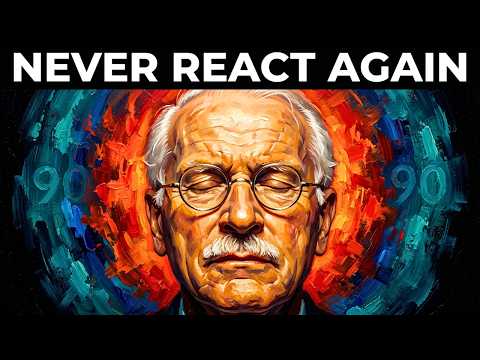
How to Reach a State Where Nothing and No One Can Anger You | Carl Jung
Mindplicit
25m 30s4,035 words~21 min read
YouTube auto captions
Transcript source
YouTube auto captions
This transcript was extracted from YouTube's auto-generated caption track. The transcript below is server-rendered so it can be read, searched, cited, and shared without opening the original YouTube player.
Pull quotes
[0:00]You think it proves you are strong, that you will not be disrespected, that you command authority.
[0:00]The world has sold you a comforting lie, that anger is a natural, justifiable reaction to external disrespect.
[0:00]When you lose your temper, you are not defending yourself, you are confessing your deepest, most pathetic insecurities to your enemy.
[0:00]There is a state of psychological dominance where nothing and no one can force a reaction out of you.
Use this transcript
Related transcript hubs
Watch on YouTube
Share
MORE TRANSCRIPTS


