[0:00]It takes thousands of hours to master all four competitive strokes: butterfly, backstroke, breaststroke, and freestyle. When swam all together, they're known as the individual medley, and they're a test of your speed, endurance, strength, and skill. And to be a true swimming master, you need to know how to swim every stroke. In this video, I'm going to show you how to swim every stroke with perfect technique. By the end of the video, you'll be able to go and crush, or at least attempt, every stroke like a pro. Let me know what your favorite stroke is down in the comments, and let's get into it. First, you've got to understand why you should know all the strokes in the first place. When you swim all four strokes, you challenge your muscles in different ways, and yes, you'll work every single muscle in your body. I don't think there's any other workout that's truly full body like swimming is. Swimmers who train every stroke end up building strong, resilient bodies that are less prone to injury. Plus, they just end up way more fit in general. That swimmer body is no joke. If you want one, keep watching. Swimming different strokes also helps keep things interesting. If you want to swim endless laps of freestyle without stopping, be my guest, but that's pretty boring. And before you say, well, I only race freestyle, so I don't need to know the other strokes. I hate to break it to you, but if you're ignoring the other strokes, you're doing yourself a huge disservice. Just trust me on this and think about adding other strokes to your workouts, okay? All right, now that we've gotten through why you should stop swimming freestyle all the time, I'm going to explain how to swim every stroke with absolutely perfect technique. Let's get the toughest stroke over with first, butterfly. I think I'm speaking for the majority of swimmers when I say that fly is not the most popular stroke at practice. It's challenging, it's tiring, and it's a great way to add some spice to your workouts. So what makes good butterfly? It comes down to proper timing and a powerful stroke. Let's start with your body position, and this applies to most strokes. You want your hips to be high in the water and your head to be in a neutral position. This creates the best baseline for your stroke to start with. Now let's look at the butterfly pull. You want your hands to move at the same time. They should enter the water relatively flat with minimal splash right in line with your shoulders. Then you'll start pulling, keeping your elbows nice and high the whole time. This is called early vertical forearm and it essentially turns your hand, wrist, and forearm into one giant paddle that can pull a ton of water. Try to pull straight back instead of using the old school S-pull. It's not as efficient. After finishing the underwater part of your pull, it's time for the out of water recovery. Sweep your arms out wide and return to your starting point. Keep your hands and arms relatively relaxed and close to the surface of the water. Next up is the kick. I see so many swimmers struggle to get their kick timing right in butterfly, so listen up. When you kick in butterfly, keep your legs together and toes pointed. To get the most out of your kick and create the best rhythm in your stroke, I recommend thinking about butterfly as having two key kicks. The first kick helps propel your arms out of the water during your recovery, and the second kick keeps you moving as your hands dive forward to start your pull. Focus on kicking both up and down here. A lot of swimmers focus only on the down kick, so engage those hamstrings and kick up too. Now, let's put it all together and add in breathing. To take a breath, lift your head up right after your catch. As your arms come forward, drop your head back down. Try not to lift your head too high when you breathe. Your chin should be just grazing the surface of the water. Lift just enough to grab a quick breath, then get your head back into that neutral position. I recommend picking a breathing pattern and sticking with it to make sure your body gets a steady flow of air and doesn't fatigue extra quickly. Try breathing every two or three strokes and see what works for you. All right, first stroke done. Before we move on, you should know, butterfly requires a baseline of strength that most beginners don't have. So if you're struggling with fly, just keep at it. Over time, you'll build strength and it'll get a little easier. For more butterfly tips, check out our video on five common butterfly mistakes and how to fix them. Next up is backstroke. It's the only stroke that requires you to be entirely on your back, which raises the question, how the heck are you supposed to swim straight? I promise we'll get to that, but first, let's build a perfect stroke. To start, make sure your body position is correct. Avoid looking at your toes. Keep that neck neutral and look at the sky. Your hips should float up close to the surface of the water. Think about keeping your belly button dry. The backstroke pull is a little different. Your arm will exit the water thumb first. As you lift your arm, rotate your body away from that lifted arm. Then, make sure your hand reenters the water pinky first and rotate toward that arm to reduce the drag your shoulders create. Pinky first is key. This hand position sets you up for a strong early vertical forearm catch. Backstroke kick is a flutter kick, just like freestyle. Don't kick too big here, the wider your kick, the more drag you create. Try to keep your kick no more than about 18 inches wide. Think small and fast instead of big and slow. Your kick should be driven from your hips rather than from your knees. Keep your toes pointed and your legs relatively straight with just a slight bend at the knee. If your knees are popping out of the water like crazy, you need to work on that knee bend. Now some notes on rotation. If you have a really strong kick, you'll probably be able to drive your backstroke rotation with your hips. If not, don't worry, try driving your rotation with your shoulders instead. But know this, whichever rotation philosophy works for you, make sure you don't over rotate. It's not about totally rotating from one side to the other, it's about reducing drag. Okay, one last thing. If you struggle to swim straight in backstroke, I recommend working on a few things. First, find something overhead to focus on, like a seam in the ceiling. If you swim outside, good luck. Try to find a cloud or something to keep you on track. Next up, make sure you're pulling with equal strength in both arms. An even pull will keep you going straight. And lastly, try to keep your head from moving too much. Maintaining a neutral head position will help keep the rest of your body in line too. All right, two down, two to go. Next up is breaststroke. This short axis stroke is all about timing and power. As with all other strokes, we'll begin with a nice streamlined body position. In breaststroke, every stroke starts and ends with a little time in streamline. The more quickly you can get back into streamline, the more efficient your stroke will be. So, high hips, head looking down, you know the drill by now. We can break breaststroke down into four steps: pull, breathe, kick, and glide. You want to build each stroke in that order. And now, let's get into the pull. From streamline position, you'll sweep your hands apart with the pinkies up. When your arms are just wider than shoulder width, start to pull back with that high elbow early vertical forearm catch. At this point, you'll lift your head to breathe. When you drop your head back down, your arms should explode forward. This is the slowest part of the stroke, so make sure to maximize your power here. Avoid diving down, that's not as efficient. Let's get into the kick now. Breaststroke has a unique, frog-like kick that can take some time to master. At its core though, breaststroke kick can be broken down into four steps: up, out, around, and together. First, pull your heels to your butt with your feet flexed. Then, start to kick out. Try to keep your knees no wider than your shoulders here. Next, you'll start to sweep your legs around, keeping those feet flexed. And finally, you'll squeeze your legs back together, ending up back in that streamlined position. Ideally, you'll kick as you drive your hands forward to boost your momentum before you glide. It takes some time to perfect your breaststroke timing, so keep working at it. One last thing on breaststroke before we move on, the pull out. You'll do a pull out after every start and turn before you begin your actual stroke. To do a pull out, push off the wall in streamline. Hold it for a few seconds until you feel yourself start to slow down. Then, do one dolphin kick, just one. Follow that with one big pull down with both arms at the same time. To get yourself up to the surface, do one breaststroke kick and bring your arms back up into streamline position, and you're ready to crush the competition. Woo, okay, now let's dive into freestyle or front crawl. Some of us learn freestyle first when we start swimming, and for good reason. Of all the competitive strokes, it's probably the easiest, but that doesn't mean it's easy. If you've watched this far, you know what's coming next. Good freestyle is going to start with proper body position. We want our hips to be high in the water and our head neutral. When the head is too high, the hips are more likely to drop and drag you down, and we don't want that. It might be helpful to think about pressing your chest down in the water to keep those hips higher too. When it comes to your freestyle pull, it's all about finding balance between relaxed and powerful. Your fingertips should enter the water about 18 inches in front of your shoulder, at a 45° angle, middle finger first. Try not to cross your arms along the center of your body here. It's inefficient and might cause you to zigzag around your lane a little bit. Follow up your hand entry with a long, reaching extension through your shoulder and arm. Once your shoulder is fully extended, your chest will open up to the side. Keep looking down. After your arm is fully extended, bend at the elbow and point your fingertips down toward the bottom of the pool and start to pull straight back. This is our early vertical forearm pull. It's much easier on your shoulders than pulling with a straight arm. Try to keep your elbows above your hand for most of the pull. Eventually, you'll extend your arm straight when your hand reaches your hips to start the recovery phase. Keep that elbow high during recovery too. One last thing on the pull. Don't squeeze your fingers together. Instead, keep them semi-relaxed with a few millimeters of space between them. This can actually increase the power of your pull. Like backstroke, freestyle requires some rotation. Instead of leading your rotation by twisting your shoulders, focus on engaging your core and initiating your rotation from the hips, and your shoulders will follow. Are you taking notes? I hope so. Now let's talk about breathing. In freestyle, you need to keep a neutral head position when you breathe. I see so many swimmers lifting their heads forward or twisting aggressively to either side, and that's just slowing them down. As you take a stroke, you'll notice your body rotating to one side. If you want to breathe, now's the time to turn your head to the opposite side to grab some air. Try to keep one eye in the water and one eye out of the water to maintain good alignment. Don't twist your head any further than that. Take a quick breath and get your head back into neutral for your next stroke. Exhale while your face is in the water and turn to take another breath when you're ready. Stick to a breathing pattern in freestyle so you don't deprive yourself of that precious, precious air. Breathing every two or three strokes works for most people usually. You can breathe on both sides or just one side, it's really up to you. Last but not least, we've got your freestyle kick. My one piece of advice is to keep your kick simple. You don't need to kick like crazy or try to have the biggest kick in the pool. Focus on a hip-driven kick that's small and fast. Try not to kick wider than about 18 inches and keep those knees from bending too much. Think of your kick as a tool to help you maintain proper body position and drive your rotation. Now, for some advice, chances are there's going to be one stroke that you struggle with. And I know, it's not fun working on things you aren't good at, but trust me, getting out of your comfort zone is actually a good thing and will make you a better swimmer. I didn't talk about turns at all in this video, but don't worry, check out our video about how to do a flip turn for tips for freestyle and backstroke and watch our video on breaststroke and butterfly turns to learn how to do an open turn. In my expert coach's opinion, I think you're ready to go try a 100 IM, or maybe even a 400 IM in your next workout. Give it a shot and let me know how it goes. And for even more technique work, plus custom daily swim workouts and training plans, download the MySwimPro app to start your very own personalized swimming journey. If you liked this video, you're going to love our video on how to swim without getting tired. Thanks for watching and happy swimming.
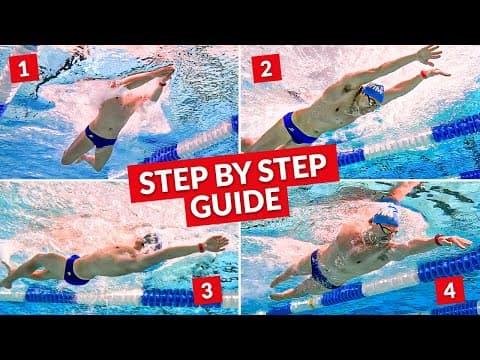
How to Swim All Four Strokes
MySwimPro
12m 9s2,444 words~13 min read
YouTube auto captions
Transcript source
YouTube auto captions
This transcript was extracted from YouTube's auto-generated caption track. The transcript below is server-rendered so it can be read, searched, cited, and shared without opening the original YouTube player.
Pull quotes
[0:00]It takes thousands of hours to master all four competitive strokes: butterfly, backstroke, breaststroke, and freestyle.
[0:00]When swam all together, they're known as the individual medley, and they're a test of your speed, endurance, strength, and skill.
[0:00]In this video, I'm going to show you how to swim every stroke with perfect technique.
[0:00]By the end of the video, you'll be able to go and crush, or at least attempt, every stroke like a pro.
Use this transcript
Related transcript hubs
Watch on YouTube
Share
MORE TRANSCRIPTS