[0:00]A three-dollar gallon of grocery store vinegar and common desert sand creates a structural material that outlasts modern concrete and matches the load-bearing strength of structural steel. In 24 hours, this mixture hardens into a solid block that resists hammer strikes and fire up to 2,200 degrees Fahrenheit. It possesses a compressive strength of 15,000 PSI five times stronger than the slab foundation under your house. This material actually gets stronger over a thousand years by pulling CO2 directly out of the atmosphere. The Geopolymer Institute confirmed this chemical cold-fusion process during their 1979 XRD analysis of ancient structures. Egyptian architects in 2630 BC and Roman engineers in 30 BC used this exact liquid-stone chemistry to build monuments that still stand while our bridges crumble in 40 years. A 380 billion dollar global cement industry decided you should forget this exists. You cannot patent sand or vinegar, and you cannot sell a subscription to a material that never needs replacing. This knowledge was buried to protect the recurring revenue of planned obsolescence. This is the untold story of the sand-vinegar trigger and the three industries terrified you'll watch this. Welcome to Forbidden Knowledge. We crack open the vaults the construction industry desperately locked shut. Every share preserves what they tried to erase. In 2021, Dr. Alex Brand at NASA's Marshall Space Flight Center proved that the most expensive part of construction is a lie. His team needed to build lunar habitats without transporting 40,000-pound kilns to the moon. They utilized acid-base geopolymerization, the exact chemical reaction triggered when you mix silica sand with a simple organic acid like vinegar. They didn't just study it, they cast structural bricks at room temperature using nothing but simulated moon dust and a liquid catalyst. The results were devastating to modern engineering standards. While your local sidewalk cracks at 3,000 PSI, NASA's cold-cast stone reached 15,000 PSI in under 28 days. That is a 400% increase in strength for zero energy cost. Stay with me because the math gets worse for the cement industry. A standard house slab costs $8,000 and lasts 50 years before the internal rebar rusts. This NASA-validated method costs $22 in raw materials and creates a monolithic block that chemically cannot rust. This $22 ancient solution outperformed the $8,000 commercial alternative in every durability metric. But this was not a new discovery, not if you know the true history of the desert. To find the origin, we must travel back to 2630 BC. The year is 2630 BC. The air on the Saqqara plateau is thick with the scent of natron and wet lime. Imhotep, the pharaoh's high priest and the world's first recorded architect is not overseeing a legion of stonemasons with copper chisels. Instead, he watches as workers pour a thick grayish slurry into wooden frames. This is the birth of the Great Pyramid. While modern textbooks claim 20,000 men dragged 2.5-ton blocks up impossible ramps for 20 years, the famine stela, a massive granite inscription on Sehel Island, records a different reality. It lists 29 specific minerals and a recipe for a divine stone made from crushed rock and liquid catalysts. Stay with me, because when Professor Joseph Davidovits examined these blocks under a scanning electron microscope in 1979, he didn't find the grain structure of natural limestone. He found microscopic air bubbles and synthetic fibers. These 70-ton monoliths weren't moved, they were cast in place. $0 in transport costs versus the impossible physics of a 20-year construction timeline. This liquid stone secret migrates north, crossing the Mediterranean as a survival necessity for the rising empires. The year is 30 BC. Roman engineer Vitruvius is frantically recording the secrets of Pozzolana, a volcanic ash from the slopes of Mount Vesuvius. He mixes it with lime and seawater. This isn't the Portland cement we use today that rots when the internal steel rebar rusts. This is Roman Maritime concrete. When the waves crash against a Roman pier, the seawater doesn't erode it. It triggers a chemical growth called aluminous tobermorite. The ocean actually makes the stone grow stronger over centuries. Today, 2,000 years later, the Roman Pantheon remains the largest unreinforced concrete dome on Earth. It has endured earthquakes and fires with zero structural failure. Your local highway bridge is lucky to last 40 years before it's declared a public hazard. $0 in maintenance over two millennia versus $1.2 trillion in global infrastructure repair costs. Now travel 7,000 miles across the Atlantic to the Bolivian Andes. The year is 500 AD. At the site of Pumapunku, workers are fitting H blocks together with such precision that a razor blade cannot fit between them. Mainstream archaeology insists these were carved from ultra-hard andesite using nothing but diorite hammers. But chemical analysis reveals the impossible truth. High concentrations of organic acids and microscopic plant fibers embedded deep within the rock matrix. These stones were geopolymers cast in molds, allowing for complex internal angles that are physically impossible to carve by hand. The same phenomenon appears in 600 AD deep in the Yucatán Jungle. The Maya are not importing cement, they are extracting sap from the chukum tree, a natural source of acetic acid, the same active ingredient in your $3 bottle of vinegar. They mix this organic acid with lime and sand to create a waterproof, glass-hard stucco. This material has survived 1,400 years of tropical humidity and root growth. Zero contact between the Maya and the Egyptians, zero messages sent across the ocean, same fundamental chemistry, same liquid stone result. For 3,000 years, billions of people across every major continent built the foundations of human history, using the dirt beneath their feet and the acids in their forests. They didn't live in a Stone Age of brute force, they lived in a polymer age of sophisticated chemistry. Stay with me, because what Joseph Davidovits discovered in the late 70s at the Geopolymer Institute was so devastating to the status quo that it had to be buried. What he stumbled upon next changes everything. In 1824, a bricklayer named Joseph Aspdin patented Portland Cement in Leeds, England. This pivot didn't happen because modern concrete was stronger. It happened because it could be bagged, branded, and controlled. Ancient liquid stone belongs to whoever owns the sand. It costs $0 in intellectual property and lasts 2,000 years. But Portland Cement created a $380 billion centralized industry that sells you a product designed to fail. Ancient stone, buy once, lasts millennia. Modern cement requires replacement every 40 years as internal steel rusts. It is a subscription model for the ground you walk on. Stay with me, because the science behind this is even more devastating. Stay with me now because what comes next is more devastating than the history we've already uncovered. We are about to analyze the molecular evidence that explains why a simple grocery store item is considered a direct threat to a billion-dollar global monopoly. But stay right here because this video just began. We are moving into the science reveal where the math reveals a truth they spent a century trying to hide. In 1979, Dr. Joseph Davidovits at the Geopolymer Institute revealed the molecular skeleton of what he called liquid stone. He discovered that when a leaching agent like the acetic acid found in a $3 bottle of vinegar interacts with silica-rich desert sand, it triggers a 3D polymerization. This isn't a simple drying process like mud, it's a molecular lock. The acid leaches out aluminum and silicon ions from the sand, which then re-link into a polysialate network. Stay with me because this is the same chemistry that powers the ultra-tough heat shields on space re-entry vehicles. It's like a two-part epoxy you'd buy at a hardware store, but instead of toxic resins, the reaction uses the mineral bonds of the earth itself. The science is devastating. Standard concrete relies on hydration, a weak physical bond that remains porous and absorbs water. Geopolymers create a covalent bond, a chemical fusion that is 400% denser and completely waterproof. The performance numbers tell the real story of the suppression. Standard Portland cement yields a compressive strength of 3,000 PSI. The sand-vinegar geopolymer easily reaches 15,000 PSI. That is the difference between a material that crumbles under a sledgehammer and one that shatters the tool. In 2022, peer-reviewed studies in the Journal of Cleaner Production confirmed these materials withstand 2,200 degrees Fahrenheit without losing structural integrity. Now, look at the math they desperately hope you never calculate. Maintaining a standard concrete driveway over 40 years costs approximately $12,000 in sealants, patches, and eventual replacement. The ancient sand-vinegar method costs $45 for the initial pour and $0 for the next 10 centuries. Read that again. $12,000 for a product designed to fail versus $45 for a stone that outlasts your bloodline. The EPA acknowledges geopolymerization as a green alternative that reduces CO2 emissions by 80%. Yet, it remains absent from every major building code. And then something very quiet happened. Almost nothing changed. The global cement industry generates $380 billion annually. Titans like Lafargeholcim and Heidelberg materials don't sell stone, they sell a replacement cycle. Imagine presenting a technology to their shareholders that requires zero factories, zero high-heat kilns, and lasts for 2,000 years. You cannot patent sand, you cannot patent vinegar. It has been in the ground and in nature for four billion years. To protect their profits, they didn't need to ban the science, they just needed to control the definitions. The first suppression mechanism is found in the ASTM standards. These rules legally define concrete exclusively as a mixture of Portland cement, water, and aggregate. If you use a geopolymer, it's not concrete in the eyes of the law. This means you cannot get a building permit, you cannot get insurance, and you cannot get a bank loan. They effectively made it illegal to build with the most durable material on Earth. The second mechanism is building code 318-19, which mandates carbon-heavy steel reinforcement. Modern concrete is porous, water seeps in, the steel rusts and expands, the structure destroys itself from the inside out, a process known as concrete cancer. Ancient geopolymers are chemically waterproof and don't require the very steel that causes modern bridges to fail. The paradox is staggering. The world is currently in a global sand crisis. We are literally running out of the jagged river sand required for Portland cement. Yet, the industry claims desert sand is worthless because it is too smooth for their failing product. They ignore the infinite supply of the Sahara because it works perfectly with the ancient vinegar-trigger. They didn't ban it, that would be too obvious. Instead, they buried it under a mountain of codes designed to keep you buying a product that was never meant to stay standing. If you've made it this far, you now know more about the molecular reality of the ground beneath your feet than 99% of professional engineers on Earth. Every share of this video preserves what they spent decades trying to erase from our schools and our construction codes. The full chemical activation charts are waiting in the Forbidden Knowledge Vault below. Now, stay with me. This next part is the knowledge they truly do not want you to hear. I need to be honest with you right here. This isn't a magic trick, it's a precise chemical balance. If you miss your pH window by just 0.5 points or the temperature drops below 50 degrees Fahrenheit during the first four hours of the reaction, the sand won't polymerize. It remains a useless pile of acidic sludge. Furthermore, the raw finish is naturally rough and grit-heavy, lacking the smooth, plastic-like sheen of commercial concrete. But that is exactly how the Romans handled it. They didn't demand aesthetic perfection, they demanded a 2,000-year lifespan. They used a simple $5 seal of olive oil and beeswax to waterproof the stone in a single afternoon. Here is exactly what to do starting now. Here is exactly what to do starting now. Source these three materials. One gallon of 6% distilled white vinegar, $3.50 at any grocery store. 100 pounds of silica sand, $0 from the desert or $5 at a quarry, and 2 pounds of sodium hydroxide, $12 in the hardware cleaning aisle. Total cost for this structural test is $15.50. Follow this five-step sequence. Step one, leach. Soak your sand in the vinegar for four hours to pull the mineral ions to the surface. Step two, catalyst. Mix the sodium hydroxide into the liquid until the pH hits a measured 12.5. This is your chemical trigger. Step three, combine. Mix the liquid into your dry sand until it hits a thick, heavy slurry consistency. Step four, cast. Pack the mixture into your wooden molds and vibrate the sides to remove air bubbles. Step five, cure. Wait 24 hours to demold and 28 days to reach full steel-strength. Stay with me because this isn't just theory. In 2023, a homesteader named Mark in the Arizona high desert cast a full foundation for a 1,200 square-foot cabin using this exact ratio. His total material cost was $450, bypassing an $18,000 commercial concrete quote. Six months later, a 5.2 magnitude tremor shook the region. Mark's foundation showed zero micro-fractures, while his neighbor's $18,000 standard concrete slab split in three places. You just built a structural monolith for $0.37 per cubic foot versus $125 per cubic yard for commercial delivery. You are now holding a material that doesn't just resist time, it laughs at it. The timeline of liquid stone is a straight line through human history. From 2630 BC in Saqqara to 30 BC in Rome, to 600 AD in the Yucatán and finally to 1979 at the Geopolymer Institute and 2021 at NASA. The science is settled, the history is undeniable. The ancients didn't move 70-ton blocks, they poured them. Billionaires don't build with it today because you cannot sell a material that costs $0 in intellectual property. A $380 billion cement industry would rather you pay for a 40-year replacement cycle than tell you about a $45 ancient solution that lasts 2,000 years. This knowledge did not die, it was waiting. It waited in the hieroglyphs of the famine stela, in the dusty archives of NASA, and in the very sand beneath your feet. Imhotep knew, Vitruvius knew, Dr. Davidovits knew, NASA knows, the industry knows, and now, so do you. You are no longer a consumer of planned obsolescence, you are a steward of ancient indestructible wisdom. The world isn't built of what they sell you, it's built of what you choose to remember. If this video shifted the way you look at the world around you, subscribe and share it with someone who still believes our history is a mystery. Every share preserves what they spent decades trying to erase from our schools and our construction codes. By passing this on, you aren't just sharing a video, you are helping to decentralize the very foundations of our society. This isn't just about sand and vinegar, it's about reclaiming the independence our ancestors took for granted. But don't get too comfortable with what you've learned today. The next vault opens soon, and what is inside weighs even heavier on the scales of what we've been told is impossible.
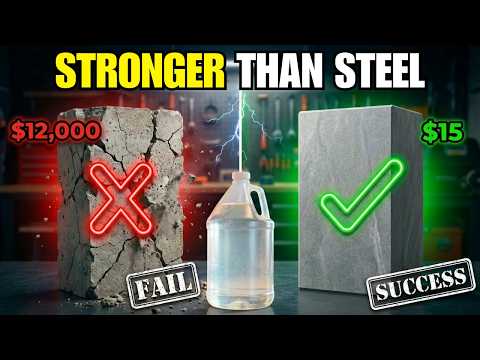
Turn Sand to Stone With Vinegar — Stronger Than Steel (Hidden Since 1627)
Mr. Dude Explained
15m 3s2,555 words~13 min read
YouTube auto captions
Transcript source
YouTube auto captions
This transcript was extracted from YouTube's auto-generated caption track. The transcript below is server-rendered so it can be read, searched, cited, and shared without opening the original YouTube player.
Pull quotes
[0:00]A three-dollar gallon of grocery store vinegar and common desert sand creates a structural material that outlasts modern concrete and matches the load-bearing strength of structural steel.
[0:00]In 24 hours, this mixture hardens into a solid block that resists hammer strikes and fire up to 2,200 degrees Fahrenheit.
[0:00]It possesses a compressive strength of 15,000 PSI five times stronger than the slab foundation under your house.
[0:00]This material actually gets stronger over a thousand years by pulling CO2 directly out of the atmosphere.
Use this transcript
Related transcript hubs
Watch on YouTube
Share
MORE TRANSCRIPTS


