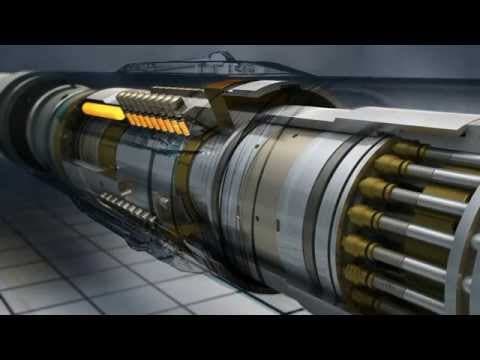
[0:10]The Weatherford Revolution Rotary Steerable System, RSS. Is suited for deployment in high-pressure, high temperature and high dog-leg wells. Our suite of solutions provide exceptional control, rate of penetration and pay zone exposure to optimize your directional drilling operations. In hole diameters from 5 and 7/8 to 22 inches, included with the Revolution system is the down link commander which enables bidirectional communications between surface systems and down hole tools. The Revolution RSS delivers full 3D directional control in a closed loop system. In conjunction with Downlink Commander, the system is capable of a full range of directional drilling applications. Including vertical and horizontal control, vertical kickoff and complex 3D well paths. The RSS assembly consists of an integral stabilizer fitted on the MWD collar. A short non-rotating bias unit and a lower pivot stabilizer.
[1:26]The upper collar of the RSS bias unit houses control electronics, the brains of the tool, and the lithium battery power pack. The control electronics insert contains navigational sensors including the accelerometer and magnetometer package, a CPU, memory boards, and the world's first high temperature angular rate gyro to detect and mitigate damaging shock and vibration when drilling in extreme environments. The non-rotating unit mounted on the main rotating shaft enables the shaft to be deflected in any required direction to accurately control the well path. Anti-rotating levers or ARLs mounted radially on the sleeve stabilizer blades hold the bias unit non-rotating sleeve steady. The lower pivot stabilizer acts as a fulcrum point, transferring shaft deflection and pointing the bit face in the required direction. The RSS bias unit drive shaft runs through the center of the non-rotating sleeve delivering torque to the bit. The shaft can be deflected in any direction at the appropriate angle to build a desired dogleg. The drive shaft deflection is transferred through the pivot stabilizer and therefore points the drill bit face in the required direction with the correct amount of tilt to achieve the planned well path. The drive shaft is deflected off-center by the piston manifold housed inside the non-rotating sleeve. Deflection is parallel to and along the length of the sleeve piston manifold housing. Therefore, no point load is transferred to the shaft. The Revolution System Piston Manifold consists of 12 banks of pistons mounted 30 degrees apart. As the center shaft rotates, it operates an internal hydraulic pump. A commutating valve is located on the rotating shaft. As the shaft rotates, the valve passes each bank of pistons once per revolution. The position of the commutating valve is referenced to the navigational sensors mounted in the control electronics. Therefore, the position of the valve with respect to high side tool face or magnetic azimuth is known at any given time. A solenoid valve is operated when the commutating valve is adjacent to the bank of pistons that are to be energized. When the solenoid valve operates, the high-pressure hydraulic fluid is directed to the bank of pistons pushing them outward and deflecting the piston manifold and rotating shaft in the opposite direction. The Revolution Suite includes four versatile systems to meet a range of drilling challenges. With a point the bit design, real-time measurement of key parameters and advanced communication, the Revolution RSS helps you drill wells precisely, efficiently and smoothly.