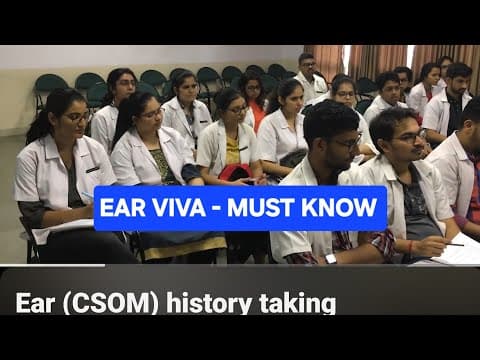
[0:01]Today we will have a case discussion about uh history taking in a year case. You can start the case. My patient, 26 year old male, student by occupation, resident of Balaji Nagar, Pune, presented with chief complaint of right ear discharge for two years, reduced hearing in right ear for two years. So we have a patient who has a history of ear discharge and reduced hearing. These two are the main complaints with which patient has come to our OPD. Okay, detailed history. History of presenting illness. Patient was alright two years back, after which he developed complaint of right ear discharge. It was on right side. It was profuse, mucopurulent, intermittent, non blood stained, non foul smelling, aggravated by upper respiratory tract infection and relieved with medication. Yes. Why do you think has she asked the patient about intermittent or continuous discharge? Sir, to know whether it is safe or unsafe CSOM. Okay, so what happens in safe, what happens in unsafe? In safe there is intermittent uh, intermittent discharge and in unsafe there is continuous discharge. Yeah, so we should understand that safe when we say a disease is safe CSOM, nowadays the term used is mucosal CSOM. It is a disease involving the mucosa of the mid ear, so the discharge is profuse. Unsafe disease is also called as squamous disease. It is the disease of epithelium and so the discharge is continuous and it has got scanty discharge. Yes. What about the quantity of discharge? Quantity is profuse in safe CSOM and it is scanty in unsafe CSOM. Same. So mucosal CSOM had intermittent discharge and mucosal CSOM also has got profuse discharge. Unsafe CSOM being colostoma being epithelium, it has got continuous discharge and it has got scanty discharge. Yes, further. Then there is complaint of reduced hearing in right ear. Let us complete the history of discharge. Why do you think did she ask for quality of discharge? To check if it is unsafe or safe. In case of unsafe there will be purulent discharge and in safe there will be mucopurulent and if there is CSF, uh, discharge then it will be watery discharge. Good. So, see both safe and both unsafe CSOM can lead to mucopurulent discharge, but unsafe CSOM starts as purulent discharge and then when the mucosa gets involved it becomes mucopurulent. In case of safe CSOM it starts, starts as mucoid discharge and when it gets infected it becomes mucopurulent. So both of them can have mucopurulent and she rightly told, if it is watery discharge, most likely it is a CSF which is coming from the ear. What about foul smell discharge? Can you tell me some causes for foul smell discharge? In unsafe CSOM there is foul smell discharge, whereas in Any other causes for foul smell discharge besides unsafe CSOM?
[3:03]Fungalin. Yeah. Otomycosis can lead to, malignancy can lead to foul smell discharge and can you say why foul smell discharge in unsafe CSOM? Because there is mixed infection of gram positive, gram negative and majority of the anaerobic bacteria and second is because of enzymatic destruction of the. Yes, so very important it is because of anaerobic organisms which affect in this region along with the mixed infection and enzymatic degeneration, this leads to foul smell discharge. What else was left in discharge? Anything left? Blood stained. Yes. Causes for blood stain discharge. Trauma. Okay. Trauma, what else? Malignancy. Malignancy. Unsafe CSOM. Vascular masses. Yes. So four common causes for blood stain discharge. Most common cause of blood from the ear is trauma, followed by unsafe CSOM, followed by malignancy, followed by vascular masses. Why does patient have blood stain discharge in unsafe CSOM? Again, unsafe CSOM is mainly a disease of the epithelium or squamous tissue or cholesteatoma which grows. It has a property of destroying whatever comes in the way. It destroys the bones, it destroys the vessels, it destroys the nerve, whatever comes and leads to high chance of complication. Development of granulations, development of degeneration, calls of degeneration, all these leads to blood coming from the ear. Okay. Uh, why did she ask for aggravating and relieving factor? Aggravating factors are upper respiratory tract infections. Why do you want to ask for that? Because if there is an upper respiratory infection, why the station tube can bring out otorhea. Yes. It can cause otorhea. So in case of safe CSOM or mucosal CSOM, the infection spreads from the upper respiratory infection via the eustachian tube and affects the middle ear. Whenever patient takes any medication it gets recovered. So a disease or discharge which improves with medication and aggravates with upper respiratory infection, think in term of safe CSOM. A discharge unsafe CSOM will not have any aggravating, will not have any relieving factors. Fine. Now we come to reduced hearing. Now there is complaint of reduced hearing in right ear since two years. It is mild, gradually progressive, non fluctuant in nature. So tell me calls for fluctuant hearing loss. Perilymph fistula, Meniere's disease and otitis media with effusion. Yes. So otitis media with effusion, Meniere's disease and perilymph fistula are three causes for fluctuant hearing loss. Anybody why does patient have, uh, Meniere's disease? Why, why would Meniere's disease lead to a fluctuant hearing loss? Due to involvement of labyrinth.
[5:50]So why would it be a fluctuant hearing loss? Pressure of endolymph is more. Meniere's disease is mainly endolymphatic hydrops, the endolymph pressure increases. Whenever the pressure increases, patient has hearing loss and when the pressure relieves and patient symptoms subsides, patient's hearing becomes normal. So in these three conditions, that is if otitis media with effusion, Meniere's disease, perilymph fistula, the OME is one which has got fluctuant conductive hearing loss. Meniere's and perilymph fistula will have, will have fluctuant sensory neural hearing loss. Can you make out from the way patient is talking whether he's having conductive or sensory loss? Yes, we can make out. If there is conductive, the patient speaks monotonous, low, low sound, if the speech is low pitch and uh, in sensory neural, he speaks loudly, loud speech is there. Yes, very correct, in that, in a patient having conductive hearing loss if you see patient will be mumbling, very soft, very soft spoken and very, very monotonous kind of speech. In case of sensory neural loss, he will talk loudly, mainly in SNHL patient has lack of speech discrimination. So when we talk to patient, he will say he is missing out few words, so clarity of sound is not there in case of SNHL. Okay, negative history. There is no complaint of pain, vertigo, headache, facial asymmetry, diplopia and fever. Can you tell me why did she ask for vertigo? So tell me, yeah. Cause for vertigo. Labyrinthitis. Yes. Anything else? Cerebellar abscess. Yes. So all these negative history, whenever we take a negative history in case of ear complaint, most of time we want to rule out each and every complication, the intracranial and the temporal complication. Vertigo is caused mainly by two reasons in CSOM, one it can be a labyrinthitis which is the ear temporal complication and second is cerebellar abscess which is intracranial complication. Facial asymmetry was asked to? Uh if there is any facial nerve paralysis or not. Yes. Facial nerve palsy also is a complication, to rule that out patient will say I'm having a facial asymmetry, maybe drooling of saliva, inability to close eyes, these are the symptoms of facial asymmetry. Headache, why did she ask for headache? Meningitis, subdural abscess, extra dural abscess. Yes, again to rule out mainly intracranial complications.
[8:19]That can be extradural abscess, subdural abscess, meningitis, even brain abscess can lead to pain, uh, lateral sinus thrombophlebitis can lead to pain, headache, but more common causes are extradural, subdural abscess and meningitis. What else? Diplopia. Yes. Diplopia. Why did she ask for diplopia? To rule out petrositis. What syndrome are we talking about? Gradenigo's syndrome. So in case of petrositis, which is a complication of CSOM, patient has three features. One is otorhea, second is retroorbital pain and third is diplopia. All three together form Gradenigo's syndrome. Why does patient have diplopia? Sir, because abducent nerve is. Yes, petrous apex in the region where we have the passage of abducent nerve, when it gets affected, it applies lateral rectus muscle, so patient has diplopia and the pain is because of affection of facial. Trigeminal nerve ganglion. It is the ganglion of trigeminal nerve which is also called as Gasserian ganglion which is present at the apex of the petrous bone. So these three form Gradenigo's syndrome. Any other negative history? Fever. Yes. Fever. All these inflammations, all these complications will lead to fever. Remember one more complication that negative history that we have to ask is no history of seizures. In case of brain abscess, patient can have, in case of brain abscess, patient can have seizures also. So all these negative history will form part of your history taking in the ear case. What else? There are no complaints of nasal block or throat pain. Yes, very important. Whenever you take any ear history, it is important that you always rule out nose and throat conditions. So always ask for no recurrent rhinitis, no nose block, no recurrent throat, no recurrent throat pain. Okay. So fine, thank you so much. This is what is important for a history taking in the ear. There can be minute and subtle variations in each patient in each case, but this is the basic routine that you should follow when you take a history in ear case. Thank you so much.

![Thumbnail for 2016 서울패션위크에서 YG모델 이호정을 만나다! [oh Hot] - KoonTV by 최군TV funny](/_next/image?url=https%3A%2F%2Fimg.youtube.com%2Fvi%2FSqHgAly3Ajc%2Fhqdefault.jpg&w=3840&q=75)