[0:01]After World War II, Germany was divided into four zones of occupation, each controlled by one of the Allies. Berlin lay inside the Soviet zone and was also divided into four zones of occupation.
[0:24]Berlin would become a source of tension between the USSR and the West for much of the Cold War.
[0:36]In 1948, Stalin ordered a blockade of Berlin in an attempt to force the West to abandon Berlin.
[0:47]The West responded by organizing the Berlin Airlift.
[0:56]The Berlin Airlift lasted for 318 days, by 1949, 8,000 tons of supplies were being flown in daily. Stalin was powerless to stop the airlift and the blockade was lifted in May 1949.
[1:18]In April 1949, the US, British and French zones formed West Germany. West Germany was capitalist and allied with the US. In October 1949, the Soviet zone became East Germany. East Germany was a communist Soviet puppet state. Tensions over Berlin continued to mount through the 1950s.
[1:57]Khrushchev and the East German government were concerned about the 'brain drain' from East Germany to West Germany.
[2:10]Between 1949 and 1961, an estimated 2.7 million East Germans defected to West Germany. This angered Khrushchev and gave a bad impression of life under communism. Khrushchev demanded that as Berlin lay inside East Germany, the West should withdraw their troops from Berlin.
[2:44]To settle the dispute, both sides agreed to hold a summit.
[2:53]But just days before the Paris Summit, a US U2 spy plane was shot down over the USSR. The US denied it was a spy plane, however the USSR produced evidence to confirm it was.
[3:14]The Americans refused to apologize and Khrushchev walked out of the Paris Summit.
[3:34]Kennedy vowed to take a tougher approach towards communism and no solution over Berlin was reached.
[3:47]Khrushchev felt he had to act to stem the flow of refugees out of East Berlin.
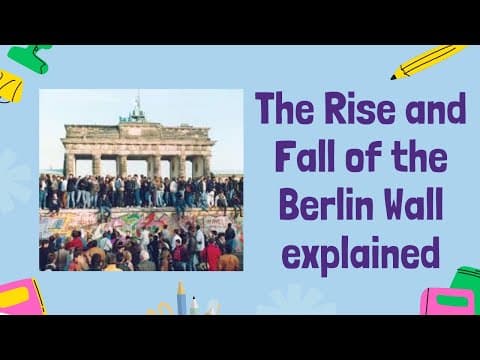
[3:58]In August 1961, a 27-mile wall was built across Berlin, separating East from West.
[4:09]The Wall was fortified with barbed wire, machine gun posts and watch towers. East Berliners could no longer enter West Berlin freely. Guards were stationed along the wall with orders to shoot any defectors.
[4:33]The construction of the wall eased tensions over Berlin and succeeded in stopping mass emigration. The wall became a symbol of communist oppression and a visible reminder of the division between East and West during the Cold War. In 1985, Mikhail Gorbachev became General Secretary of the Communist Party. Gorbachev wanted to modernize communism and take a new approach to foreign policy.
[5:18]Gorbachev introduced two major policies - 'glasnost' and 'perestroika', which were part of his 'New Thinking'. Glasnost means 'openness'. Be more 'open' with the West.
[5:39]Free speech was allowed. Censorship was relaxed and thousands of political prisoners were released. Glasnost encouraged opposition to communism in Eastern Europe.
[6:01]In 1988, Gorbachev abandoned the Brezhnev Doctrine, the USSR would no longer interfere in the satellite states.
[6:14]Soviet troops, tanks and aircraft were removed from the Eastern Bloc.
[6:24]This energized opposition to communism in Eastern Europe and encouraged reformist movements.
[6:36]Opposition movements could now operate with no fear of Soviet military intervention. In May 1989, Hungary opened its border with Austria, which allowed East Germans to escape to West Germany. Thousands of East Germans defected, the East German regime struggled to control the situation. However, the Soviets did not provide any help.
[7:18]In October 1989, mass protests against the communist regime erupted across East Germany. In November 1989, the East German regime agreed to open its borders and the Berlin Wall was torn down. The fall of the Berlin Wall showed the Soviets were losing their grip on the Eastern Bloc.
[8:03]In 1989-90 communist regimes fell in Hungary, Romania, Bulgaria and Czechoslovakia.
[8:14]In 1990, Germany was reunified as a capitalist country.
[8:24]Thanks for watching.