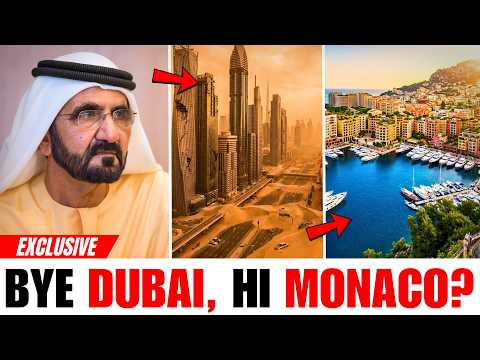
[0:00]There is a photograph that will define this era of global wealth. A yacht, white and gleaming, sails through the waters off Dubai's coast. Behind it, a column of smoke rises from the port of Jebel Ali. Thick, dark, unhurried. Climbing into the sky the way a question climbs into a room, slowly and without an easy answer. That photograph was taken on March 1st, 2026, and in a single frame, it captured something that no analyst report, no bubble warning, no ratings agency downgrade had managed to capture in years of trying. The moment Dubai's greatest asset began to burn. Not the port, not the hotel on the palm, not the airport terminal with the scorch marks. The asset that began to burn was the idea. For almost two decades, Dubai had sold the world a very specific promise. Come here. Bring your money, bring your family, bring your ambitions. We have the sun, the towers, zero income tax, zero capital gains tax, zero inheritance tax. We are safe, we are stable. We are the eye of the storm that never touches the eye. 81,000 millionaires believed it, 20 billionaires planted their flags here, 237 centimillionaires woke up here every morning and looked out at the gulf and thought, I chose well. And then the missiles came. Debris from a downed Iranian drone set fire to the Burj Al Arab hotel. The Fairmont, the palm was struck by an explosion. Dubai International Airport sustained damage. The American consulate was targeted. The port of Jebel Ali, the engine behind 36% of Dubai's entire GDP, suspended operations. And across the city, in the lobbies of five-star hotels and the offices of hedge funds, and the glass towers of the palm, the wealthiest people in Dubai did something they had never expected to do here. They panicked. Charter jets sold out. Private car services reported demand spikes as the ultra-wealthy scrambled toward the Saudi border. Flights were booked to Muscat, to Hyderabad, to Bangkok, anywhere with open air space and a seat available. A finance professional, one of thousands who had relocated to Dubai precisely because it felt like the safest place in a dangerous world, posted on social media with the dark humor of someone who has just understood something they cannot unlearn. Moved to Qatar to hide from taxes. Now I am hiding from missiles.
[2:38]That line is not just a joke. It is an epitaph for a myth, and the story of how that myth was built, who built it, who believed it, and what replaces it. That is the story we are about to tell. To understand what broke, you first have to understand what was built. The foundation was tax. Not low tax, no tax, zero personal income tax, zero capital gains, zero inheritance. For the ultra-wealthy, managing family offices with hundreds of millions under administration, running hedge funds generating tens of millions a year, this is not a minor incentive. It is a fundamental restructuring of the mathematics of wealth preservation. But tax was only the beginning. The ruling Maktoum family understood decades before most Gulf states that oil was a finite game, so they built something else. Special economic zones, world-class infrastructure. The Dubai International Financial Center, designed from the ground up to operate under English common law, giving international investors the legal familiarity they needed to trust it. By early 2026, the DIFC hosted 290 banks, 102 hedge funds, 500 asset management firms, and 1,289 family office-related entities.
[3:59]The top 120 families operating within the zone managed a combined wealth of more than 1.2 trillion dollars. Then came the Golden Visa, the masterstroke. Buy a property worth 550,000 or more, receive a 10-year renewable residency. No employer required, no bureaucratic uncertainty, just a purchase and a life in the sun. Launched during Covid, when wealthy people across the Western world were locked in their homes, watching their cities shut down, asking themselves why they were paying enormous taxes to live somewhere they couldn't leave. Dubai's answer was printed on a golden visa application. The results were staggering. Dubai's millionaire population doubled between 2014 and 2024. In 2025 alone, 9,800 millionaires relocated there, bringing 63 billion dollars in liquid wealth, more than any other country on earth. 500 properties sold for more than 10 million dollars in 2024, up from just 30 in 2020. A penthouse at the Bugatti Residences sold for 150 million dollars. Prices surged roughly 70% between 2021 and 2025. At the center of it all was the promise that made everything else possible. Safety. Dubai had cultivated an almost mythological reputation for security. Residents left their cars unlocked. The crime rate was negligible. The government was stable, predictable, and ruthlessly professional about protecting the conditions that attracted capital. Dubai's economic model is based on expatriate residents providing the brains, brawn and investment capital. You need stability and security to bring in smart foreigners.
[5:48]Dubai had that stability for years, for decades until it didn't. The cracks were visible to anyone willing to look, even before the first Iranian drone crossed into UAE airspace. In September 2025, UBS released its annual Global Real Estate Bubble Index. Dubai appeared with the fifth-highest bubble risk of 21 major cities surveyed. In the spring of that same year, Fitch Ratings predicted a correction in late 2025 and through 2026, with prices potentially falling by as much as 15%. The reason, supply. Approximately 210,000 new housing units were set to enter the market, double the average of the previous three years. Real estate and construction together accounted for more than 17% of Dubai's GDP, making the city uniquely exposed to any demand correction. But there was another crack, one that lived not in spreadsheets, but in behavior. Off-plan investing, buying property before it is built, accounted for 60% of Dubai's real estate sales. Entire industries existed to serve this market. Developers offered structured payment plans. Buyers took on leverage they sometimes struggled to calculate. People who are new to Dubai saw this as a free money wheel. One senior trader who relocated from London told Financial Press. Prices went sky-high after COVID, and people bought into this with leverage. There were people running in and buying whole floors. Buying whole floors on leverage, on the assumption that prices would perpetually rise. It's not funny, a Goldman Sachs trader said, speaking off the record to financial media in March 2026. People are being wiped out by this. The fragility was structural. Dubai's model had worked brilliantly when all variables held, but nobody had built a model for missiles. February 28th, 2026. The United States and Israel launched strikes on Iran. Iran retaliates with a scale and precision that shocks even analysts who had warned of exactly this possibility. The UAE absorbs over 800 drones and 200 missiles in the opening days. The Burj Al Arab catches fire, the Fairmont, the palm is struck, Dubai International Airport sustains damage. And then, the blow that many analysts would later describe as the most economically significant, Jebel Ali Port is hit. The port and its adjacent free trade zone account for 36% of Dubai's GDP. Hundreds of ships in surrounding waters freeze in place. DP World suspends operations. Iran's threatened closure of the Strait of Hormuz, through which 20% of the world's oil supply flows, sends shockwaves through global energy markets. At the same moment, airspace across the Gulf collapses. Emirates, Etihad, Qatar Airways, British Airways, Lufthansa, Virgin Atlantic, all suspend operations. Over 4,000 daily flights are canceled. Dubai International Airport, the world's busiest international hub, goes quiet. The Dubai Financial Market real estate index plunges 30%, erasing every gain made during 2025. The stock exchanges suspend trading, an unprecedented step. 120 billion dollars in market capitalization is wiped from UAE financial markets within a month. Hotel bookings drop by more than 60%. Real estate transaction volumes plunge 51% in a single month. Property prices are projected to fall by nearly 20% in the near term. Marco Kolanovic, former chief market strategist at JP Morgan, was blunt. With 80% of expats, tourism, finance, air and shipping exposure, this can also send shockwaves globally. And for the wealthy residents of Dubai, an unprecedented question: how do you leave a city when the airports are closed, the border roads are jammed, and a charter jet costs more than most people earn in a year? Some paid hundreds of thousands of dollars for a private flight through Muscat. A British expat trying to flee with his pregnant wife and three-year-old son, described prices spiking in real time as he attempted to book. A Turkish mother of two looked at the fire burning on the man-made island she called home and made a calculation that had nothing to do with tax rates. Not everyone leaves, that is the important nuance. Dubai's 3.5 million residents, over 90% of them expatriates, mostly stay through the initial shock. The business case remains structurally intact. The tax framework is unchanged. The DIFC is functioning. The banks are open. Hasnain Malik of Dubai-based Telemir made the point precisely. Those reasons have not changed. It is only in one aspect of the lifestyle driver, pristine security, that recent events have called into question. Technically accurate, but it understates how wealth actually migrates. The wealthy do not leave all at once, they leave in layers. First, the most mobile, people who were never truly anchored, quietly adjust their plans. Then come the contingency conversations. Quiet meetings with relocation advisors, calls to lawyers in other jurisdictions. Real estate agents in Monaco and Geneva receiving inquiries with a very specific character, not I'm thinking about moving, but how quickly could I establish residency if I needed to? And then most critically, the pipeline slows. The 9,800 millionaires who relocated in 2025 were the product of a calculation. That calculation now requires recalibration. For a city whose entire growth model depends on attracting globally mobile talent and capital, the cooling of incoming intent matters as much as current departures. The question every analyst, every hedge fund manager, every wealthy expat in a Bangkok hotel room comes back to is the same: is this a pause or is this an ending? Dubai has answered that question before. After the 2008 crash, when property values fell by 50 to 60%, and luxury cars were abandoned at the airport, the city rebuilt. It survived COVID in under a year. It survived the Arab Spring by positioning itself as the stable alternative to regional chaos. But here is what is different this time. Every previous crisis was an external shock, something that happened to Dubai from the outside. Each time, Dubai's pitch remained intact: come here, because here is safe while everywhere else is not. This time, the missiles landed inside the city. The hotels are on fire, the airport is damaged, the pitch, that specific foundational pitch about safety, is the thing that is broken. And a broken promise does not go back together cleanly. It goes back together with a seam. And wealthy people are extraordinarily sensitive to seams. There is a phrase circulating in international wealth circles right now. It has no official author. It emerged the way all genuinely resonant phrases emerge, from the accumulated private conversations of people who share a problem and have found a shorthand for its solution. The phrase is this: "Earn in Dubai, live in Monaco." Monaco did not launch a marketing campaign when the missiles hit Dubai. It did not hold a press conference. It did what it has always done, what it has been doing with extraordinary consistency for over a century. It simply continued to exist. And in a world increasingly discovering the value of things that simply continue to exist, that turns out to be a more powerful argument than anyone had a model for. Monaco is by almost every conventional measure improbable, two square kilometers wedged between the French Alps and the Mediterranean. Fewer than 40,000 residents, no airport, the most expensive real estate on Earth, strict residency requirements, perpetually inadequate housing supply. For most of the past decade, it was regarded by financial press as a charming anachronism, a tiny, wealthy relic of another era. The real story, the consensus agreed, was Dubai. Serious people, it turns out, were missing something fundamental. While the consensus watched Dubai's explosive photogenic rise, Monaco was doing something quieter and, in retrospect, far more durable. It was not competing on the same terms. It was not trying to attract more people, build more towers, or generate better headline numbers. It was being Monaco, stable, scarce, European, and completely insulated from the category of risk that just dismantled Dubai's greatest asset. When the missiles hit, Monaco's estate agents began receiving inquiries with a velocity they had never seen before. Not from retirees, from family offices, from the wealth managers of Gulf residents who had been running contingency scenarios and arrived at the same answer every time. We are no longer just selling sunshine, one Monaco property expert told BFM TV. We are selling security. And Monaco cannot grow horizontally. It is physically bounded on three sides by French territory and on the fourth by the Mediterranean. There is nowhere to expand. The Maritera Project, Monaco's most ambitious development in decades, a neighborhood literally built from reclaimed sea, added 110 apartments and 10 villas. This was celebrated as a breakthrough. In any other real estate market, 120 units would not constitute news. This scarcity is not a problem Monaco is trying to solve. It is the foundational feature of the entire market. The average resale price climbed to 7.6 million euros in 2025, a rise of 26.8% in a single year. The average price per square meter stood at 57,569 euros. In the Lavoto District, prices crossed 71,000 euros per square meter for the first time. Knight Frank forecasts 4% price growth for 2026, consistent with Monaco's 30-year historical average of 5% annual appreciation. Apartments are rented before they are officially listed. One Monaco agent with a decade in the business said, in 10 years, I've never seen such a frenzy. The residency structure reinforces market quality rather than diluting it. Monaco requires proof of funds, background checks, and evidence of housing proportionate to family size. What this creates is not merely a wealthy community, but a self-selecting one. The people who make it through Monaco's residency process are, almost by definition, long-term, capital-rich, stability-seeking residents who sustain a market rather than speculate in it. This distinction between a market sustained by residents and one inflated by speculators is the core structural difference between Monaco and Dubai right now. In Dubai, 60% of sales before the conflict were off-plan, speculative, leveraged. In Monaco, the overwhelming majority of buyers pay in cash. Interest rate cycles barely register because most buyers don't use mortgages. A scenario of widespread depreciation appears unlikely, one of Monaco's leading analysts concluded. Supply remains structurally constrained. Demand is solvent and predominantly patrimonial, and acquisitions are often financed with equity. Solvent, equity-financed, patrimonial. This is not the language of a speculative market. It is the language of a vault. And then there is the political structure. Monaco is a constitutional monarchy with centuries of institutional continuity. The government does not change with an election cycle. When the United Kingdom abolished its non-dom tax regime, thousands of wealthy residents left almost overnight. France debates wealth taxes with every political season. Monaco simply does not participate in this cycle of uncertainty. For a family building multi-generational wealth and seeking somewhere to anchor it for the next 100 years, this continuity is not a minor detail. It is the entire point. Something is shifting in how the wealthiest people in the world think about where to live. And the shift is more profound than headlines about Dubai or Monaco suggest. For most of the past 30 years, the first question a billionaire's wealth manager asked when advising on residency was, where do you pay the least? The entire architecture of wealth migration, golden visas, non-dom regimes, flat tax structures, zero tax Gulf environments, man. Was built around that question. That question has not disappeared, but it has been joined and in some cases, overtaken, by a different one. Where is my wealth safest from governments and from geography? An estimated 35% of high net worth individuals are now actively planning to move themselves, their capital, or both to lower tax and more stable jurisdictions. A record 128,000 millionaires relocated globally in 2025. Analysts project that number reaching 165,000 by 2026. And the language driving these decisions has changed fundamentally. Where advisors once spoke of tax optimization, they now speak of operational redundancy. Where the pitch was once pay less here, it is now lose nothing anywhere. In this framework, Dubai and Monaco are not competitors, they are complements. Dubai is where you operate, where you build, transact, network, and scale. Its connectivity, its entrepreneurial energy, its financial infrastructure, genuine advantages that no amount of missile damage eliminates overnight. Monaco is where you anchor, where you put the family, the primary real estate, the long-term capital that must survive whatever happens in the active zones. Monaco's property analysts report that the profile of new inquiries has changed in 2026. Fewer retirees seeking a quiet life, more active entrepreneurs, seeking what one analyst called geopolitical stability insurance. A Monaco residency is no longer primarily a tax tool. It has become an asset class. The geopolitical equivalent of holding gold in a vault, not because you expect to need it, but because you cannot afford not to have it. Wealth advisors note a rising interest in Monaco from clients navigating complex global exposure, seeking to stay offshore while avoiding both geopolitical risk and unintended tax consequences. And the broader European landscape is feeding this demand. Italy's flat tax regime for new residents, Greece's equivalent program, Portugal's record inflows. Southern Europe has emerged as, in the words of the Henley Private Wealth Migration Report for 2025, a new center of gravity for wealth migration. And sitting at the apex of that realignment is the most stable, most legally certain, most deliberately exclusive point in the entire landscape, is Monaco. The irony is almost perfectly calibrated. Dubai spent 20 years positioning itself as the alternative to Europe's high taxes and political uncertainty. And now, as Dubai faces its own instability, Europe, in its most controlled, most exclusive corner, is positioning itself as the alternative to Dubai. Let us be honest about what we know and what we don't. Dubai is not over. The city has resources, resilience, and a governmental structure capable of responding to crisis with speed and decisiveness. It has rebuilt before. It survived a 50 to 60% property crash in 2008. It survived COVID. It survived floods. It will survive this. What it will not quickly recover, and possibly never fully, is the myth. The singular, load-bearing myth of invulnerability that was the foundation of the entire pitch. That myth required only one thing to remain viable, that no serious harm ever came to it, that the hotels stayed pristine, that the airport hummed, that the smoke, if there was ever any smoke, came from somewhere else. When the Burj Al Arab caught fire from a drone, that building, which had become the global shorthand for Dubai's version of impossibly glamorous safety, something irreplaceable was lost. Not the building. The building can be repaired. The irreplaceable thing was the certainty, and certainty once broken does not go back together cleanly. It goes back together with a seam. Monaco, meanwhile, is not experiencing what anyone in that small principality would describe as a boom. It is too restrained and too self-aware for the word. What it is experiencing is confirmation, confirmation of a thesis that its market has embodied, quietly and consistently for decades, that the most valuable thing in a volatile world is not the highest return. It is the most reliable floor. Monaco's price per square meter has never fallen dramatically. Its political structure has not shifted. Its institutional framework will not change because of an election result. Its geography tucked between the Alps and the Mediterranean, embedded in European legal and cultural infrastructure, 7 minutes by helicopter from Nice's International Airport, insulates it from the category of geopolitical risk that just dismantled Dubai's greatest pitch. Monaco is not winning this moment by being more dynamic than Dubai. It is winning by being exactly what it has always been. And by the world finally arriving at the calculation that stability, in sufficient quantity and of sufficient duration, is its own form of extraordinary wealth. There is a phrase, older than any wealth migration report and longer lasting than any golden visa program, that captures what is happening in the global billionaire class right now. It is not a financial concept. It is not a residency strategy. It is something closer to wisdom.