[0:09]Imagine a world free of hunger, where everyone had equal access to enough food, good nutrition, clean water, and basic health care, no matter where they live. Imagine a world where every child had equal access to good quality education and did not have to worry about learning or going to bed on an empty stomach. A world where women in poorer communities around the world did not have to walk miles and miles away, some with children on their backs and heavy loads on their heads in search of their daily bread. Imagine what that world would look like. Growing up in Nigeria, I saw how often food was rationed in many households, simply because it was not enough. Many ate, not to be filled or satisfied, but rather to survive. Eating what you wanted was not always a choice, because what was served was what was available. Some, including children, went to bed hungry, with the hope of waking up to a better tomorrow, a tomorrow that did not guarantee enough food for them. This is the reality of millions of people living in food insecure communities around the world today. The 2022 Global Report on food crisis estimates that one in five Africans go to bed hungry. And that over 140 million people on the continent are severely food insecure.
[2:00]According to the UNICEF, six million children in West and Central Africa are currently facing severe acute malnutrition. And this may even get worse, considering the rapid rise in human population and the adverse effects of the climate change on our fragile food systems. Today, we see the negative impacts of climate change on the farms with extreme drought, excessive heavy rainfalls, degrading soils, the emergence of deleterious crop pests and diseases that continue to ravage crops in the field, and the severe consequences of the excessive use of agrochemicals to the environment and to the health of farmers. The COVID-19 pandemic, war, conflict, rising tensions, inflation and inequalities continue to exacerbate the wildland hunger gaps in African nations. And oh, it breaks my heart to see that from my childhood until today, basic food such as bread, a food often thrown to the birds in richer countries, still remains a luxury for millions of people at home. But in all of this, Africa is not a poor continent. Africa has so much wealth that it does not need to rely on any other continent to feed its people. In fact, of all other continents, Africa is endowed with a wealth of human and natural resources. Africa harbors 60% of the vast arable land of the world and 30% of the world's mineral reserve, gold, diamond, cobalt, crude oil, name it. When it comes to crops and livestock, African countries have hundreds of indigenous species that if properly improved, preserved, and diversified, can sustainably feed Africa and the rest of the world. How then can we reconcile these wealth of resources with a level of suffering we see today? Agriculture is one of Africa's greatest assets. It is the major economic driver, contributing to an average of 23% of Africa's gross domestic product. According to established reports, more than 60% of Africa's population rely on subsistence agriculture. And about 33 million smallholder farmers produce a significant proportion of Africa's food supply. Yet, despite these opportunities, African countries still import food, what about 23 billion US dollars every year? And these are mostly cereal crops such as rice and wheat, and also edible oils. These cereals were never major sources of food for us when we were growing up, simply because they were not readily affordable. In fact, most of our people would rather prefer to eat indigenous fufu, made from indigenous cassava, yam, cocoyam, millet, sorghum, and other indigenous crops. My parents never fancied these imported crops and neither did their parents. So sometimes I wonder when most of the imported cereals became a major staple for most of Africa. Don't get me wrong, I love rice. In fact, I've eaten more rice living in the United States and the United Kingdom, more than I ever ate growing up in Nigeria. Simply because here it is readily accessible and affordable. But this is not the case for millions of people living in food insecure communities across Africa. So each time I hear that Africans need more of this foreign grains to save them from starvation, I wonder, who made this up? What were people eating before these imported cereals dominated our local diets? If truly Africans need more of these cereals as key crops to live them out of acute hunger, then why are our smallholder farmers not producing enough to feed the entire continent? Could it be that they cannot afford the amount of land, water, inorganic fertilizers and agrochemicals required to grow these crops, which may not even be very adaptable to the local agro-ecological systems? What if African smallholder farmers were rather economically empowered to grow their indigenous crops? The crops they love and have grown for generations, wouldn't that be a right step towards closing the hunger gaps?
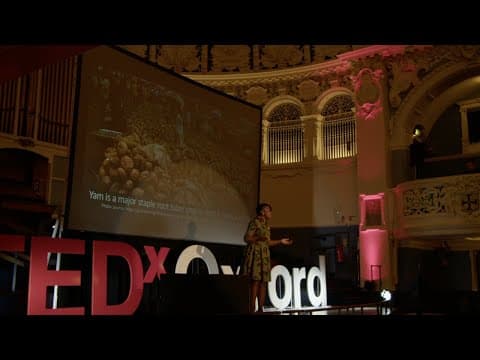
[7:13]Wouldn't that be a right step towards closing the hunger gaps? Excitingly, African indigenous staple crops represent a large pool of untapped reservoir of nutritional and genetic potential. They are integral to the local food systems, the rich cultural traditions and economic sustenance for smallholder farmers. Unlike some of the imported crops, many African indigenous crops are rich in nutrients, antioxidants, medicinal properties, and resilient traits that make them more adaptable to their local environment. After all, they grew up there. A typical example of an indigenous crop that has so much cultural importance is yam. Yam is the second most important staple root tuber after cassava, and a major source of food for at least 300 million people in West and Central Africa. In my Nigerian tribe, the Ebo tribe, yam holds a great deal of cultural significance. It is known as the king of all crops. Yam is seen as a symbol of power, strength and authority that almost every significant occasion in my culture includes the display or eating of yam. This includes marriage ceremonies, where in certain practices, yam constitutes a part of the dowry paid by the groom's family. Yam is ascribed so much recognition and respect in my culture that an entire annual festival is dedicated to it. The new yam festival is known as the Iri Ji Festival, where Iri Ji simply means eating yam. But beyond just eating yam, the Iri Ji Festival brings together the Ebo people to celebrate and give thanks for the gift of such a great crop. Held annually not only in Nigeria, but all around the world, the Iri Ji Festival is graced by lots of cultural celebrations, eating, dancing and more. As yam was considered a crop for the men in the patriarchal evil culture, the women of Abagana, a town in Anambra State, also of the Nigerian evil tribe, believe that if the sowing and harvesting of yam was dedicated or reserved for the men, then, of course, they too women ought to celebrate the sowing and harvesting of crops designated as the women's crops. One of such crops is cocoyam, my mother's favorite. Cocoyam is the third most important staple root tuber after cassava and yam, and a major source of livelihood for millions of smallholder farmers, especially women, in most of West and Central Africa. No wonder, the people of Abagana will come together every December to celebrate an annual cultural festival dedicated to cocoyam. During this festival, the women will bring together some of their harvested cocoyam to the deity in an expression of their joy for its protection and help during the farming season. The festival then takes off with more cultural celebrations, eating, dancing, and more. These are just a few examples of the rich historical traditions linked to African crops, the crops of the people. Yet, despite their deep ancestral ties and their proven nutritional, cultural, and socio-economic benefits, scientific research to boost the productivity and resilience of these crops, particularly in the face of a looming climate crisis, has been historically hindered. Whereas Western dominated crops often described as mainstream crops have attracted billions of dollars in research investment for their continued improvement and diversification. Many indigenous crops are facing a rapid decline and some even facing extinction due to adverse biological and climate conditions. Unlike the mainstream crops, indigenous crops are described with all sorts of colonial biased terminologies, such as minor crops, abandoned crops, forgotten crops, neglected crops, underutilized crops, lost crops, even orphan crops. Often, although these crops still have parents that are living or they wouldn't exist. These colonial biased terminologies diminish the value of these crops to the people who rely on them and further excludes them from funding global funding priorities. After all, words matter and language can shape perception over time. The big question here today is, how can we achieve the United Nations sustainable development goals of ending hunger, malnutrition, and poverty in African nations by 2030 and beyond, if African staple crops, the crops of the people and the people who grow them, are not given the full attention they deserve? If we must achieve these goals, then these crops must be re-centered into global research and development funding priorities. And by this, I do not mean investing more millions of dollars, solely to Western institutions to develop solutions for Africa. Neither does this exclude the African governments from investing in improving their own crops. This simply draws attention to the urgent need and the moral obligation to meet the needs of the smallholder farmers, who produce a significant proportion of Africa's food supply, but yet in themselves, live in extreme poverty.
[13:51]By providing the right infrastructure, access to modern technologies, research tools, technical expertise, among others, African scientists, farmers, and businesses or organizations that work with them will be empowered to develop resilient crops that assure food security for the African people. As a plant scientist and founder of the JR Biotech Foundation, my own little contribution has centered around leading efforts aimed at building excellent agricultural research capacity in African research institutions. I set up the JR Biotech Foundation from my experience, completing my undergraduate degree in Nigeria and realizing during my first master's degree in the United States, that my previous degree did not equip me with relevant practical skills in modern biosciences that I could use to solve local or global problems.
[15:05]Of course, I was frustrated, but instead of just complaining, which I still do, by the way, I decided to do something to set up an organization that will help to bridge the scientific skills and knowledge gaps that are hampering agricultural research and productivity in Africa. So over the last seven years, we have developed and delivered world class training programs designed to upscale emerging African scientists, equipping them with the knowledge, skills and networks that they need to improve their research and teaching. For the first two years, we focused on offering these world class training programs at the top UK university, but we still realized that most of the scientists that we trained were not able to apply the skills at home due to the lack of well-equipped laboratories, no access to modern technologies and tools and the resources that they need to do good science. So we changed our strategy to meet them right where they are. We started to partner with African universities and research institutes to run our world class training program, and this was a game changer. Because it enabled us to better understand the challenges that African scientists face at home and how we may better address them. To date, we have reached over 3,000 scientists and students in more than 19 African countries through our in-person workshops as well as our online Reach and Teach Science in Africa initiative, which we started during the COVID-19 pandemic. Our alumni continue to train others. It's like a ripple effect, the more you train, the more they train, but we are not done yet, because there's still a lot of work to be done. And this is why I'm excited about our uh pioneering new initiative, the Africa Crop Innovation Hub, which seeks to bring together Africa's brilliant scientists, farmers and institutions to develop groundbreaking solutions that will assure food security for the African people without disregarding indigenous resources, knowledge, and practices. This is the game changer, and this gives me hope that collectively, we can break the generational cycle of hunger, malnutrition, and extreme poverty. After all, there is no glamour in poverty, and there is no joy in seeing any child or anyone go to bed hungry. Thank you.