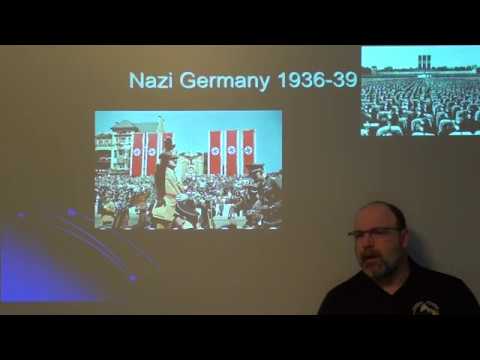
[0:17]All right, good afternoon, everybody, and welcome to my second part lecture, I'll call it of pre-war Nazi Germany. Uh, the first one dealt with the years 1933 to 1936, and then we're going to pick up from there. Uh, there's a lot of material to jam in here, and I want to clarify too that, you know, we are sort of, uh, taking a very broad sort of overview of the main themes of this period of history. Any of these topics, of course, could be investigated, uh, very deeply, and there's so much, um, historical, uh, literature out there about this period of history, and and material continues to be written, there continues to be, uh, revisionism in this period. And mind you, history in general, I think, is being revised on a regular basis. You know, the wonderful thing, I think, in history in general is that, uh, it seems that the further away we get from certain periods, uh, the greater the clarity in which we can kind of, um, assess that period. Uh, and, you know, there continues to be, uh, new material coming out about this period, but we have to consider too that those people that were adults during the, um, Nazi period, uh, the vast majority, of course, have have passed away now. And there's really not that many people left who are able to reveal primary source information about their experiences. Uh, certainly, of course, the same can be said about the World War II generation, where if you look at somebody who may have been 19 years old at the very end of the war, um, would now be, uh, well, how old would that person be? I guess they would be, let's see, if 75, they would be 94 years old, so the youngest World War II veterans would be 94 at this time. So, you know, um, and I'm just very, very thankful that so many people have taken the initiative of interviewing people. We know that in Canada there's been an active campaign to interview vets and, uh, and and and sock away that information, and we will always have a a a plethora of primary source information, you know? And for me, as a historian, primary sources are the stuff of what makes history, that hearing recollections from people who lived in the period in which we study, so. Uh, but aside from that, we are going to to move in, uh, it's fair to say that by 1936, of course, the Nazi regime was incredibly well entrenched. Uh, there was zero, uh, um, political opposition, all other political parties had been banned. The Nuremberg laws had come into effect the year before. Um, the grand design of the Nazi government was pretty clear by 1936. And in many ways, what makes things interesting is that while the other Western democracies were grappling and struggling with the Great Depression, it seemed that the two most prevalent dictatorships, at least on the surface, from the outside looking in, the two major dictatorships of this period seemed to be doing well. The Soviet Union during Stalin's Five-Year Plans was pumping out the propaganda of success. Of course, we didn't really know what was happening, uh, in the Soviet Union at the time, but we we were fed information that implied that things were going very, very well. We are not attached with the capitalist economies, so our economy didn't falter during the Depression. The other, of course, would be Nazi Germany that appeared to be employing people, there was a new energy, there was a new excitement, and Hitler really wanted to show off, uh, his great new, uh, Reich that was going to last a thousand years. And, uh, so when they put a bid in for the Olympics, uh, and they would get that bid in 1936, which I'm, I'd have to look, but I'm sure that that process of getting that, um, bid may have even started before the Nazis came into power, but either way, here we were, 1936, and their opportunity to show the world everything they wanted the world to see. Now, we should be clear that for the Jews of Germany at the time, particularly those in Berlin, this two to three week period, uh, was a tremendous reprieve from the ugly realities of anti-Semitism in Germany and specifically in Berlin. All anti-Semitic posters were removed, all, um, uh, you know, stars of David that may have been painted and and derogatory slur, everything, and all of course all the newspapers have been removed. So there was a little bit of a during this two-week period, but as soon as that period ended, and all the tourists went home, um, it all came back again. You know, the tragedy was a lot of people who could afford it, uh, came to Berlin because they were curious. They watched the newsreels and maybe in Britain and France or Canada, the United States and other places, and they were simply curious. If you have the money to to to go and see what was really happening in Germany at the time, uh, a lot of people were doing that, and of course, the Berlin Olympics became the perfect, uh, opportunity to see Germany in the height of its glory at the time, so. Here we can see, uh, you know, there's Hitler at the podium and, uh, and at one of the, uh, probably at the opening of the games, and here we can see the, uh, torchlight parade and, of course, the lighting of the, uh, of the Olympic torch.
[6:21]And, uh, here we have all the swastikas, so, I mean, it would have been a pretty remarkable spectacle for anybody that arrived. Um, as we've said, there was a temporary lull in attacks on Jews at the time. Anti-Semitic posters were removed and papers removed from news stands, and Germany won the most medals, and visitors were greatly impressed as they witnessed no ill treatment of Jews. So, when people leave, they say, well, all this anti-Semitic stuff is just a bunch of nonsense. Whatever they're doing in Germany, uh, is remarkable. I mean, Hitler had his fan base outside of Germany. Charles Lindbergh said favorable things about the Nazis. Um, Henry Ford, who had a dark chapter in his life, and he was known to be quite strongly anti-Semitic, he would give Hitler $50,000 a year on his birthday as a gift. In addition to that, all the sales of Ford vehicles, um, sold to Germany by the Ford Motor Company, was sold to them at cost, so that when the Germans sold Ford vehicles in Germany, they would reap all the profits.
[7:44]So, um, you know, there were people out there who who strongly supported what the Nazis were doing. Uh, even Joseph P. Kennedy, uh, the American diplomat, the American Ambassador to Great Britain, uh, said some fairly frank and, uh, flattering things about Nazi Germany. Uh, there was question, of course, about the king who abdicated 1936, Edward, and his wife, Miss Simpson, who had, uh, been known to mingle with Hitler and, uh, and and say also flattering things about Hitler as well. So, I mean, now, it's too easy to throw these people under the bus because, you know, hindsight is 20/20, but I think at the time, if you were coming from a country that was suffering from the Depression, and you were looking at the Soviet model with a great deal of curiosity but fear. No, you know, uh, socialism wasn't something that may have appealed to you. Fascism, yeah, there might have been some ugly elements, but for most people who looked at what they were doing, they were hard on labor, they were hard on political opposition, they were doing what they felt they need to needed to do to get their economy going. So, on the outside, I suppose people could look at Nazi Germany as sort of, uh, a country that seemed to be doing something, uh, taking the bull by the horns, but, uh, but, unfortunately, there was just simply so much that outside observers would not have known. Now, for this piece here, Germany winning the most medals, the reason I say that is unfortunate, um, if I didn't already say it, but I'm saying it now, that it was unfortunate because in a way, it became through their racist, uh, doctrine, a justification for what they had been doing in Germany and all their racist philosophies and ideas. Uh, they could now justify by saying, aha, see, we won the most medals of all the countries in the world.
[9:45]And also, when people came, they were oppressed by this and also by the fact that there were no, there was no apparent ill treatment of Jews. Jesse Owens, of course, would win several gold medals, which Hitler greatly regretted. Um, I think, I would have to look, it was the 100 meter, the high jump and the long jump, I'm I'm sure, but if you, you could look that up online and and get the exact, um, uh, races that he, that he won the medals, and I'm pretty sure that was it. Um, there were three, I believe, but, um, what's interesting about this is that Hitler, uh, you know, it's customary that the leader of each country that hosts the Olympics kind of shakes hands with all the, um, athletes who win gold medals, you know, and, uh, and at this point, Hitler was not interested in shaking Jesse Owens's hand. So, what he does is he says, well, I'm just not going to shake anybody's hand, you know. He didn't have the the the audacity to actually say, I don't want to shake his hand, which everyone knew what, you know, what was going on here. Uh, but what's interesting is that when all the foreign athletes left and all the tourists went home, he called in all the German athletes who won medals, um, and shook their hands in a private ceremony. So, pretty interesting, you know, that the, the, the hypocrisy of all this kind of thing, you know? So, Hitler did not shake hands with any winners to avoid embarrassment. Aryan racism was confronted head on. One thing I love about the Jesse Owens part of this is that it was a real slap in the face to this, uh, you know, pure race, master race nonsense that the Nazis had been advocating since even before they took power in 1933. One of the very interesting questions I pose with my students, and it's one I often think about, and, uh, it it it really, I get some wonderful discussions out of this question. I want you to think about this as well, but, uh, were the Nazis, leading Nazis, so convinced that the Jews were to blame and that they were the cause of everything, and therefore felt completely justified in what they were doing in terms of anti-Semitic laws because they felt it was absolutely true? Or did they do it because they hated Jews, but they knew it was immoral and the wrong thing to do, but they did it anyway? Right? And, you know, it's an interesting question, and I would say the latter. I would say they knew darn well that what they were doing was immoral and wrong, um, because there is never any justification for discrimination like this, but, um, you know, I I just think it's an interesting idea that that that the potential of people believing in something so doggedly that it clouds their, their compassion and reason and anything, you know. And, uh, so it's an interesting idea, but, uh, to me, if they felt completely justified in what they were doing and that they were on the right side of, of, of, um, progress, if you will, then they wouldn't have concealed the anti-Semitic posters during the, um, Berlin Olympics. They wouldn't have concealed it because they would have said, we're doing this because we know it's the right thing to do. But instead, they took it all away. I mean, they knew they were going to get heat from other countries if they if they demonstrated this, but still, to me, it demonstrates clearly that that that they had no, there was no morality in this, they understood very, very well that what they were doing was completely immoral and wrong, but they did it anyway. So, interesting idea. When visitors left full of praise for the new Germany, Hitler resumed his persecution when foreigners left, right? So, when up they come, the banners, the anti-Semitic posters, the newspapers, the stars of David, um, it gets ugly again. Here's some more pictures, uh, here's Jesse Owens doing the long jump, remarkable athlete. He himself was incredibly, he almost did not come. He was so conflicted about walking into the center of this, this racist regime. Um, he nearly walked away from it, but he was convinced, you know, his friends and his, his trainer said, look, we've got to do this. We've got to confront this, this racism head on and you're just the guy to do it. So, really interesting story, his story behind the decision to actually go. Uh, here's a picture of the part of the stadium, I believe the Olympic Stadium in Berlin could hold 80,000 people. This was unprecedented, we had never seen stadiums of this magnitude before. So, if you were in the audience and they were Zi Heiling and and doing all their thing, people were like, overwhelmed with the intensity of it, so there's no question it was quite a spectacle. And here we go with the flag again, or with the, uh, torchbearer. So, all right. Well, unfortunately, and once again, I'll explain why I'm saying it's unfortunate, the Nazis had remarkable success in re-employing Germans despite the measures. Um, this is a this is unfortunate because what it does is he's come through in his promises of getting Germans back to work. Never mind the fact that it was all about rearmament or building highways or building tanks or whatever it was, uh, people were back to work. There was a new vigor, there was a new sense of national pride and all that business, but what it does, unfortunately, is because he came through in his promises of getting people back to work, it made people sort of in the putty of Hitler's hand where he could further exploit the situation by saying, look what I did for you, now you need to hold up your end of the bargain. And maybe your end of the bargain is to support every policy he implements. Maybe your end of the bargain is to turn a blind eye to people being beaten on the streets or or violently, um, arrested or or Jewish shops being looted and and and destroyed or boycotted, you know. So, uh, it's a real, really strange situation, but, uh, nonetheless, that's the conundrum people found themselves in. Nationalism, of course, was the focal point and projects like the Autobahn put thousands to work. Here's a an aspect of the Autobahn, the Autobahn was the most modern network of highway systems in the world at this point. And it was a huge engineering feat, and it employed thousands, hundreds of thousands of people. You know, the propaganda was that it's going to provide, uh, roadways for German citizens to now travel comfortably across the country. Well, yeah, that was part of it, of course, the other part was the fact that you can now move troops and tanks and supplies to the borders really quickly, which is really what the motive of the Autobahn was all about. Uh, the road system was the most modern in Europe at the time, and the Volkswagen also provided cheaper vehicles for common Germans. Now, the Volkswagen, the Volkswagen Bug, to be precise, won a contest. I always kind of thought that the Volkswagen was a Nazi vehicle, and even when I began to learn about Nazism, I I always wondered why on Earth are Volkswagens so popular, even in like, you know, in the '70s, the VW Bug was all the rage in the '60s and '70s and the VW buses and so forth. Um, when, in fact, it wasn't a Nazi vehicle. What it was, is that the Nazis put out a competition to the leading, um, auto makers in Germany for a contest to see who could who could provide, uh, the least expensive vehicle that would be affordable for all Germans to buy, blah, blah, blah, and Volkswagen wins. So, they are endorsed by the Nazis who have come up with the VW Bug, and, um, just before they begin to mass produce these things for German citizens, of course, the war would break out, and, uh, that whole phenomenon would, um, would be pushed to the margin. But, of course, after that, they become quite a phenomenon in the West, so it's interesting, you know?
[18:52]So, here you go, this is a Volkswagen May 1938, so, um, very close within a year to the beginning of the war, a year and a bit. Here's part of the route, the network, and here's the first line of VW Bugs, and, you know, it's amazing, they look exactly the way they did, uh, in the '60s and '70s, too. They changed very, very little, and, um, so, it's interesting because the the the, um, those of you that might know, the engine was actually in the back, not in the front. So, I remember as a kid, my dad had a VW Bug, and I just remember being really noisy in the back seat, it was it's such a loud vehicle. I know they were reliable and and all that, but they were really noisy to drive around it, uh, but there you have it, so. All right, so, um, you know, with all this employment, with all this now with the Berlin Olympics behind them, um, you know, they continued to move forward. And Hitler wanted eventually to do the same as Benito Mussolini, uh, to achieve autarky, which would mean economic self-sufficiency. What a great idea. What a great idea if you had enough resources in your country that you could supply your people with everything that they needed to live their lives, and you wouldn't have to trade with anybody. It's, it's a ridiculous notion because we all need things from other places, and that's why we import products. And that's why we export products. Canada, of course, is rich in lumber and rich in water, right? Amongst other things, so we export a lot of lumber and timber overseas, where we might import a lot of cheaply made products from China and so on and so forth. Now, if you want to be in a position where you don't have to trade with anybody because you have access to everything you need to fuel your economy, how does this work? Well, it's pretty straightforward, you take over the country that, countries that have the things you want, and then you don't have to trade with them, you just take from them. And that is the way autarky works. So, it's a very, it's an imperialistic, a chauvinistic, and an arrogant idea, you know, well, if if if we can just take over our neighbors and and run their economy and have their, you know, put their put their, uh, civilian population in servitude of the German nation, then so be it, you know. That is how incredibly arrogant and crass Nazi thinkers and philosophers were, and certainly the Italian fascists were no better. The focus on increasing the military was instrumental in ending unemployment. And this is the thing, he has mobilized this economy to a constant move towards rearmament and militarization. And at some point, when you begin to spend more on the programs and and work programs that you've created to employ everybody, then taxes that you're taking in, your economy is going to start overheating, which is what happens by 1937, '38, and for the most part, I would argue that war broke out in 1939 because that's exactly what was happening in Germany, their economy was overheating. And we'll talk about that later. Industry boomed as no strike or labor issues were a concern, you know, uh, you know, like in 1933, Hitler gave the workers their May Day, uh, parade on May 1st, and then on May 2nd, I think he abolished, uh, uh, labor unions and and the May Day parade, so, I mean, there were no labor issues, there was no marches, there were no red banners in the streets. I mean, um, workers, unfortunately, in Germany, I mean, what what Hitler does is he does do things for workers that that he says the socialists claimed they would do for them, but, um, but there were no labor disruptions, there were no strikes anymore. Um, and as a result, workers did get cheap housing, and they got subsidized holidays. So, you know, I mean, I guess the Nazis had to appease the working class in some way, because if you're going to, uh, uh, make the parties that they had been connected with historically, predominantly the Social Democratic Party, then you've got to offer them the same things, so. From 1937 onward, though, Germany spent more than the country earned from taxes and sales of goods. Okay. You have a problem. It may not hit you right away, but once, a point will come where bills have to be paid, banks have to be, you know, paid and and, uh, and at that point, um, your only choice from the Nazi perspective is to do what you have been working towards since 1933, war in Europe, so. All right, well, let's look at now the steps towards war, and of course, between 1933 and 39, sorry, there was clearly, the writing, the writing was on the wall. And this is why I find the the age of appeasement so troubling, because the markers were there, the evidence was there, yet instead of confronting this menace, the decision by the League of Nations was to simply just give in and hope that the problem goes away, and of course, it didn't. The more we gave in to Hitler, the more he wanted, the more we made it easy for Hitler to get what he wanted, the more he would want to take. So, that's the fundamental flaw of appeasement. However, since 1919, since the Treaty of Versailles was signed, the, the, um, mobilization of the German masses against the Treaty of Versailles was Hallmark to the Nazi philosophy, and you have to consider that hatred towards the Treaty of Versailles, uh, was not a partisan issue. The left, the right, and the center, everybody hated it. Hated the Treaty of Versailles, especially something called the War Guilt Clause, so if you can use that Treaty to mobilize public opinion behind your party, because you are going to smash that, that, that treaty that is, uh, that has shamed and stained our German, uh, nation, um, you're going to get a lot of support from a variety of people, whether you're a fascist or not, you're going to agree with that idea. Initially, Hitler wanted to reunite one million Germans in Poland, three million in the Sudetenland, and seven million Austrians.
[25:49]So, if you look at this map here, um, here is, uh, there's a lot of German-speaking people in here, especially here, because East Prussia was now cut off from the rest of Germany by what was called the Polish Corridor when they created the new state of Poland.
[26:04]So, you want to, you know, reunite those Germans, you want to reunite the Sudeten Germans, and you want to reunite, although they were never part of greater Germany, Hitler always had grand designs of connecting Austria, because that was the country of his birth and where he grew up, so. Nazi racism believed that inferior races like Poles and Russians would be cleared from fertile lands for extra living space or Lebensraum. That is, it doesn't get any more crass than that. Lebensraum means living space. That we want to and therefore have the right to to evict and remove people from that territory that we don't want there, because we're better and stronger, and we're going to push them aside and we are going to control that area, so we can till it and bring all the fruits of our labors back to the German people. And in a better case scenario, for a Nazi perspective, you would put those conquered people to work for the Nazi state, whether they liked it or not. Slave labor, right? Slave labor is what drove the Nazi war machine throughout much of World War II, so. Ukrainian wheat and the oil fields of the Caucasus were eyed up early by the Nazis.
[27:32]Smashing the USSR would also bring about the death of Jewish Bolshevism. If you have a chance to look at, um, now, I know they would be in German, but I'm sure you could look at translated versions of German newspapers at the time, it is truly, truly shocking to see what the German media was able to get away with in terms of what they printed and what they said, um, and, you know, and I've said this also in the past lecture about, uh, textbooks for for students, um, in high school and in elementary school that it is absolutely shocking the things that are said and and the models that are used to to demonstrate math equations or or biological, um, understanding and so forth that, you know, really the Nazis had completely, uh, perverted science and reason and everything else, and this kind of thing, uh, was just a a a regular basis of spoon-fed, um, propaganda that that begins to numb the minds, you know, I heard one, uh, civilian in an article I read many years ago who talked about, um, you know, Nazism like an anesthetic grip. You know, it didn't come on all in one shot, it happened gradually, bit by bit, and you became more and more numb to it. And by 1939, you were just completely absorbed by you'd almost forgotten what it was like to think objectively or rationally or with reason because that whole mechanism of of propaganda had begun to really mess with how people were thinking and the way in which they were interpreting, uh, the world around them as well.
[29:17]So, uh, the propaganda campaign in Nazi Germany had been extremely, uh, effective. All right, so, let's look at the years that lead up to the war. 1934, Austrian Nazis, encouraged by Hitler, assassinated the leader Dolfuss. Mussolini was outraged and rolled in the tanks to defend Austrian sovereignty, Hitler backed down. Isn't that ironic that the only time that Hitler was ever actually outmaneuvered was by Mussolini? And remember that Mussolini and Hitler were not friends until both of them came together in their support of sending troops to Spain during the Spanish Civil War in 1936, that, um, many believe the Austrians or the Italians rightfully believed that Austrian Nazis assassinated the leader in hopes that, um, Germany would then absorb Austria and make it part of greater Germany. And Mussolini sure as heck didn't want that back then, so he rolls in these three or four tank divisions. I can't remember which one it was, three, maybe four, but to the to the border, and Hitler backs down. Now, in 1934, Hitler, of course, didn't have any army yet, I mean, he was still in the building phases, so. January 1935, Germans in the Saar, coal mining region in the Rhineland near the French border, voted 90% to return to German control, and in March, Hitler announced he would increase his army to 600,000 men.
[30:49]Okay, this is just one of the many things he does and says. The terms of the Treaty of Versailles stated very clearly that Germany could have 100,000 troops, period. But now, he's saying, well, we're going to bump it up to 600,000. Now, he goes, of course, well beyond that, but of course, the West, Britain and France, who are the two most powerful nations in the League of Nations at the time, say, hey, hey, hey, you can't do that. And Hitler would say, well, what are you going to do about it, you know? And this becomes the the narrative of appeasement. This led to something called the Stresa Front, interestingly enough. A union or an alliance between Italy, Britain and France, agreed to oppose Nazi violations of Versailles. Here they are talking in, uh, Stresa. So, as late as 1935, Benito Mussolini was very, very concerned about the growth of Germany, and he was willing to connect with Britain and France to say, hey, listen, let's get together and and hold them here and make sure they don't, um, try to reverse anymore of the terms of the Treaty of Versailles. So, they come together, they have great conversations, um, even though the fact that Benito Mussolini is a dictator, he's a fascist, uh, the the French and the British are willing to work with him because they were beginning to become a bit concerned about Germany as well. But then something happens that I think Britain needs to come to terms with, and I'm sure they have in their history. Two months after these three nations agreed to work tri-laterally to oppose Nazi violations of Versailles, two months later, Britain signs the Anglo-German Naval Agreement between Germany and Britain, which allows Germany to have a navy 35% of the size of Britain's. Okay, a couple of problems with this. Number one, Britain didn't tell France and Italy that they were doing this. Number two, how do you actually ensure that they're only going to make one build one ship to every three of Britain's? How do you, you going to have inspectors on the ground, British inspectors in Germany counting ships? I mean, it's ridiculous. When Hitler signs the Anglo-Naval Agreement in 1935, he considers this his greatest foreign policy success, because for Adolf Hitler, that's what I've said in other lectures. Um, he was a great admirer of Great Britain. He loved the Anglo-Saxon connection, there was that racial historical connection, so there was that part. Um, he had tremendous admiration for the Navy. He was, he marveled, marveled at the idea that Great Britain could control four quarters of the globe through his colonial network. Um, you know, the sun never set on the British Empire, and he did marvel at that, so, for him to come up with this kind of agreement, uh, was a moment of tremendous pride. Although, he was not going to be held to 35%, he was going to keep building and building and building. Well, things continued to get tense. Hitler, inspired by Mussolini's success in Ethiopia, marched into the Rhineland in March 1936, the League did not react. What's interesting about, you know, because the Rhineland was demilitarized, which meant that there were no German troops allowed. What happens is Germany, Hitler gives the troops the orders to cross the Rhine.
[34:39]And when they get into the Rhineland, if if the Belgian or French troops that are there, or if anybody, uh, gives them any grief, if there's any type of shooting or warfare, I want you to turn around and come back because we are not ready for war right now. And unfortunately, when they cross the Rhine, you know, there were people on the other side waving flags and throwing flowers, and Britain and France did not react. So, here we go again. Hitler says, well, oh, wow, I bluffed my way into the Rhineland. That was pretty easy. I mean, we were willing to turn around and go home, but nobody moved, so, you know, once again, bit by bit, October 1936, Berlin-Rome Axis is formed, agreeing to send troops to Spain in support of Franco. We don't really have the time during this lecture to talk in great detail about the Spanish Civil War, but I believe the Spanish Civil War is absolutely overlooked in the age of appeasement, because in 1936, a Republican government comes to power, broad coalition of of groups. I mean, it was actually too broad. I mean, there were anarchists, communists, socialists, liberals, conservatives, all coming together, um, and they because the left has quite a bit of influence in this popular front government, they implement land reforms, they cut back on, uh, the expenses for the army, of course, then elements in the Spanish army are upset about land reform. The Catholic Church is upset about land reform, the army is upset about reducing funding to the army, so Francisco Franco and his colleagues, um, invade, and there's a three-year Civil War. And what's interesting is that's what brings Mussolini and Hitler together, and it's in Spain where they practice their dive-bombing tactics. I mean, Blitzkrieg is kind of perfected, particularly the air force, the Luftwaffe would carpet bomb Guernica, Madrid, and other major centers. In fact, someone like Pablo Picasso was so upset about the bombing of Spain, and particularly Guernica, that he would, uh, paint that remarkable painting, which I believe is called Guernica. Uh, have a look on the internet, uh, Pablo Picasso, you'll recognize it when you see it. Um, I mean, in many ways, I would argue that the Nazis would perfect their many of their military strategies, they would later use a Blitzkrieg in Spain during the Spanish Civil War. So, the next year, uh, the Japanese and Germans become friends. Japan is drawn into an agreement in anti-Communist International Pact, so, basically what draws these three nations together, and while we do not generally refer to Imperial Japan as fascist, I would argue that they had all the hallmarks of fascism. They were racist, uh, they were arrogant, they were militaristic, they were nationalistic, just because they were so culturally different than, um, Italy, uh, Germany, and Spain in terms of fascism, uh, it it doesn't, should exempt them, exempt them, rather, from getting the moniker of being a fascist type of government. But nonetheless, here they were in 1938, Hitler walks into Austria, same effect as the Rhineland, flags waving, flowers thrown, you know, and, uh, because Hitler was Austrian, and I think the Austrian, a lot of the leading Nazis were from Austria anyway. And, uh, you know, I think that for many of the Austrians at the time, it was, well, we might as well jump into bed with these guys because look at how big and powerful they are anyway, so. Um, Munich Pact of '38 gave Sudetenland to Germany. Six months later, Hitler occupied to rest of Czechoslovakia. So, Munich was the great sellout. Munich is the great stain during the age of appeasement where Czechoslovakia, the Sudetenland is handed over to to Hitler without any consent from the Czechs, and of course, when they entered the Sudetenland, there's flowers and flags waving because they're German-speaking peoples, but then within six months of that, uh, Germany would then occupy the rest of Czechoslovakia. And that's when things were quiet at that point. So, appeasement fails, Joseph Stalin and the Soviet Union would sign the Nazi-Soviet Pact in August 24, 1939, and within a week, war breaks out. Now, I go into great detail about the role of the Soviet Union and what their response was to during the appeasement years. If you look at my lecture on Joseph Stalin to 1939, uh, that'll fill in a lot of the gaps, so I don't want to repeat that information here for our purposes, but it's fair to say that when Stalin signs a pact with Nazi Germany, within one week, war breaks out. You know, why does Stalin do this? Because he knew that the Nazis were inevitably going to come their way, and he needed time to get things in order, so. All right, anyway, that is, uh, where we will leave it. I'm going to leave you with a map to quickly look at.
[40:00]Um, here's the demilitarized zone of the Rhineland, that was, uh, determined by the Treaty of Versailles. That's uh, the Germans walk into the Rhineland. Here is Austria, part of Anschluss, because part of greater Germany, and there's the brown is the Sudetenland, and then there's the rest of Czechoslovakia. This is the Polish corridor. This is East Prussia. You can see it's still part of Germany, but it's now separated by this corridor. And when the Nazis invade Poland in September 1st, 1939, they do it because they say that East Prussians are being discriminated against and so on and so forth. So, uh, I have a three-part series on the Second World War, which might be a good one to look at after this. I have essentially two series, uh, one is the three-part series on the big picture of the war, and I'm in the process of putting together a two-part series on Canada during World War II as well, so you've got both those options, so. All right. That being said, thank you so much as always for having a look at my lectures. You're always welcome to comment, and, uh, we will see you next time. Thank you very much.