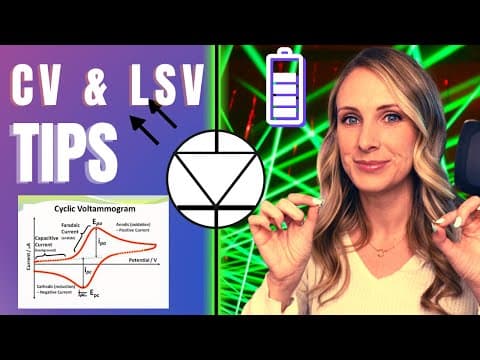
[0:00]CV and LSV are two widely used electrical and electrochemical tests. The difference is mostly in their names, cyclic versus linear sweep. For cyclic voltatry, you're doing a cycle through a potential range or voltage range. Linear sweep voltatry on the other hand is a linear sweep through a potential range. I'll be using the words voltage and potential interchangeably throughout this video. What this means is that you're applying a voltage or a potential across your test sample and measuring the current that flows as a result of that applied potential. With a CV, you start a certain potential, you ramp up or ramp down to a certain potential, and then you loop back around to a higher or lower potential, the reverse of where you went to begin with. For linear sweep voltatry, you're only doing a linear sweep in one direction. From a lower potential to a higher potential and then stopping or from a higher potential to a lower potential and then stopping. For both CV and LSV, the data that you're receiving are the voltage, current, and time. With this information, you can create what's called a tole plot, which is a graph of the voltage versus the log of the current. These techniques are used in a variety of different applications to understand the current flow at different potentials. They are particularly useful to study devices that are used under a varying voltage. Now, let me share with you two examples of why it's important to gather this data. And the two samples that I'm going to be sharing are diodes and batteries, which are very different systems. A diode is an electrical component that allows current to travel in one direction through it. Diodes are typically made by dope semiconductors that form a PN junction. And I love this topic of materials physics, but I'm not going to get into it today. If you want to take your own time to look up diodes and how they work, I strongly encourage you to do so. There are so many different types of diodes. There's rectifier diodes, laser diodes, and even light emitting diodes, which is probably the kind that you're most familiar with. That's like this light right here. In a little bit, I'm going to perform LSV on this rectifier diode. And in general, rectifier diodes are used to translate AC current into a pulsed DC current. Before we get started, let me give you a little bit of background about diodes and cyclic votametry versus linear sweep votametry. For electrical components like diodes, theoretically, no matter how many times you cycle for a CV, you're going to get the same voltage and current reading. There is no hysterisis on current flow because the materials inside the diode are not really changing. Because the materials aren't changing and you're not going to get a different current at a different voltage, there's no hysterisis. Often times, linear sweep votammetry is good enough to get your data. You don't have to cycle it multiple times like you would for a CV. For batteries, which are very different than diodes, if you want to perform CV or LSV, you're going to want to be particularly strategic with how you're applying the voltage to your system. Each sweep of potential in a certain direction will actually cause a change in the current that you observe. You will get hysterisis when it comes to batteries' current output. This is due to the materials changing inside of the battery as you cycle it. If you are a battery scientist though, you often want to study how these changes are happening inside of the battery. How the materials are changing and how that affects the different reactions inside of the battery. For example, you can perform CV on multiple cycles of voltage to look at how a battery cycles and how the reactions inside of the battery change. This could be used to help measure how the materials are degrading inside of the battery. I've even used LSV to measure at what potential electrolytes begin breaking down or reacting. And this was done by sweeping the potential from a low potential to a high potential and measuring at which potential do I see a spike in current flow? That current flow, the higher current flow indicated when my electrolyte was breaking down because it was generating a current as it reacted. If you have any questions on CV or LSV of batteries, please leave your questions in the comments below. I do want to make another video on this topic at a future time and we'll definitely answer your questions. For now, I will be demonstrating how to perform CV and LSV with some crucial tips on this Admiral Instruments Squidstat plus potentiostat. Here at Electric Goddess, we named ours Squidward because we are SpongeBob fans here. At least I am and my coworker is who named this. I just love how it has this super cute squid logo on it, and yet it's a research grade instrument that we use here in our lab. Science can be cute and extremely reliable and functional. Squidward has a really user-friendly interface that's also built by Admiral Instruments as you can see here. It uses a block diagram, so you can design your experiment using little stackable blocks. I designed a simple LSV experiment here in this little block that I'll be using in a moment for both a rectifier diode and then for a laser diode. So we'll see if we can light it up. Like I said earlier, the input signal for an LSV and CV experiment consists of a linear ramp. However, modern digital potentio stats cannot produce a true linear ramp. They have to approximate the ramp by a series of incremental voltage steps that have are defined by the resolution of the analog to digital converter or the ADC. When typical manufacturer's potentiostats are approximating this incremental step for the voltage ramp, they're using a potential of about 1 to 2 mV. While this works for most experiments, it doesn't work when you want to use a very slow or a very fast scan rate. In this potentio stat, however, you can change that step size. So when you're setting your settings for a CV or LSV, you want to pay particular attention to not just the scan rate, which is the scanning rate of the voltage in mV per second. But you also want to pay attention to that incremental voltage step size, measured in mV. Balancing these is essential for resolving the data that you need. Let me explain why that is. For a slow scan rate, the voltage step should be smaller, or else when you do a very abrupt change in voltage, you're going to have an artificially inflated current. The current is going to try to keep up with that large step that it just experienced in voltage. If you do want to increase the voltage by a lot and get that artificially inflated current, you're going to want to use a completely different technique to measure that. And the technique I would recommend is Potentiostatic Intermittent Titration Technique or PITT. So we covered why for slower scan rates, the voltage step should be smaller, but for faster scan rates, we want the voltage step to be larger. Note that at this high scan rate with large voltage steps, you're going to get fewer data points. This could mean loss of crucial information about your system. You want to be mindful about when you're using a fast rate. I often want to use a fast rate because it'll speed up the experiment itself. I don't want to be up all night looking at an experiment. But if I use a fast rate, it can cause that loss in data. It's like taking a picture of something when the subject is moving, it's going to become blurry. That current read out is not going to be very high resolution. The advantage though to using a high scan rate is not only that you complete your experiment quicker, but also because certain systems actually change over time. And so by scanning a system quickly, you're capturing that brief moment when that system was in whatever state it was in. If you do a slower rate, perhaps the system's going to change over time and you're not going to get that data you need about that state that you want to see the system in. In summary, in order to avoid the artificially high or low current in your system, that blurry data, you're going to want to be very selective about your scan rate, your voltage scan rate, and your voltage step size. Now I'm going to set up the LSV experiment for that rectifier diode I showed you in order to demonstrate why it's important to select an appropriate scan rate and step size. Here I connected the rectifier diode to Squidward. Here we have the Admiral Instruments window, and this is the software that controls the Potentiostat Plus. And this is the block I'm using. You can see it's called the DC Potential linear sweep, so this is for linear sweep voltmetry. And I've dragged this block over from this left panel here. So after I drag this block, I can click on this, and on the right you see a list of settings. I have the voltage range set, so that means it'll sweep from negative 0.2 to 0.2 volts. And I have it set to a scan rate of 10 mV per second to start at a sample rate of 1 mV. So that's the step rate, and I'm not going to have any kind of maximum current since this is a pretty sturdy diode. I don't think it'll burst or break if I put too much current through it, especially with this small voltage range. So let's go ahead and run this experiment. We can go to this tab to run an experiment and hit start. Let me switch the view to current versus voltage. This is a typical IV curve or current voltage curve for a diode, where at one end where you have a certain potential, in this case, it's a negative potential. You're seeing current flow, but on the opposite end of the potential range at a positive potential in this case, we're getting no current flow. This shows that that diode, the current that passes through it can only pass in one direction, and in this setup, it's just through the negative potential. When I reviewed the settings, this is a 10 mV per second sweep, and I used a step size of 1 mV. Like you can see, I got a lot of data points, maybe more than I actually need for this curve. But in a moment, let me show you what I get with a faster scan rate and a larger step size. Now I'm back at the build and experiment tab, and I'm going to increase the scan rate to, let's say, 1000 mV per second, 1 volt per second. And I'll increase the step size to 100 mV. Mind you, I'm going from a range from 0.2 to 0.2 volts. And so 100 will definitely skip a lot of data points, but let's just say I want to do this experiment really, really fast. Now I'm starting the experiment and you can see that I only got three data points and the data is completely swamped out. It, it looks like a straight jagged line, so obviously that was not the sampling rate or step size that you want for this data.
[11:52]Let's take a closer look at the data we just acquired. The blue line in this top graph is that slow scan rate of 10 mV per second with the small step size of 1 mV. And then in the red line, you can see the data for the 1000 mV per second scan rate, super fast, and the 50 mV step size. Obviously, we're getting much better data with that blue line than the red line, proving my point that if you want really precise data that high resolution data, you want to use a slower scan rate and a smaller step size. I can't tell you exactly what voltage scan rate and voltage step size you should use for your system because each system is so specific. For instance, when I was doing fuel cell research, I was using a scan rate of about 5 to 20 mV per second. That was the scan rate that we needed to resolve our reactions in our experiments. But when I worked on batteries, I was using a scan rate of about 10 mV per second whenever I performed a CV. Like I said earlier, sometimes there's a trade-off between wanting that high resolution data that a very slow scan rate can give you and wanting to capture that split second of time when your system is in that state.
[13:16]And for that reason, you'd want to use a fast scan rate to capture that. You must choose a scan rate and a step size that compromises between high resolution and capturing that data results in the state that your system is in. To set your scan rate, I recommend learning about the system that you're studying, and particularly the rate of reactions and mechanisms that you're investigating. Then gather a few samples that are exactly the same or as close to the same as possible and run a few tests at different scan rates on those. From there, you can determine at what scan rate and step size render you the best resolution. Finally, when you do this measurement of the different scan rates and step sizes for your system, be sure to take a moment and actually analyze that data and make sure what you're seeing is exactly what you expect to get for this experiment. If you take these steps before completing your final step of getting the data that you actually want to get, then you're going to save yourself a lot of time and possibly headache if you make sure that you're using the appropriate settings for your experiment. After all, you want that perfect dataset for your publication or patent, right? The more you understand the theory behind CV and LSV, the better you'll be able to plan your experiment. Now for fun, let's light up these laser diodes using LSV. Now it's time to try out our laser. I have it wired to the potentio stat, and then I have my camera recording the laser to see when it actually shines and lasers. And then I'm going to lead you through the interface here. First, let's set up the experiment. You can see I have a block diagram of first a measure of open circuit potential for a second and then a DC potential linear sweep that LSV. From 0 volts to 5.3 volts at a scan rate of 200 mV per second and a sampling interval of 1 mV. So let's start this experiment. Now I've started the experiment. I'm going to switch the view to current versus voltage, and we have that increasing potential. Now, look at that diode and see if you can see when it starts to laser to turn green. For 2.5 volts, 3 volts. Oh, there you can start seeing it turning green.
[15:57]And as we increase that voltage, you see the current increasing up to about 1.4, 1.6, 2 milliamps. And then the experiment stopped and the light turned off. That was so cool. You actually saw the current flow through this laser diode and that's why it lasers. And we have the data to prove it. If you enjoyed learning with us, like this video and subscribe to our channel so that you get notified of our next videos. Thanks for watching, fellow cosmic beings. See you next time.