[0:06]Somewhere in medieval Switzerland, a weary traveler is relieved to see a monastery up ahead. He's welcomed, guided to a crowded guest house and promptly served the Abby's specialty. A tall glass of beer. For centuries, monasteries across modern-day Europe were the primary large-scale brewers of beer. But this is hardly where this drink's journey began. Beer refers to any alcoholic beverage made from fermented cereal grains. The edible seeds of a particular group of grasses. The oldest evidence of beer brewing dates back 13,000 years to what's now modern-day Israel. But experts believe the drink developed independently across the world. In each of these regions, its composition was shaped by native grains. For example, 9,000 years ago, in Eastern China, people drank a sweet, cloudy beer made from rice, millet and tubers. In the Andean region of South America, 5,000-year-old pottery suggests production of Chicha, a brew of fermented maize. Whatever the ingredients, ancient beer brewing required two main steps. First, the starches in the cereal grains had to be converted into fermentable sugars. Some groups achieved this by chewing them, while others soaked them in water to trigger germination, a process that naturally breaks down starches. The second step was fermentation. Unbeknownst to brewers at the time, wild yeast found its way into the mixture, carried through the air on fruit or via reused tools still harboring yeasts from prior brews. With time and storage, yeasts converted some of these sugars into alcohol while releasing carbon dioxide. This ancient beer was often imperfectly filtered, so it contained much more fiber, B vitamins, and protein than modern beer. And some cultures boiled the initial sugar mixture, which killed many unwanted microorganisms, making it safer to drink than other available water sources. The oldest surviving recipe describing this process appears in a Sumerian poem dedicated to their goddess of beer, Ninkasi. The Babylonians built on this adoration. Hammurabi's code mandated daily beer rations for every citizen, and any brewer caught overcharging for a pint was condemned to death by drowning. In ancient Egypt, beer was primarily made in the home by women and was a staple of the daily diet. It also played a central role in religious festivals and served as an offering at temples and the tombs of pharaohs. By the 20th century BCE, beer had spilled over from Egypt into Greece, though it wasn't as popular as wine. Nevertheless, over the following centuries, a thirst for beer spread through Europe and beyond. In the early Middle Ages, European monasteries pioneered large-scale beer production, both to provide to traveling pilgrims and to sell to support monastery upkeep. Around this same time, brewers from Central and Eastern Europe made a key change to their recipe. They began adding hops. These green flowers are rich in acidic compounds, imbuing beer with a new bitter flavor and acting as a preservative. Hops became so closely associated with beer that in 1516, a Bavarian duke issued a beer purity law, known as the Reinheitsgebot, that defined beer's composition as strictly barley, hops, and water. The Industrial Revolution ushered in other essential beer innovations, including advances in refrigeration. In 1876, French chemist Louis Pasteur identified yeast's role in beer fermentation. With this, a key beer ingredient was finally made visible. Brewers began selecting for different yeasts to refine recipes and experiment with flavor. Today, there are well over 100 distinct beer varieties, with lagers and ales being the two main types. Lagers, which include pilsners and bocks, are fermented with yeasts that thrive at colder temperatures and live at the bottom of fermentation vessels. Ales, like porters, stouts, and pale ales, ferment quicker with yeasts that live at higher temperatures and float at the top of the mixture. But some beers break this mold. Kölsches, for example, start with ale yeast, but are finished at colder temperatures like lagers. Others draw on ancient methods, like Belgian Lambics, which rely on spontaneous fermentation with wild yeast. Meanwhile, there are still new challenges to navigate. The growing demand for non-alcoholic beers has pushed producers to find ways to limit or remove alcohol while still preserving flavor. And if history is any indication, beer's story will continue brewing for many years to come. If you enjoy learning about history, subscribe to this channel. Because the lessons of yesterday can help us face the challenges of today.
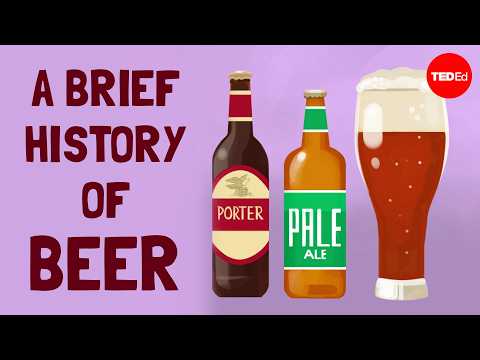
One of the world’s oldest beverages - Malcolm Purinton
TED-Ed
6m 16s730 words~4 min read
YouTube auto captions
Transcript source
YouTube auto captions
This transcript was extracted from YouTube's auto-generated caption track. The transcript below is server-rendered so it can be read, searched, cited, and shared without opening the original YouTube player.
Pull quotes
[0:06]Somewhere in medieval Switzerland, a weary traveler is relieved to see a monastery up ahead.
[0:06]He's welcomed, guided to a crowded guest house and promptly served the Abby's specialty.
[0:06]For centuries, monasteries across modern-day Europe were the primary large-scale brewers of beer.
[0:06]The oldest evidence of beer brewing dates back 13,000 years to what's now modern-day Israel.
Use this transcript
Related transcript hubs
Watch on YouTube
Share
MORE TRANSCRIPTS


