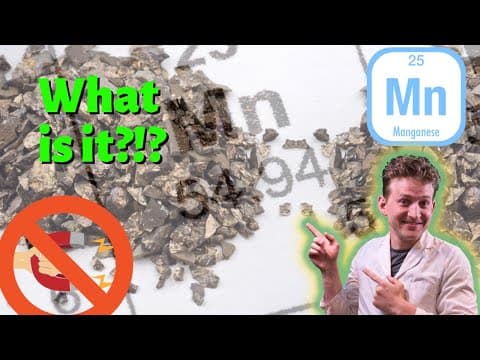
[0:00]Hello, and welcome back to another element feature with District of Creativity. Okay, this is a really cool one. This is manganese.
[0:07]This is one of my favorite elements, although I say that with every single element, so take that with a grain of salt. Okay, so manganese, one of the most confusing elements on the periodic table of elements, not because it's complicated or we don't understand it, but because it's named very strange. Manganese, it is not magnetic and it has nothing to do with magnesium. So, yeah, it's just another element. Let's break this down into a few different sections so that I can keep my thoughts straight. First of all, what is it? Second of all, what is the history of manganese? And thirdly, what are the uses of manganese? Okay, pretty straightforward. Uh, what is it? Well, manganese is an element on the periodic table of elements with an atomic weight of 25, and it is incredibly useful both for life and for basic industry and production. Can you eat it? No, I mean, yes, you should, but not, you shouldn't. You need manganese to survive. But just a very, very, very small amount. If you were to just start ingesting large amounts of manganese, you would have manganese toxicity levels in your body that would cause neurological damage. It would give you brain damage and reproductive damage, and you'd probably die. So just don't eat pure manganese, just, you know, take little bit of supplements every so often because your body does need it. It is a silver metal that is very hard and very brittle, so you couldn't just melt this down and make a sword out of it. I mean, you could, but the sword would probably break because it's so brittle. You need to mix it with something else like iron, which we'll get to later on. It has a very high melting temperature, so you're it's okay to hold it. It is not toxic to touch, so you can feel it and touch it without getting toxicity in your skin. All throughout history, manganese dioxide was the most common form that we had of manganese. And that's what it looks like there. It's a black powder, and we got ours out of some batteries, some, uh, zinc batteries, which we don't recommend, but if you want to see how manganese dioxide is used in a battery, you can go check out that video. So what is the history of manganese? Why is it called what it is, because it's not magnetic, it's not related to magnesium. Well, manganese comes from the ancient Greece region of Magnesia. And this is all ancient history, so we're there's a few different theories about where the name actually came from. But in Magnesia, there were the male suffix and female suffix that they would give to different rocks and different compounds. And they found a couple of new rocks that they were able to find out were different. One of them became iron ore and magnetite, which is where the word magnet comes from. Eventually, through like Latin, and then the secondary, the female suffix of Magnesia's material was manganese. This continued all throughout history because we were able to find manganese dioxide fairly easily in nature and create it. And guess what me manganese dioxide is a very powerful marking. So you could take some manganese dioxide and draw on a cave wall and suddenly you have paintings. Hooray, art. Yay. And eventually manganese could be combined with things like potassium and then create a vivid purple color or vivid other colors as well. Very cool. This continued all the way up until 1774 when the Swedes got involved. Hoy, this feeds got involved with science. Yeah, the scientist Carl Sheer. Now, he theorized that manganese was an element on the periodic table of elements, and later that year, it was actually proven to be so because they were able to refine some with Johan Gotlib Gan. All right, so then what are some of the applications of manganese? Well, manganese when you mix it with certain other elements, it becomes a very powerful oxidizer. When you mix it with potassium or sodium, suddenly it really wants to rip the oxygen away from other things, which is why it's used with water purification. So potassium permanganate, which I've made a couple of episodes on, check them out here if you want to. is used with water purification and water treatment because it just kills all of the organic matter. But by far, all of the manganese that we mine out of the ground, most of it gets used with steel or iron production because mixing a little bit of manganese with your iron makes it much stronger. And it holds an edge better, and it's just so much better than just iron by itself. Interestingly, some historians think that the city of Sparta was actually the first one to mix manganese with their steel or with their iron. Which is why the Spartans had better swords because they could hold their edge better and they were harder, which is a very cool historical tidbit that we can't really prove. So, maybe it's true. Maybe it's not. Who knows? Manganese is essential for photosynthesis, for the the process that plants make sunlight into oxygen. So without manganese, we wouldn't have any oxygen on the earth. Uh, without manganese in our bodies, we wouldn't be able to do some essential bodily functions, and we would die because of it. So manganese is very, very useful. Now, how do we get it? Well, we do mine it out of the ground with pyrolusite, I believe is what the the ore is called. I could be wrong in the name there, but it looks like this and that's how it's spelled. That's the common ore that we get manganese from. Now, you know the video game Subnautica. Now, Subnautica, you are trying to survive on an alien world, and you go mine under the ground, and you pick up little bulbs of elements everywhere, which is totally unrealistic. You can't just go and find a bulb of potassium and pick it up, but with manganese, actually that is kind of how it works. If you go way down in the ocean near a hydrothermal vent, you can find manganese nodules, which are made up of almost 28% pure manganese. So you really could dive down if the pressure didn't crush your body and just grab a nodule, and you'd have almost pure manganese, which is so cool. It's not very often that real life imitates a video game. Anyways, this is destructive creativity. I hope I helped you out with an overview of what manganese actually is. Do you know of any other uses that manganese has? Let me know down in the comments. See you next time, we have new stuff coming out every single Wednesday. Bye.


