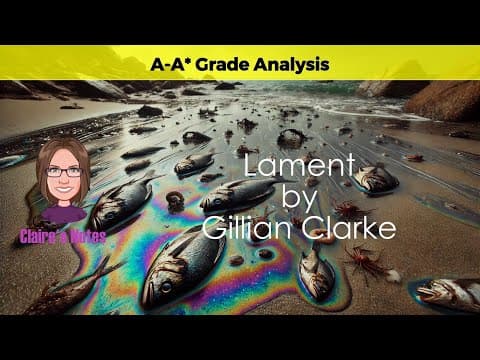
[0:05]Lament by the Welsh poet Jillian Clark was written during the Gulf War, which took place between 1990 and 1991. This war began when Iraq, led by Saddam Hussein, invaded Kuwait, claiming historical ownership and aiming to control its vast oil reserves. This act threatened global oil supplies and destabilized the region. A US-led coalition, including Britain, launched Operation Desert Storm in January 1991, using air strikes and ground forces to drive Iraqi troops out of Kuwait. The conflict caused massive environmental destruction. Retreating Iraqi forces set fire to oil wells, creating toxic smoke and spilled millions of barrels of oil into the Persian Gulf, devastating ecosystems. Civilian casualties and long-term regional instability followed.
[1:10]In Lament, Clark mourns various losses caused by this human conflict and environmental destruction. The poem is deeply evocative, blending nature's suffering with the violence inflicted by humanity. Clark's use of imagery connects the natural world with tragic consequences of war and ecological damage. On her own website, she explains that Lament is an elegy, an expression of grief. It can be a sad, military tune played on a bugle. The poem uses the title as the start of a list of lamented people, events, creatures and other things hurt in the war. War can't be waged without grave damage to every aspect of life. All the details in the poem came from reports in the media.
[2:06]These reports included photographs of wildlife such as cormorants covered with oil and a soldier burnt when his tank was bombed, as well as radio interviews with the mothers of fallen soldiers. She also explains that the creatures who appear in the poem were listed by Friends of the Earth as being at risk of destruction by oil pollution.
[2:29]The poem comprises seven stanzas of three lines, otherwise known as tercets. It is written in free verse, which means that it has neither a fixed metrical or rhythmic structure, nor a set rhyme scheme. Each line is end-stopped with either a comma or a full stop. This lack of enjambment contributes to a slow, deliberate pace, with each line standing on its own as a self-contained thought. This mirrors the solemnity of a prayer or elegy, allowing the reader to pause and reflect on the gravity of each lamentation. The end-stopped lines reinforce the sense of finality and mourning, as if each image or event is being carefully and respectfully acknowledged before moving on to the next. This measured rhythm enhances the poem's tone of sorrow and reverence for the victims of war and environmental destruction.
[3:36]The poem's structure is built around a series of "for" phrases, each expressing sorrow for different subjects, from endangered animals to the individuals involved in warfare. The use of anaphora with the repetition of "for" eleven times at the beginning of each verse, and a further four times within the body of the poem, creates a solemn, rhythmic quality that echoes the tolling of a funeral bell. This repetitive structure, enhanced by the asyndetic nature of each lament, reinforces the mournful tone of the poem, as each "for" introduces another casualty or loss to be grieved. Like the measured striking of a bell, the repetition invites contemplation and emphasizes the sheer scale of destruction, each toll marking a life, a species, or an aspect of the natural world devastated by the war.
[4:46]The effect is both hypnotic and haunting, mirroring the persistence of grief and the unrelenting nature of the damage caused.
[4:57]Clark's diction is lyrical. Her choice of words often carries a musicality and emotional resonance that enhances the elegiac tone of the poem. This lyrical quality heightens the poignancy of the subject matter, making the destruction even more vivid and heartbreaking. She skillfully weaves sound patterning throughout, such as alliteration, e.g., the "dugong and the dolphin." Extensive sibilance, e.g., "nest of sickness" and "iridescence on the sand." Consonance, e.g., "hook-beaked," and assonance, e.g., "struck dumb." The poem is rich with figurative language. Note, however, that there are no similes, only metaphor, e.g., "nest of sickness," and personification, which is a specific type of metaphor, e.g., "the cormorant in his funeral silk." This focus on metaphor intensifies the poem's impact. By asserting that things are rather than merely being like something else, Clark suggests that the destruction caused by war has fundamentally altered the essence of the natural world. For instance, the "cormorant" isn't like a mourner, it is "in his funeral silk." Ocean isn't just tainted, it bears a "mortal stain." This choice of language reflects the permanence of the damage, emphasizing that the world hasn't simply been disrupted, but transformed irrevocably. It underscores the poem's sense of grief and loss.
[6:57]Jillian Clark explains that the poem uses the one-word title, Lament, as the start of a list of lamented people, events, creatures, and other things hurt in the war. The word Lament is understood to be tacitly present before each instance of the word "For," e.g., [Lament] For the ocean's lap with its mortal stain. [Lament] For Ahmed at the closed border.
[7:30]The poem begins, "For the green turtle with her pulsing burden, in search of the breeding ground. For her eggs laid in their nest of sickness." This first image of a pregnant turtle seeking the exact beach where her instincts tell her to lay her eggs, is particularly poignant. A burden can be a literal physical weight, as well as metaphorically a natural responsibility. This dual meaning highlights the turtle's vulnerability and the significance of her journey, carrying the weight of life but also the curse of survival in a poisoned world, adds a tragic dimension to the turtle's mission.
[8:25]The use of the adjective pulsing to describe this burden, not only evokes the life that she carries with her, but also suggests the urgency of her mission. The plosive "p" and "b" here, enhance the sense of vitality and tension, mirroring the heartbeat of new life within the eggs. This vitality, however, is juxtaposed with the despair of the "nest of sickness" in the oil-saturated poisoned sand. We associate a nest with birth and new life, but instead this one will only breed death and disease and emphasizes the tragic futility of her instinctual journey, as her offspring are doomed by the polluted environment even before they are hatched. The use of the definite article "the" in "the breeding ground," conveys the way these creatures are hard-wired to go back to their ancestral breeding ground, even though it is poisoned. They are unable to adapt to sudden environmental changes like this. This contrast sets the tone for the rest of the poem, highlighting the clash between nature's resilience and the destructive impact of human activity. In the second stanza, Clark alludes to oil deliberately spilled into Persian Gulf by retreating Iraqi army.
[10:19]The phrase "funeral silk" refers to the black clothes that are worn to a funeral, and so evokes the shiny, viscous black coating of oil over the bird's feathers. Through this use of personification, Clark creates an image of a mourner dressed for a funeral after the death of his habitat. This funereal imagery is further developed in the next line, as the oil has left a veil of iridescence on the sand, and reinforces the poem's tone of sorrow and loss. Black veils were traditionally worn by women at funerals up until the mid-20th century. If something is iridescent, it shows luminous colors that seem to change when seen from different angles. This is caused by the way light interferes with the thin layers of the surface, reflecting and refracting different wavelengths, and is typical of the appearance of oil. This image evokes how the oil has left a beautiful yet poisonous sheen on the sand. The image of a shadow on the sea, caused by the oil slick, is also a metaphor for death and creates a sense of foreboding and inevitability. Note the extensive sibilance in this stanza, with a combination of "silk," "iridescence," "sand," "shadow," and "sea." Its hissing quality, evoking an insidious sense of a spreading evil. This stanza seems to deepen the theme of ecological destruction, illustrating not only the physical damage caused by human activity, but also the emotional toll it takes on the natural world. The third stanza continues the poem's exploration of the environmental devastation, as it begins "For the ocean's lap with its mortal stain." The word lap evokes the gentle rippling sound of the water as it washes against the shore. It now, however, carries a "mortal stain." Literally, this is the black coating of oil that will bring death and destruction, as it in turn will "stain" and poison the land. Metaphorically, this evokes a blood "stain," as though the ocean has been "mortal[ly]" wounded, or injured in such a manner that it will ultimately lead to death. Clark now switches her focus to the human collateral damage of this war. "For Ahmed at the closed border. For the soldier with his uniform of fire." By giving the refugee a name, Clark moves from a generalized image of suffering to one of individual tragedy, highlighting the toll that war takes not only on the land, but also on the lives of innocent people. The "closed border" is particularly poignant, because it symbolizes the hopelessness and entrapment of refugees, unable to escape the conflict that ravages both their homes and their futures. The soldier in his "uniform of fire" intensifies the hellish imagery of war. Where death is not abstract, but visceral. The image of being burnt to death adds a layer of horror and suggests the brutal, unrelenting nature of the violence. This stanza makes the poem shift from the natural world to the human world, connecting the two by illustrating how the devastation of nature parallels the suffering of people caught in the war. In the fourth stanza, Clark laments "the gunsmith and the armourer." The inclusion of those who furnish and maintain weapons and defense systems, and who could be said to profit financially from warfare, deepens the sense of mourning in the poem. Not just for the victims of war, but also for those who, perhaps without choice, become complicit in it by making weapons.
[14:43]This adds complexity and a certain moral ambiguity to Clark's critique of war. It's not only the soldiers and civilians who suffer, but also those whose livelihoods are tied to the production of violence. The lament for them could be seen as an indictment of a system that perpetuates destruction, suggesting that their work, though essential to the war machine, contributes to the cycle of death.
[15:15]The lines "the boy fusilier who joined for the company, the farmer's sons, in it for the music," creates an image of innocence and vulnerability, and distances these people from the dictators and governments who are really waging the war. Clark's portrayal of these young men as joining for personal reasons, i.e., human connection or a desire to be part of a military band, emphasizes their innocence and vulnerability. They have not been driven by political motivations, but are instead caught up in it for more personal, even naive reasons. This disconnect between their motivations and the larger political forces at play adds to the tragic nature of their involvement. By using "boy" and "sons," Clark also reinforces the theme of lost potential, highlighting the youth of these individuals and the bright futures that are cut short by war. Whether they survive or not, they are victims in a different sense. Victims of the system, of their own vulnerability, and of the misguided reasons that led them to war. Clark returns to the environmental impact in the fifth stanza. "For the hook-beaked turtles, the dugong and the dolphin, the whale struck dumb by the missile's thunder." The term "hook-beaked turtles" is another name for the Hawksbill turtle, which is a critically endangered species. The Dugong is a sea cow, similar to the much better-known Manatee, found on the coasts of the Indian Ocean. By specifically mentioning "hook-beaked turtles" after already referencing green turtles and dugongs, Clark is drawing attention to the diversity within the natural world, and highlighting that all forms of life - no matter how unique or less widely known - are at risk. This reinforces the poem's broader message about the widespread impact of human activity on the full spectrum of life forms, not just on the most obvious or well-known species, but on the full spectrum of life forms. The line "the whale struck dumb by the missile's thunder," does more than just suggest the physical destruction caused by war. It also evokes the psychological and sensory impact on the natural world. Whales, with their complex communication and reliance on sound, would be profoundly affected by the noise of missiles and explosions, disrupting their ability to navigate and communicate. The repetition of the harsh sounds in the guttural consonants of "hook-beaked" and "struck," and the plosive alliteration of "dugong and the dolphin" and "dumb," and the assonance of the short /uh/ in "struck dumb" draw attention to these creatures' collective peril, heightening the emotional weight of their inclusion.
[18:35]Clark continues, "For the tern, the gull and the restless wader, the long migrations and the slow dying, the veiled sun and the stink of anger." Terns and gulls are related seabirds who spend much of their time airborne as they search for food, rely on fish for survival, while waders are shorebirds, such as sandpipers and plovers, that are commonly found wading along shorelines and mudflats searching for food, often by probing or digging in the mud and sand. The adjective "restless" has negative connotations, implying unease or discomfort. This could reflect the bird's struggle to survive in its polluted habitat, where the water it wades in, its lifeline, has become a source of harm. The fact that migrations are long suggests that yet more of the bird's instinctual behavior - this time to migrate at certain times of the year to warmer or cooler climates - has been made even more arduous and more fraught with danger by the polluted air through which they have to fly. The slow dying to which they are now subject, conveys prolonged suffering, and suggests that the harm inflicted on the environment is not immediate, but lingering, creating a sense of inevitable decline and helplessness. The image of a "veiled sun" is a powerful one. The sun is personified as the smoke from the burning oil fields obscures it, and acts like a funeral veil, symbolizes the death of nature and the world as it once was. It adds to the poem's mournful tone, and reinforces the theme of mourning for the planet. The image of the "stink of anger" fuses the sense of smell with an emotional state. This merging of sensory and emotional realms conveys the palpable, overwhelming rage and grief that hangs in the air. It could also refer literally to the acrid smell of burning oil, linking the physical to the emotional devastation caused by war.
[20:59]Clark concludes the poem with an apocalyptic vision of death and destruction. "For the burnt earth and the sun put out, the scalded ocean and the blazing well. For vengeance, and the ashes of language." The image of the "burnt earth" evokes the devastating aftermath of human conflict, where the land itself is scorched and rendered lifeless. A scorched earth policy is a military strategy of burning or destroying crops or other resources that might be of use to an invading enemy force, and alludes to the way the defeated Iraqi army sought to set everything on fire as they retreated. The "sun put out" is a chilling metaphor.
[21:47]It directly connects to the earlier image of the veiled sun, but takes this imagery to its ultimate conclusion: the extinguishing of life itself. The casual connotation of the verb "put out," as though it were as easy as flipping a switch, emphasizes human recklessness and the fragility of the natural world.
[22:08]It also suggests a terrifying imbalance, where something as monumental as the sun can be destroyed by human actions. The verb "scalded" personifies the ocean, giving it a sense of suffering and vulnerability, as if it were a living entity capable of feeling pain. This ties into the broader theme of nature being a victim of human actions. The mention of the "blazing well" directly refers to the oil wells set ablaze during the Gulf War, a striking image of wastefulness and destruction. This was a calculated move to wreak havoc, pollute the environment, and deprive others of resources. The blazing oil signifies not only environmental devastation, but also the greed and violence that underpin such conflicts. The final line, "For vengeance, and the ashes of language," ends the poem on a sombre note. The idea of vengeance shifts the tone slightly, suggesting the human motivations behind war: retaliation, anger, and an endless cycle of violence. The metaphor "the ashes of language," which Clark herself explains as a reference to the death of truth during war, suggests that much more than the physical is lost. The inclusion of these abstract concepts contrast with the tangible imagery of earlier lines, adding a broader philosophical layer.
[23:45]Thanks for watching. If you have any questions, please let me know in the comments section below, and I'll do my best to answer them. Don't forget to subscribe to my channel for more videos on English language topics and exam techniques, and English literature texts.