[0:00]Today I'm going to show you the easiest and most effective exercises I've ever used for getting pretty much instantaneous results improving your rib flare. First, let's talk about what rib flare actually is, so we can understand the mechanism for how we can get quick improvements. Rib flare down here in particular is representative of a lower rib cage that is in an inhaled position. I talk about this a lot in a lot of my other content. When we normally inhale, what should happen is our rib cage should expand in all directions, front to back, side to side, and our belly should rise simultaneously with that. And it doesn't have the ability to expand in all directions as it normally should, then we're going to have a little bit of a problem because our lungs are in our rib cage, and we need to expand it in some way. So we're going to find a way to create compensatory expansion via the path of least resistance. The way we're most often going to do that is move these lower ribs up and out of the way. So what we want to do is we want to actually get these low ribs to come down and facilitate more opening of the back because, obviously, if I'm stuck in this position right here, muscles of my lower back and upper back are probably going to get a little bit tight. So we want to facilitate better expansion by holding these ribs down right here and getting this space to open up. Because there's actually more space for expansion to occur in our back rib cage than our front rib cage. So by getting more expansion in the back rib cage, we can get more bang for our buck in improving rib cage dynamics and getting rid of this lower rib flare. Therefore, because I'm touching on breathing a lot, the most important thing is how we're going to breathe during these exercises. Let me review that really quick, because this is essential, and if you're not getting this right, you're not going to see much success here. The first and most important thing is a full long exhale. Put your hands in your low ribs right now. Stand up or sit up nice and tall and just softly exhale through your mouth like you're sighing, like you're disappointed in someone. And even softer than that. It can be like this. Whatever it is, you need to have your mouth open. It can't be because your mouth is like a faucet. Imagine a faucet of water. If that faucet is very narrow, then you're not going to get much air out. But if your faucet is wider, then you're going to get more air or water coming out of that faster. So, you want to make sure that it's a soft and long exhale for about 5 to 10 seconds. Because what that's going to do, if you do that, you're going to feel your ribs come down right here. And you're going to feel at the end of that exhale, a little bit of side ab tension, not your six-pack, but more so your side abs. If you can get that, and you can hold on to that very subtly as you inhale through your nose, you're going to feel your ribs expand in all directions. So the key is, after you feel those side abs a little bit, just relax, close your mouth, maintain that a little bit, maybe just two out of 10, and silently inhale through your nose. You should feel this all open up and that's great. That's exactly what we're looking for here. I should not hear you inhale because if I do, you're probably more likely to use your neck, and we don't want you to use your neck. When I see someone's neck kick on, it's because the neck is trying to take over for the role of the diaphragm. We want the diaphragm to create this expansion primarily and not the neck as much. So to recap, a nice soft and full exhale through the mouth, nice and soft, for about that 5 to 10 seconds. Close your mouth and then silently inhale through your nose for about three to five seconds, depending on what's comfortable without you feeling your neck. With that in mind, here are the really easy exercises. What we're going to do here is get a pillow about that thick and fold it in half. Or you can get some sort of soft object that will allow you to be in this position pretty comfortably. And what we're going to do is get that underneath our lowest ribs and our belly just like that. And then we're going to get in a child's pose position. Right like that. So, you can tell that Trevor is doing his best to rock his hips back towards his heels. And he's about as far back as he can go comfortably and you need to be in this position 100% relaxed. If you can't, we'll talk about some modifications, but this is generally where we want to end up, where we have length and relaxation in the back. The head's in a neutral position and it's not too far down or too far up, it's nice and relaxed. And we also have our elbows towards our knees right there. And we're going to focus on feeling just a little bit of inner elbow contact. If that isn't possible or comfortable for you, what you could do is simply widen your elbows out a little bit. And then sort of bring your hands together like that and you can adjust it as necessary. Whatever's comfortable for you. Now the breathing sequence is the same as it would be on any other exercise. So nice, soft, long exhale through the mouth. And then at the end of that exhale, close your mouth and then put your tongue on the roof of your mouth and inhale through your nose very silently and slowly. And you're going to feel your back expand. It's going to feel really nice and relaxing. If you're finding it's uncomfortable to rock your hips back very far, take a foam roller, put it right there and now it'll wedge your hips and your feet closer together. And you'll be able to stay there pretty relaxed and hang out. Just make sure that you're still chilling through here. If you like this approach of simple and easy exercises that address a lot of the common issues that people deal with, check out my beginner body restoration program, which has a lot more where this came from. We're going to get in this seated position, obviously, but we have a step underneath Trevor because that's what's allowing him to keep his whole foot flat but still get around a 90° bend up both his knees and his hips. So if your chair allows you to do that, great, stick with it, but regardless, you need to be able to feel your sit bones on both sides throughout the duration of this exercise. So those little bony protrusions in each butt cheek, make sure you're feeling relatively even contact with those while you go through this. We're going to take that pillow, fold it in half, so it's about that thick, which is what you want, and we're going to wedge it in between our lowest ribs and the top of our thighs right there. And now we're going to do is take our arms over them. And we're going to get in this position where we have a bent elbow, palms facing us, and now we're going to reach and protract forward. So we are going to bend forward a little bit and that's okay because the goal of this exercise is to open up our backs. So, holding that position right there, keeping your whole foot flat on both sides, feeling your sit bones a bit. We're going to exhale through our mouth nice and soft and long and at the end of that exhale, sighing it out, we're going to feel a little bit of side abs engaged. And you're going to slightly maintain that, the pillow's there to help you do that. And then softly and silently inhale through your nose for about 5 seconds, 3 to 5 seconds depending on how comfortable you can be. And then exhale again. Keep working through that for about five breaths. Some things to keep in mind here is that we want our head to be in a neutral position. So it shouldn't be shoved far forward or retreated back. We want it to be that we're looking somewhat in between our hands straight ahead right there, and that will ensure we're in a pretty good neck position. And the other thing is that people, despite this being a flexion-based exercise, will want to sit up when they inhale. That's you trying to breathe into your belly and extend, so we're trying to get your back to relax, we're trying to open up your ribs in the back. So, maintain that posture right there. It's actually a little bit better to be a little bit more slouched than extended. We can do other drills to open up your front ribs, but the purpose of this is to open up your back ribs. I would recommend doing about two sets of 5 to 10 breath cycles on each of these exercises. You should be able to stand up and see an immediate difference within your rib flare.
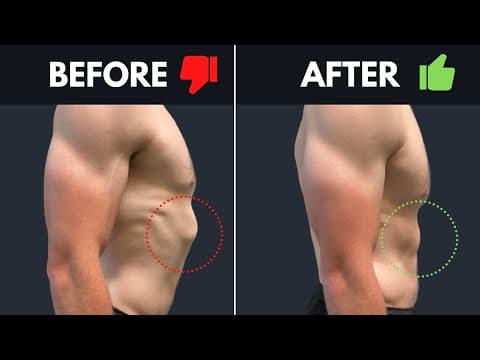
Fix Rib Flare In 1 Exercise (fast results)
Conor Harris
8m 11s1,614 words~9 min read
YouTube auto captions
Transcript source
YouTube auto captions
This transcript was extracted from YouTube's auto-generated caption track. The transcript below is server-rendered so it can be read, searched, cited, and shared without opening the original YouTube player.
Pull quotes
[0:00]Today I'm going to show you the easiest and most effective exercises I've ever used for getting pretty much instantaneous results improving your rib flare.
[0:00]First, let's talk about what rib flare actually is, so we can understand the mechanism for how we can get quick improvements.
[0:00]Rib flare down here in particular is representative of a lower rib cage that is in an inhaled position.
[0:00]When we normally inhale, what should happen is our rib cage should expand in all directions, front to back, side to side, and our belly should rise simultaneously with that.
Use this transcript
Related transcript hubs
Watch on YouTube
Share
MORE TRANSCRIPTS


