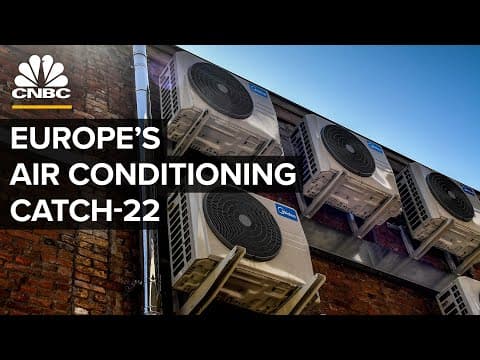
[0:00]Europe is heading for a tough winter. It's going to be a gloomy winter on the streets of Germany, shop windows darkened after 2:00 p.m. and advertising displays extinguished.
[0:11]And when winter's over, European countries may have some tough choices to make before summer comes around again. Europe faced sweltering heat waves this past summer. They ignited wildfires, worsened existing droughts and caused the spike in heat related deaths. Authorities suspended flights after the runway buckled and a military source told our sister network Sky News the Royal Air Force stopped all flights at the largest air base in the UK because the runway melted. This past summer was the hottest on record in Europe. Spain and France saw seven times the amount of land burnt in wildfires through this July, compared to average levels.
[0:52]Spanish and Portuguese authorities say more than 2,000 people died in the two countries due to extreme heat. What large parts of Europe lack may be taken for granted by some in the US. Air conditioning. Fewer than 10% of households in Europe own an air conditioning unit, according to the International Energy Agency. There's a number of reasons for it. One is, everyone would accept that last summers in the UK, in the past over, you know, all the years I've been here working and what have you, and even for as a child, like, you rarely have a huge, long sustained hot weather that continues for more than a couple of weeks. So, I think it's often been the attitude that people would grit their teeth, get through that and, and move on from there. The other thing that we've got here that in the US it's certainly not a problem having stayed in a few apartments around that way is about 90 to 95% in our experience of apartment blocks here, won't allow lease holders to install an air conditioner. Air conditioning is a big catch 22 in a warming world. It's a big contributor to carbon emissions, yet, demand for air conditioning will increase along with rising temperatures.
[2:18]If we were looking at the beginning of this summer, it was fairly quiet, to be honest with you. Like, we were getting typically 20 inquiries a day maybe for people interested in air conditioning. And following on from when it was suddenly reported on the BBC and all over the weather were going to hit 40 degrees, literally that afternoon the calls went absolutely wild.
[2:43]More so than, I mean, I've been here for over 15 years now and I've never seen anything quite, quite like it. The United Kingdom is only getting hotter. Two studies found that the UK is now much more likely to have temperatures in the 104 degrees Fahrenheit range, which is the highest on record there. by looking this climate projections, it is clear that if no effective mitigation strategies will be put in place at a global scale to cut emissions. Then this kind of summer and this kind of events will become the new norm because we we are going towards really an increase and intensification of extremes, both in terms of intensity, but also in terms of occurrence.
[3:33]Air conditioning can help the short term effects of heat waves, but it can also contribute to rising temperatures in the future. Despite the fact that people often sense temperature and adjust their thermostats with temperature, humidity can actually be what causes a lot of the emissions that we have for, for climate change. The national renewable energy lab recently conducted a study on emissions from temperature control. So if you look at all the emissions across the globe, 4% of those are due to air conditioning. Some of that is refrigerant leakage, and some of that is energy use for both temperature and humidity control. And so that's around 2% of global emissions, temperature and humidity control. So about half of it's for controlling humidity and half of it's for controlling temperature. A lot of people point to water, air and geothermal heat pumps as a sustainable temperature control method. But they're not a silver bullet. Today, heat pumps use a lot of extra energy to remove humidity than they could if you had a better technology to control humidity. They they do they do control humidity, but they do it much less efficiently. There is a need to adapt, adapt means develop and implementing sustainable adaptation strategies in each different sectors, may be agriculture, energy sector in a way that what we do is of course reducing the risk and the impacts of climate change, especially extremes.
[5:06]NREL's Jason Woods points to a different method for reducing emissions surrounding temperature control. Some of the technologies we're working here at, at NREL are focused on doing improved humidity control because there's a lower hanging fruits so to speak to improve cooling efficiency by focusing on that as opposed to improving standard air conditioners as they are today. Most current air conditioning systems remove humidity in the building, while also lowering temperatures. Doing both at the same time is not very energy efficient. Which is why creating a system that separates the two functions, removing humidity and cooling the air could create air conditioning systems with smaller carbon footprints. This is what scientists like Jason Woods call quote, separate sensible and latent control. there's a lot of efficiency advantages by kind of separately controlling humidity and temperature at the same time. And we're working on technologies like that here at NREL but that's there's a lot of technologies that the Department of Energy is focused on from universities and other national labs is kind of focusing on that separate sensible and latent control as they're calling it. Richard Salmon's company in London has begun to install more efficient air conditioning products like air source heat pumps. the magic that those units do. We've been installing a fair few of these um air source heat pumps recently and uh, the uh, the efficiency that uh, people are getting out of it are just phenomenal actually and and really green down bills, as well as being more environmentally friendly.
[6:39]I think it's it's very difficult to say, I know you're uncomfortable, but you don't need to have air conditioning, right? We I don't think we want to have that as our as our policy. And so I I think there could be some careful thought about what minimum standards we should include for air conditioners as we start to roll them out, if we know we're going to use more air conditioning, especially in Europe where they have these heat waves. How do we ensure that as a society, we're installing the efficient air conditioners? As we move more into the, the heat pump technology side, which is going to gather a lot of steam and get bigger and bigger over the next few years. You know, we're not even advertising on that and we're getting a huge amount of inquiries um to uh, to do it. And the, the real issue is it's all about skill shortage. That there are not enough people to install. And I think there's a, there's a feeling with gas boiler engineers that the old ones can sort of get by over the next 10 years just still doing gas so they don't have to learn the new technology. But this sort of younger generation coming through, they, you know, they need to, this is what's going to happen, they, they need to learn about this. And um, so we're doing whatever we can to sort of help the UK to meet its target. Yeah, large scale drought affecting one region may also have consequences through a cascade of impacts in uh, regions, in other regions of the world that are really far from the, the one where the event is happening, because often we are really focusing on uh just uh where the event or an event is occurring. But we, we need to really switch these uh, this approach and look at the global perspective and the, the global scale.


