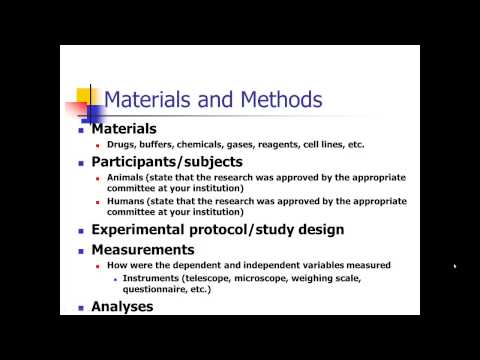
[0:14]So in this third module, we're going to talk about writing the methods section. So the methods and material section to give a clear overview of what was done. It's basically the recipe for the study. It gives enough information that you can replicate the study, essentially just like a recipe. You want to be complete in your methods and material section. You want to give enough information that somebody can replicate your study. But try to minimize the complexity, try to make life as easy as possible for your reader. So when you're giving those details, try to think of ways that can make it a little bit easier for your reader to digest. So a couple of ways you can do that is to do things like break your results section into smaller sections with subheadings. Cite a reference for commonly used methods rather than going to all the details if it's something that's really common. And wherever possible, display methods information in a flow diagram or even a table. And you get creative, but there's a lot of things in the methods and materials that is a lot better presented as a table or a flow diagram rather than as a text. And in the method section, we're going to jump ship on some of the things that I told you, so you're going to be allowed to use jargon and the passive voice more liberally in the method section. This is the place to stick all your jargon and your passive voice. You're going to need to, it's going to it belongs there. So I mentioned, um, the, uh, guide to, um, clinical in this clinical chemistry scientific writing series that was written by Thomas Ansley, in clinical chemistry. Again, I'm going to refer you to that whole series, it's really available online. Um, I pulled a few key figures, uh, from his series that I really liked. This is a really busy slide, and I'm not going to go over it in detail, but I thought it was really useful this table that he put together for the methods section. Basically, he's saying the methods section is the who, what, when, where, how, and why. And it goes into details for each of those. Who maintained the records? What was used? When was it done? Where were the records kept? So it's a really kind of a nice checklist to go through as you're writing your methods section. Not all of these, um, questions will apply, but most of them will apply, and it really gets you thinking about all of the different things that need to go in your methods. So I really like this table, and I'll leave it there, uh, for you to, to look at, and again, refer you to that series. Again, it applies more than to just clinical chemistry, it applies kind of across all scientific disciplines. So what do you need in your materials and methods sections? Well, you need to tell about the materials, things like drugs, buffers, chemicals, gases, reagents, cell lines. You need to give specifics like pH, temperature, uh, ingredients, doses, all of those things. You, uh, may have participants or subjects like animals or humans. You, of course, want to state that the research was approved by the appropriate committee at your institution. So those things have to be approved to do those kinds of studies, and you need actually an official statement of that in your methods section. You'll also have some kind of experimental protocol or study design, depending on exactly what type of study you're doing, what, uh, steps did you go through in your experiment. There's going to be something about measurements. Everybody has to measure variables, no matter what discipline you're coming from. So how did you measure your variables? How'd you measure your dependent and independent variables, what instruments did you use, telescopes, microscopes, weighing scales, questionnaires, etc. And then finally, how did you, what analyses did you do? How did you analyze your data at the end of the day? So those are your basic elements. Now, the materials and methods section, of course, is going to differ slightly depending on what scientific discipline you're coming from. So I'm going to give kind of a high level summary here that would apply sort of across, but these are your basic elements that you're looking for, having in that section. I really want to encourage you to make life easy for your reader. The methods section is not the most fun section to read. So think of your reader as being somebody who's going to actually kind of skim the method section and just look for the key things that they want to know about. So one way to help your reader with that is to actually break your method section into subsections with informative subheadings. I'll just give you some example sets of subheadings from different papers I pulled out. So like this was a set of a subheading on viruses that they had a general approach, biosafety, isolation of the virus, serologic analysis, pathological and immunohistochemical studies, molecular analysis. So had, uh, information for each of those. And again, depending on what type of study you're doing, what scientific discipline you're coming from, of course, those subheadings are going to vary, but just to give you a couple of examples. Here's another one. This was looking at, um, flying of albatrosses, and so they started with subjects, the subjects being the albatrosses and experimental protocols, hardware, they're doing some GPS tracking, GPS data processing, and wind. So, uh, so that's another set of, uh, of subheadings, uh, another paper had cell culture and transfections, if this is a biological paper, antibodies, plasmids, recombinant virus production and infection, metabolic labeling and immunoprecipitation, immunobloting, subcellular fractionation, electron microscopy. You get the idea, so having a very specific section for each of those important, uh, pieces of the experiment.
[6:40]Another way to make life easy for your readers is for commonly used methods or things that you've already reported about. Rather than going into all the details, again, you can refer the reader to those references, especially if it's not really, really critical and you don't need to kind of walk the reader through it. So here's an as previously described, and they give a reference, as previously described, and give a reference. So rather than having to go through details, things that a lot of people are going to know in your discipline, you can just refer them to a reference to save space.
[7:18]Another way to make life easy for your readers is to use flow diagrams or tables to help simplify the explanation of methods. So the very common thing that people will do is if you get a clinical study and you've got participants flowing through your study, you might do a a participant flow diagram like this. 174 persons were asked to participate, here's how many actually enrolled, here's what happened to them. So you can see that information like this is really easy to glean off of a diagram like this. Really hard to get if you tried to write that in text, it would be really boring to read and it would be hard for the reader to glean that information. So it's actually much better presented in some kind of diagram. There's probably a, you know, it's very common to use study participant flow diagrams like this, but there's probably a lot of other instances where we ought to make use of diagrams like this to present this kind of information in a way that's easier for the reader. Sometimes you'll see like if you've got studies with complex, uh, experimental protocols, complex dosing of drugs, those might be better in a diagram or a table. For the verb tense, in the methods section as in the results section, you're going to report uh, methods that are already completed in the past tense, because it's already done. We measured, we enrolled, we analyzed, the data have already been analyzed, all that's in the past. But again, same as before with the result section, you're going to use the present tense to describe how the data are presented in the paper, because when the reader reads the paper, they're still presented in that way. So you would say data are summarized, notice the passive voice there, but again, you might have passive voice in the method section. So data data are summarized as means and standard deviations. So or table, the table one shows, that's going to be in the present tense because the data still are there, they're still presented in that way, they're still showing that. Everything that's about the analysis of the data is already completed, however, so that would be in the past.
[9:41]All right, so the other thing I'm going to tell you about, uh, verbs in the methods section. I've been admonishing you about the use of passive verbs, but now I'm going to tell you that for the method section, it's actually okay to use the passive voice or even to use a combination to go back and forth between passive and active voice, uh, as long as it's not too jarring on the reader, it's fine to do that. And the reason it's okay to use the passive voice, there's a couple of reasons. So one is that in the passive voice, it emphasizes the what was measured, the what was done, rather than the who did it. And it's actually more important what was measured or what was done. So, for example, oral temperatures were measured, that's in the passive voice, that emphasizes the oral temperatures as opposed to the, the authors of the paper, and that's appropriate there. The other reason it's okay to use the passive voice is that most people don't read the method section word for word. Uh, so it's okay if the method section is a little boring. You can expect that your reader is just going to kind of skim that method section and look for the key things that they're, that they want more information on. So you don't have to treat it exactly like it's going to be great prose. Uh, the active voice here would be we measured oral temperatures, and that's okay, it's more lively, but again, it fails to emphasize the material, method, or variable. So, uh, so that's a drawback, and also you in order to put the whole method section in the active voice, you'd have to be really creative because it's mostly we, it's mostly the authors who are doing all the actions. And so to avoid starting every sentence with we, you're really going to have to be very creative. And it's probably just not worth that much effort. So again, the one section there, I'm going to say, if you want to be use some passive voice, go ahead, is, is the method section.
[11:53]So again, passive voice and jargon even is okay in the methods section, unlike the rest of the manuscript, we're going to tell you use less jargon, use active voice. So, for example, this paper, they said, for sequencing, amplicons were purified with ExoSAP codes. The partial nucleotide sequences of the polymerase gene were aligned with published coronavirus sequences, using CLUSTAL W for Unix (version 1.7). There's a lot of jargon, it's in the passive voice, polymerase gene were aligned with published coronavirus sequences using CLUSTAL W for Unix, all of that. Jargon is appropriate there, we need all of that details about specific technical details. So in the method section, perfectly appropriate and again, okay to use the passive voice. There's another example, peptides were synthesized by the biopolymer core facility, Massachusetts General Hospital, Boston. Peptides representing portions of the FGF-23 precursor — [Cys70]FGF-23(51-69)amide, [Tyr185]FGF-23(186-206)amide, and [Tyr224]FGF-23(225-244)amide — were coupled to keyhole limpet hemocyanin, emulsified with complete Freund’s adjuvant, and used for subcutaneous immunization of eight goats (with approximately 100 μg per animal); each… There's a lot of jargon, a lot of details, but that's appropriate in the method section.
[13:50]The preceding program is copyrighted by the Board of Trustees of the Leland Stanford Junior University. Please visit us at med.stanford.edu.