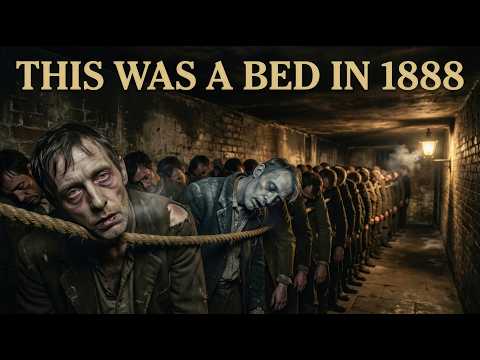
[0:00]Right now, tonight, you are going to fall asleep in a bed. You will lie down. You will close your eyes and your body will be horizontal. In 1888, in the richest city on Earth, thousands of people could not afford to do that. A man is asleep standing up. His arms hang over a rope stretched across a dark room at chest height. His chin rests on his collar bone. 30 other men lean on the same rope beside him, packed shoulder to shoulder, swaying slightly in the dark. The room smells of coal smoke, sweat, and cheap gin. A single gas lamp flickers on the wall. This is called the twopenny hangover. For two pennies, the price of a single match, a person could rent a spot on the rope for the night. Sit on a bench, lean forward over the rope and try to sleep standing up. At 5:00 in the morning, without warning, a man they called the valet walks to the end of the rope and cuts it. Everybody in the room drops forward at once. Some hit the bench, some hit the floor. Nobody complains, nobody shouts. This is how every morning begins. The rope is the alarm clock. The fall is the wake up call. And here is the part that will stay with you. On some mornings, when the rope was cut, not everyone woke up. Some people had frozen to death during the night, still standing, still leaning on the rope. They were carried out like furniture and the room was reset for the next evening's customers. If you think that is the worst thing in this video, you are wrong. It is the least worst thing. And that is why this story matters. This is London in 1888, the capital of the largest empire in human history. And the things that happened to ordinary workers in this city are so strange, so cruel, and so bizarre that if I told you they were fiction, you would believe me. But every single thing you are about to see is real. Before we go any further, take a breath. Seriously, breathe in through your nose right now. What you just smelled, whatever it was, clean air, maybe coffee, maybe nothing, that experience would not exist in Victorian London. The air in 1888 was not air. It was a yellow brown fog made of coal smoke from 300,000 chimneys, mixed with the stench of horse manure on every street, open sewers running between houses, and the output of slaughter houses, tanneries, and chemical works that operated in the middle of residential neighborhoods. Here is a number that will put this in perspective. There were over 300,000 horses in London in the 1880s. Each horse produced between 15 and 30 pounds of manure every single day. That is over 4 and a half million pounds of horse dung hitting London's streets every 24 hours. Children were hired to scoop it up. They were called crossing sweepers, but they could never keep up. The manure, mixed with rain, and formed a brown paste that covered everything. Londoners wore black clothing, not as a fashion choice, but because black hid the filth. The entire city dressed in the color of its own dirt. London in 1888 had 4 million people. It was the largest city the world had ever seen, and it had been built for a quarter of that number. The East End, the part of the city where workers lived, was so overcrowded that families of eight shared a single room. Streets were so narrow that neighbors in facing buildings could shake hands from their windows. The buildings leaned toward each other across the gap, blocking out the sky. The ground floors were dark at noon. And here is a detail so bizarre it sounds fictional. In the 1880s, wealthy Victorians invented a hobby called slumming. They would dress down, hire a guide, and take evening tours through the East End, visiting doss houses, gin palaces, and opium dens for entertainment. They treated the worst poverty in Europe as a tourist attraction. They wrote letters to their friends about the fascinating squalor. The same people who could have changed the conditions with their money, chose instead to pay to watch them. And then there was the river. The River Thames, the heart of London, was an open sewer. Raw human waste from 4 million people flowed directly into it, untreated, unfiltered, undiluted. In the summer of 1858, the smell was so extreme that Parliament itself could not function. Members of the House of Commons soaked curtains in chloride of lime and hung them over the windows. It did not work. They considered moving the entire government out of London. The Thames was not a river. It was a toilet that 4 million people shared. And yet people kept coming, from the English countryside where farming had collapsed, from Ireland where famine had driven entire families across the sea, from Eastern Europe where persecution had pushed Jewish communities westward, they all came. To London because London had one thing they needed, work. Let me tell you about the match girls. And I need you to pay attention here because what happened to them is one of the strangest and most horrifying facts in all of British history. At the Brianton May factory in Bow, East London, young women and girls, some as young as 13, dipped thin wooden sticks into white phosphorus to make matches. 14 hours a day, six days a week, for less than five shillings. The phosphorus entered their bodies through their skin, through their lungs, through the food they ate at their work stations, because they were not allowed to leave to eat, so they ate with phosphorus still on their fingers. The first symptom was a toothache. Then the gum began to swell. Then the jawbone itself started to rot. The condition was called Fosi jaw. And here is the detail that no one forgets once they hear it. The jawbone glowed in the dark. The phosphorus absorbed into the bone caused it to emit a faint greenish glow that was visible in a dark room. Women with Fosi jaw could see their own face glowing at night. And then the bone died. And then it fell away, and the factory find them. Not for being sick, for other things. They were fined for talking, fined for having dirty feet, fined for dropping matches, fined for going to the toilet without permission. One worker was fined for letting a machine alter, in other words, for adjusting a machine that was cutting her fingers. The fines could take half their weekly wage. Think about the job you have now. Think about the worst day you have ever had at work. Now multiply it by every day for the rest of your life. Add a glowing jaw bone, and subtract any right to complain. That was a good job in 1888. Below the factory workers, there were jobs so strange they sound invented. The pure finders walked the streets of London all day collecting dog excrement with their bare hands. They sold it to leather tanneries, who used it to soften animal hides. 200 to 300 people in London made their living this way. The Toshers crawled through London's sewers in total darkness, waste deep in human waste, feeling through the filth for coins and valuable that had been flushed down drains. They worked by candlelight, a single flame strapped to their chest, in tunnels so fragile that the bricks could be scooped out with a spoon. If the candle went out, they navigated by touch. They reported encountering rats the size of cats. One Tosha told an interviewer that a man had been found in the sewers eaten down to his bones by rats. There were even legends of wild pigs, born and raised in the sewer, that had never seen daylight. And below the Toshers, at the very bottom, there were the mudlarks. Children, mostly boys, some girls as young as six. They waited barefoot into the freezing Thames mud at low tide, searching for anything they could sell, coal, rope, nails, bones. They cut bones. Their feet on broken glass and rusted metal buried in the mud. They worked in winter without shoes. The tidal Thames could rise faster than a child could run. Some of them drowned. The next time you see someone mudlarking on the Thames for fun, and it is a popular hobby in London now, remember that the people who invented the activity were not hobbyists. They were starving children standing in raw sewage. When the shift ended, the workers went home. But the word home needs a new definition for 1888. A single room, 10 feet by 10 feet. A family of six inside it. No running water, no toilet, no heating, except a handful of stolen coal burned in a grate so small it barely warmed the hand held above it. One window, if they were lucky, looking out at a brick wall 3 feet away. One bed, shared by the parents and the youngest children. Older children slept on the floor. The floor was bare earth in the worst buildings, damp boards in the better ones. And here is a detail that sounds impossible. In many doss houses, beds were rented in shifts. Three shifts per day. You rented a bed for 8 hours. When your 8 hours ended, someone else climbed in. The sheets, if there were sheets, were not changed between shifts. Three strangers shared the same bed every 24 hours and never met each other. For those who could not afford a bed at all, there were the fourpenny coffins. A narrow wooden box, literally the size and shape of a coffin, with a tarpollin for a blanket. Four pennies for the night. You climbed in, pulled the tarpaulin over yourself and slept in a row of identical coffins like a morgue that charged rent. Below the coffins, the rope. The two penny hangover from the start of this video. And below the rope, the penny sit up. For a single penny, you could sit on a bench in a warm room until morning, but you were not allowed to sleep. Monitors walked the room all night, waking anyone who closed their eyes. Sleep was not included in the penny price. You paid for warmth, not rest. Here is the darkest detail. Three of Jack the Ripper's victims, the women murdered on the streets of White Chapel in the autumn of 1888, lived in doss houses on the same street. On the nights they were killed, each of them had been walking the streets trying to earn the fourpence needed for a coffin bed. The price of not dying was four pence. The price of failing to earn it was their life.
[10:55]What did a Victorian worker eat? The short answer is, poison. Bread was the staple. Workers ate it three times a day. But the bread sold in the East end was not food as we understand it. Bakers routinely mixed chalk into the flour to make it whiter, alum to make it heavier. Heavier bread, sold for more money. Powdered bone, ground plaster. A worker eating bread three times a day was eating a construction material three times a day. Milk was watered down, sometimes to half its original volume. And then bulked back up with chalk powder or plaster of Paris to restore the white color. The water used to dilute it came from the same sources that carried cholera and typhoid. The meat available to the poorest workers came from animals that had died of disease. It was sold green with rot and washed in chemicals to disguise the smell. Street vendors sold sheep's feet, hot eels and meat pies made from ingredients that no inspector ever examined. And here is a fact that connects 1888 to your life right now. The word hangover, the one you use after a night of drinking, comes from the two penny hangover. Workers who spent their last pennies on gin instead of a bed, ended up sleeping on the rope. And the miserable feeling the next morning, the aching body, the pounding head, the inability to function, became associated with the rope itself. You are still using a word invented by people who were too poor to lie down. Gin was cheaper than bread. A glass cost a penny. The gin palaces of the East End were the most beautiful buildings most workers would ever enter. Bright gaslights, polished brass, mirrored walls, warm air. They were designed to be beautiful. They sold temporary beauty to people whose lives contained none. A factory girl with a rotting jaw could walk into a gin palace and for one penny, for 20 minutes, exist in a room that did not want to hurt her. Pause this video for a second and look at your hands. Whatever germs are on them right now, the ones you cannot see, they are nothing compared to what lived on the hands of a Victorian worker in 1888. Cholera killed within hours. A healthy worker could eat breakfast, feel stomach cramps by noon, and be dead by nightfall. The disease spread through contaminated water, and every water source in the East End was contaminated. Tuberculosis was everywhere. The white plague that thrived in damp, overcrowded rooms. A single person with tuberculosis could infect an entire family by breathing in their shared 10 by 10 room. Smallpox, scarlet fever, typhoid, diphtheria. The diseases rotated through the population in waves, and each wave took the youngest and the oldest first. But here is the thing that makes Victorian disease truly strange. Germ theory had only been accepted by mainstream medicine in the 1880s. Most workers in the East End had never heard the word bacteria. They did not know what made them sick. The prevailing belief, even among many doctors, was that disease was caused by bad smells. They called it miasma. If something smelled bad, it was dangerous. If something smelled fine, it was safe. This meant that a family drinking crystal clear water from a pump that was contaminated with cholera, believed they were safe because the water did not smell. Meanwhile, the Toshers crawling through the sewers, surrounded by the worst smell in London, rarely caught cholera, because the filth they waded through was not entering their drinking water. The people who smelled the worst were safer than the people who smelled nothing. Nobody understood why. In fact, the sewer workers, the flushmen who cleaned the tunnels, reported a side effect so bizarre, their supervisors did not believe them. The steam rising from the sewers near breweries and distilleries, contained enough alcohol vapor to make the workers drunk. Men emerged from the sewers, intoxicated, stumbling, slurring their words, not from drinking, but from breathing. They called it being made innocent drunk by the sewers. It is possibly the strangest workplace hazard in history. The average life expectancy for a working man in the East End of London was 31 years. Let that land for a moment. 31. Not because adults routinely died at 31, but because so many children died before age five that the average collapsed. One in four babies born in the poorest parts of London in 1888 did not survive to their fifth birthday. One in four. The causes of death were recorded in parish registers with a clinical detachment that is difficult to read. Debility from birth, wasting, marasmus, a medical term that means the child starved to death. The parents buried their children and went back to work the next morning because a day without wages was a day without food for the children who remained. This is the part of the video I almost did not include. Not because it is not true. It is. But because the truth about Victorian children is the kind of information that changes the way you think about the world. Children in the East End were not children in any sense we would recognize today. A child who could walk, could work. A child who could work was expected to earn. Boys as young as four climbed chimneys. The flues of London's houses were sometimes only nine inches wide. The boys were sent up naked. Their clothes would catch on the brick work and scrape the soot from the walls with their bare hands. If a boy was too frightened to climb, the chimney sweep would light a small fire beneath him. The choice was climb or burn. Some got stuck in the flues and were left inside. The ones who survived developed a specific cancer of the scrotum caused by constant contact with soot. It was the first occupational cancer ever identified in the history of medicine, and it was found in children. Girls went to the factories at 12 or 13. By 16, their lungs were damaged, their hands were scarred, and their life expectancy was shorter than a modern person's retirement age. The children who had no factory or chimney to go to became mudlarks, crossing sweepers, flower sellers, or pick pockets. Some became all four in the same day, depending on what opportunity appeared and what they needed to survive until nightfall. Some caught rats for a living, not to exterminate them, but to sell them alive to pub owners who ran rat baiting pits. The rat catcher would grab rats with his bare hands, rubbing sweet oils on his skin to attract them. The rats bit constantly. The infections from the bites killed more rat catchers than any other occupational hazard in the East End. And here is a detail about Victorian children that is not horrifying, but deeply strange. Because so many children died, one in four before age five, many families never had a photograph taken of their child while alive. Photography was expensive. You did not waste money on a photograph of a baby who might not survive the winter. But when a child died, the family would sometimes pay for a photograph of the dead child, posed as if sleeping. Sometimes with eyes painted onto the closed eyelids to make them appear alive. These death photographs were often the only image a family ever had of their child. They kept them in lockets, on mantelpieces, in family albums beside the living. The dead child, frozen in silver, remembered forever in the only portrait they could afford. The one taken after they stopped breathing. Education had been made compulsory in 1880. In the East End, it was nearly unenforced. A child who could earn four pence a day was worth more to a starving family than a child who could read. The choice between literacy and dinner was made every morning, and dinner won every time.
[21:24]Everything you have seen so far, the rope, the factories, the coffin beds, the Fosi jaw, the crawlers, the children in the chimneys. All of it was considered normal. It was not hidden, it was not secret. The wealthy knew. The government knew. Everyone knew. And then, in July of 1888, something happened that nobody expected. The match girls walked out. 1400 of them from the Brianton May factory. Mostly teenagers, many already showing the early signs of phosphorus poisoning, all of them earning less than five shillings a week. All of them replaceable, all of them invisible. One of their co-workers had been sacked for speaking to a journalist. The factory demanded the remaining workers sign a document declaring they were satisfied with conditions. The women refused, they walked out without a union, without a strike fund, without savings, without a plan. They had nothing. And nothing, it turned out, was the most dangerous weapon in London. When you have nothing, there is nothing left to take away. The strike lasted three weeks. The women marched through the streets of London. They spoke at public meetings. Factory girls who had never spoken in public before, stood in front of crowds and described what phosphorus does to a human jaw. They collected money from strangers on the street. London's newspapers, which had never published a single word about conditions in a match factory, suddenly could not look away. Brianton May surrendered. They abolished the fines. They improved ventilation. They recognized the union the women formed, the largest union of women and girls in the entire country. 1400 teenage girls with rotting jaws changed British labor law forever. And they did it in three weeks with nothing. Remember their names, or rather, remember that history did not record their names. We know what they did. We do not know who they were. 1400 people who changed a nation. And not one of them was considered important enough to be remembered individually. That tells you everything about 1888. The world the match girls fought against did not disappear overnight. It took decades of reform. Factory acts, housing legislation, public health laws. Two world wars that reshuffled the social order in ways no Victorian could have predicted. But the streets are still there. White Chapel Road, Brick Lane, Commercial Street, Flower and Dean Street, where the doss houses stood. The buildings have changed, the people have changed. The geography has not. Walk through the East End of London today and you are walking on the same stones where children crawled through mud for pennies. The same river still flows past, clean it out, but the same river. The same narrow lanes still wind between buildings that were thrown up two centuries ago to house people nobody cared about. Here is one last strange fact to take with you. The word tosser, the British insult, is a mispronunciation of tosha. The men who crawled through the sewers. Over the years, tosha became tosser and lost its original meaning. But the insult survives. Every time someone in Britain calls another person a tosser, they are unknowingly referencing a Victorian sewer worker covered in human waste. The language remembers what the history books forgot. The minimum wage exists because of what happened when there was none. Health and safety regulations exist because girls' jawbones rotted in match factories. Labor unions exist because 1400 women walked out of a building and refused to walk back in. The world these workers built with their broken hands is the world we live in now, and they deserve to be seen. Not as statistics in a textbook, but as human beings, in the streets where they lived, doing what they had to do to survive one more day in the most unforgiving city on Earth.
[27:06]If this story moved you, subscribe to this channel. There are more lost worlds waiting to be rebuilt.