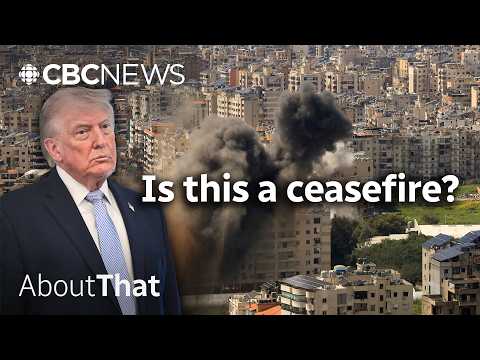
[0:00]The problem with ceasefires is that they're often confusing, because they're contingent on things that just raise more questions. Even the classic, I'll stop shooting if you stop shooting, begs the question, well, who stops shooting first? Or to place this in the big news today. Donald Trump announcing a double-sided ceasefire, wherein he says, I agree to suspend the bombing and attack of Iran for a period of two weeks. This will be a double-sided ceasefire, the reason for doing so is that we have already met and exceeded all military objectives and are very far along with a definitive agreement concerning long-term peace with Iran and peace in the Middle East. We received a 10-point proposal from Iran and believe it is a workable basis on which to This seems straightforward. World oil starts moving again, bombing stops. Until you realize that Iran's take on that same point frames it a little differently. Safe passage through the Strait of Hormuz will be possible via coordination with Iran's armed forces and with due consideration of technical limitations. Which could mean everything from, go ahead through, the water's fine to, actually coordination is just another word for payment. And technical limitations might refer to the minds we've planted in the water. Watch out for those. And never mind the fact that the Straight of Hormuz never officially closed in the first place. It's always been open, but ships don't go through because they don't want to risk getting blown up. So if the ceasefire doesn't even begin until we see the safe opening of the straight, what does that mean? And on whose terms? Right now, the entire world looking at this two weeks to see if some of these details can be worked out for a ceasefire agreement. But it is a delicate moment in the region and a lot of moving parts. I say all of this, not because I hold the key to everyone's coded diplomatic language. President Trump forged this moment. Iran begged for this ceasefire, and we all know it. I don't, but I understand vagueness when I see it, and I'll show it to you. Starting not with the straight of for moves, but with something that is much more clearly contradictory.
[2:06]So where does the ceasefire actually apply? One thing that can get lost in all of the fighting happening in Iran is all of the fighting happening in Lebanon. Israel already launched strikes on Bekar in Southern Lebanon. The military has warned of more strikes after Hezbollah fired into Israel. This is a map from the Institute for the Study of War. They've done a great job chronicling confirmed Hezbollah strikes against Israeli targets, those are the red triangles, as well as claimed Hezbollah strikes in that yellowy orange. Israel has had boots on the ground in Lebanon since the very earliest days of the war. They say they're fighting Iran through its proxy, Hezbollah. And here's the ISW's tally of just how extensive that ground war has been. Nearly 1500 claimed Hezbollah attacks over more than 30 days. And the Israeli Defense Forces too have been claiming wins, publishing illustrations of its strikes against key river crossings inside Lebanon. And actual footage, graphic footage, I'll point out, that the IDF claims to show actual attacks on members of Hezbollah. Like this footage showing a group of people on a pair of motorcycles, one of them being hit, sending the riders on the other running for their lives. I point all of this out because you'd think it would be made explicitly clear in the announcement of a ceasefire, whether it applies to Lebanon. It did, according to a pretty good source, the country mediating the ceasefire itself. It covers everywhere including Lebanon. Except Lebanon, as it continued facing Israeli bombardment, wondered what was getting lost in translation. Hezbollah's fighting force seemed to think the fighting should end, but Israel said explicitly the ceasefire does not apply in its war. The Pakistani mediator said the ceasefire does include Lebanon. Israel immediately shot back and said absolutely it doesn't and it stepped up attacks on Lebanon. I think that's very confusing to the public and leaves a lot of questions to the public about what should we expect. I think this comes from a legitimate misunderstanding. I think the Iranians thought that the ceasefire included Lebanon and it just didn't. We never made that promise, we never indicated that was going to be the case. What we said is that the ceasefire would be focused on Iran and the ceasefire would be focused on America's allies, both Israel and the Gulf Arab states. As of the moment I record this, every headline I've seen suggests the Israeli point of view, at least so far, is unchanged. Which effectively means there is no current agreement on exactly where this ceasefire applies, which is a problem. seeing that because of these strikes in Beirut, Iran is now saying that oil tankers can't get through the straight. Iran would be wise to find a way to get the carrier pigeon to their troops out in remote locations to know uh not to shoot, not to shoot any longer. One-way attacks or missiles because uh this is takes time sometimes for ceasefires to take hold. Uh we're watching it. We're we're prepared if necessary, but we we we hope and believe that it'll hold.
[5:17]When Trump's Secretary of War was asked about how he understands the conditions Iran has placed on reopening the Straight of Hormuz, Iran has said that safe passage through the straight of Hormuz will be possible in coordination with Iran's armed forces and quote technical limitations. What do you believe that means? His reply was to avoid the question entirely and simply restate the goal as opposed to how any of it would work or what anything means. What we know is that Iran is going to say a lot of things. A lot of people are going to say a lot of things, claim a lot of things. What has been agreed to, what's been stated is the straight is open. Uh our military is watching, I'm sure their military is watching, but commerce will flow. Now, no one is saying ceasefires ought to have every term set in stone, but how do you close the gap between the two sides? The US insisting on restoring free passage, but Iran arguing the opposite. Iran is believed to be charging some ships up to $2 million in one case for safe passage through the straight. This had enough momentum that at one point there were reports Iran and Oman, which controls the other side of the straight. They might both be expecting to profit from tanker traffic. Except, most recently, Oman shut that idea down, a direct contradiction of what Iran had planned. So, where is this going? Well, let's add one more layer and you'll see. Trump posts the morning after the ceasefire is announced. The United States of America will be helping with the traffic buildup in the Strait of Hormuz. There will be lots of positive action, big money will be made. Big money will be made. What's he talking about there? Like everybody can get back to making money because oil will flow again, or is Trump moving in on the deal Oman just rejected? He's reported to have told ABC's chief Washington correspondent that maybe the Strait of Hormuz should be paid to pass. As long as the US gets a cut, a beautiful thing, he reportedly said. It's a way of securing it, also securing it from lots of other people. It's an idea the president has floated, as you know, uh and it's something that will continue to be discussed over the course of the next two weeks, but the immediate priority of the president uh is the reopening of the straight without any limitations whether in the form of tolls or otherwise. The point here being that there is nothing simple or straightforward about this ceasefire, about where it takes effect or even how its preconditions can be satisfied. And all of this is to say nothing of how you get a ceasefire with an uncertain starting point to hold. Consider how far apart the two sides have long been on these critical points of negotiation. Iran's nuclear program, the lifting of sanctions, the unfreezing of assets, the costs of reconstruction, the withdrawal of US forces. We'll stay put, stay ready, stay vigilant as the chairman laid out. Uh our troops are prepared to defend, prepared to go on offense, prepared to restart at a moment's notice. Plus, the very inconvenient fact that this war started while the US and Iran were in the midst of negotiations on some of these very issues. At face value, all sides seem to want for this ceasefire to work. But for it to truly stand a chance, there will have to be good faith, trust, and clarity that so far, the two sides have not been able to find.


