[0:00]This is um acrylic paint. Red and black mixed together, okay? Yay.
[0:22]William Golding's Lord of the Flies addresses the dark side of human nature through the character of me, Jack Merridew, who personifies the subject of evil. If you don't know the Lord of the Flies, it is a tale that follows a gang of British school boys who become savages after becoming stuck on an abandoned on an abandoned island. Jack's shift from a disciplined choir director to a ruthless dictator reflects the corrupting influence of power and the innate capability for evil that all people possess. At the outset of the novel, Jack is introduced as a charismatic and disciplined leader, heading the choir with a sense of authority. However, as the boys' time on the island progresses, his true nature is revealed. Jack's desire for power and domination fuels his spiral into barbarism. destroying his humanity and blurring the border between civilization and anarchy.
[1:28]For Jack, power becomes an enticing drive and he sees the island as an opportunity to build his reign. He is drawn to the primeval, primeval. OK. Initially, Jack follows the rules and maintains order, but as the island frees him from society's limitations, he is drawn to the primeval instincts that lay within him. His desire for power progressively overcomes him, causing him to reject logic and morality.
[2:07]Jack's obsession with hunting, particularly for pigs, um becomes a symbolic representation of his descent into savagery. And him targeting pigs specifically, um could also symbolize him targeting uh morality, intelligence, academia, um logic because the character of Piggy represents those topics. The hunt represents his growing appetite for violence and the thrill of domination. In chapter 4, "His mind was crowded with memories; memories of the knowledge that had come to them when they closed in on the struggling pig, knowledge that they had outwitted a living thing, imposed their will upon it, taken away its life like a long satisfying drink." This quote signifies the lust for power that fuels his actions as he seeks to prove his worthiness to the other boys and asserts authority over them. Simon realizes the evil inside of them when he is isolated in the woods, explaining "Fancy thinking the beast was something you could hunt and kill. You knew, didn't you? I'm part of you! Close, close, close! I'm the reason why it's no go! Why things are what they are!".
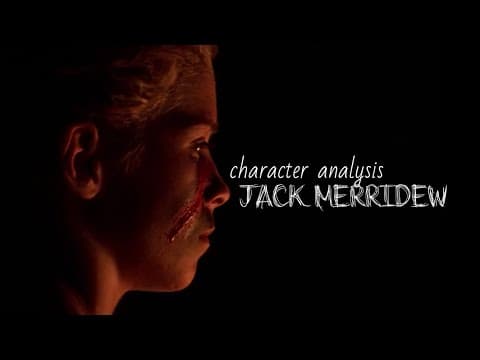
[3:26]Jack's transformation into a savage is marked by his abandonment of societal norms and the adoption of a tribal-like existence. He sheds his clothes, paints his face, and embraces the primal instincts that civilization had previously suppressed. The mask of paint becomes a symbol of his liberation from the constraints of morality, allowing him to unleash his darkest impulses without inhibition. In the novel, Jack paints his face with charcoal and clay, but in the 1990 movie, um Jack puts the pig's blood onto his face. I personally prefer the blood as paint rather than clay because it shows more evidently how he is completely abandoned his morals and humanity that would lead him to full barbarity. And that's why I have blood on my face. He uses the little ones in his choir to bully Piggy, giving them a false sense of power but still belittles and abuses his own group. By creating an atmosphere of uncertainty and terror, he gains a following of loyal followers who are willing to commit unspeakable acts under his command. Jack's manipulation demonstrates the persuasive nature of evil and its ability to corrupt even the most innocent individuals. As Jack's influence grows, the moral fabric of the boys' society disintegrates. He disregards the rules, shows no remorse for his violent actions, and revels in chaos.
[4:57]The rejection of morality highlights the fragility of civilized behavior when confronted with the absence of external authority and the allure of power. Jack's moral decline serves as a reminder of the potential for evil within all individuals when left unchecked.
[5:21]The conflict between Jack and Ralph represents the clash between civilization and savagery, order and chaos, pretty self-explanatory. Ralph, who represents reason and democracy, struggles to maintain an semblance of order and morality. In contrast, Jack embodies the destructive force of evil, exploiting fear and violence to gain control. Their conflict symbolizes the battle between good and evil within human nature and the fragile nature of societal structures. Ultimately, Jack's character in Lord of the Flies serves as a compelling exploration of the theme of evil. Through his obsession with power, manipulation, and the descent into savagery, Jack becomes a symbol of the destructive force of evil, serving as a cautionary tale about the potential consequences of unrestrained human nature.