[0:00]Hey, it's Professor Dave. I want to tell you about moles.
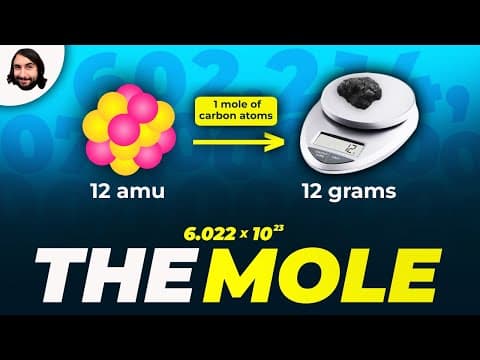
[0:09]In doing chemistry, we have to deal with the fact that we can't see molecules. They are just way too small. But they still obey stoichiometry. That is, they react in certain proportions. These proportions have nothing to do with mass, since every molecule has a different mass. Rather, they are by number, as we saw when balancing equations. So to do chemistry, we need a way to talk about molecules numerically, and that number has to be so big that it represents a number of molecules that we can see with our eyes. Enter the mole. A mole is just a number, like a dozen or a score. But it is a huge number. It is equal to Avogadro's number, which is 6.022 * 10^23. That's almost a trillion, trillion. What's special about this number is that it is the number of carbon atoms in exactly 12 grams. One carbon with six protons and six neutrons weighs 12 atomic mass units. So a mole is the number of carbon atoms that weigh that same amount, but in grams, which is an amount that we can see, touch, and do chemistry with. So the mole is the way to go between atomic mass units and grams. Now, when we look at a chemical reaction, we can say 1A and 1B make 1AB. Or we can say 100A and 100B make 100AB, or we can say one mole of A and one mole of B make one mole of AB, which will probably be an amount that we can weigh on a balance and do experiments with. Every substance will have its own molar mass, which is the same as its molecular mass, but expressed in grams instead of atomic mass units. For example, one water molecule weighs 18 atomic mass units, 16 for an oxygen atom and one for each hydrogen atom, which are the average atomic masses from the periodic table. By definition, then, a mole of water molecules weighs 18 grams, about this much. To find the molar mass of a substance, you just add up the atomic masses for all the atoms in the molecule. Let's try one for practice.
[2:42]Now that we understand the mole, we can do stoichiometric calculations, which allow us to make predictions about a chemical reaction. For example, let's say we're performing this combustion reaction. We start with 20 grams of propane, and we want to know what mass of water we are going to produce. This is very powerful because mathematical predictions like these are what enable us to use our understanding of chemistry to create technology. So, what we need to do is convert this mass of propane into moles. Because knowing the mass of something tells us nothing about the mass of something else we can expect, since every compound has a different mass. But these coefficients tell us about the numbers of molecules involved, and moles are a number. So let's convert to moles. We can do this by using the molar mass of each substance. For propane, that's 44. Remember, when we convert between units, we multiply by a fraction equal to one. This many grams of propane does equal one mole, which is why this doesn't alter the quantity. So we can see that 20 grams of propane is actually 0.45 moles of propane. That's a number of molecules. If we have that, we know how many moles of water to expect because there is a 4:1 ratio. If one propane molecule makes four water molecules, then one mole of propane molecules makes four moles of water molecules. So we multiply by the stoichiometric ratio, seeing that units and names of substances cancel out, and now we have a number of moles of water to expect. Exactly four times the number of moles of propane. Then, we can use the molar mass of water to see what mass that number of water molecules represents. Again, we want to make sure to put this unit where it needs to go to cancel out the existing unit, in this case, on the bottom. 32 grams of water is what we should get.
[4:54]These calculations can easily be performed all at once. Just place all of these conversion factors next to one another and make sure the units cancel the way you want them to. If they do, you probably did it right. Common problems of this type will have you convert from a mass of one thing to the moles of that thing, to the moles of another thing, back to grams for that other thing. Let's check comprehension.
[5:38]Thanks for watching, guys. Subscribe to my channel for more tutorials, and as always, feel free to email me, ProfessorDaveExplains@gmail.com.


