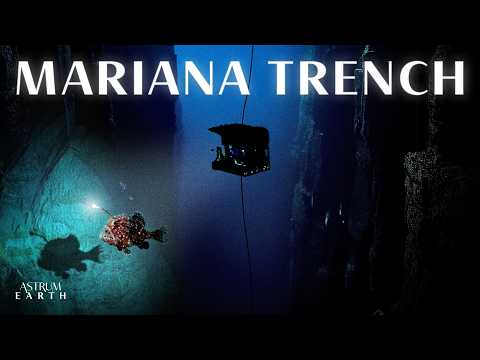
[0:02]Deep below the warm tropical waters of the Pacific Ocean. There is a dark and almost frozen world. A place so dangerous to explore, that we know precious little about it. Finding anything alive there was once believed to be impossible. Conditions are so extreme that even the cells that make up all living things, would be destroyed. Bones and shells would simply dissolve. The processes essential to life would come to a stand still. That was until 1960, when a creature was witnessed at the very bottom. The first signs of life had been found. But things got even more strange, because not only was life found at these depths, that life had adapted to here, and nowhere else on Earth. Much of what we know about this secretive place comes from rare specimens that have been brought up by remote probes or are occasionally caught by deep sea fishing. Strange creatures that have adapted to living in conditions that we still don't fully understand. And are sometimes washed up on our shores. Removed from their natural environment, they are distorted out of shape. Often destroyed altogether. So we can only guess what they should look like and how they might live. The vast expanse of our deep ocean floors is the last unexplored frontier on our planet, waiting to be discovered. I'm James Stewart and you're watching Astrum Earth. Join me in this video as we take a journey into the deepest of them all. The Mariana Trench.
[2:11]Our journey begins 150 years ago, when the British ship HMS Challenger was nearing the end of a four-year mission. The first ever mapping of the ocean floors. They had already taken hundreds of soundings, a back-breaking job in all weathers from blistering tropical heat to frozen polar waters. Lowering a lead weight until it touched the ocean floor, then pulling up meter after meter of cold and heavy wet rope. The picture that emerged was of a featureless surface of mud and silt around three to four kilometers below the surface. Alone in the empty ocean, 2,000 km east of the Philippines, they were taking another routine sounding. On this day, however, the lead weight did not touch the bottom at three kilometers down, nor at four or even five. It kept lowering into the deep. More rope was added and still it went down. We can only guess how they must have felt as they tied on yet more rope and that lead weight kept sinking into the depths, right underneath the thin wooden hull of their ship. Sailing the high seas in those times was a treacherous ordeal. The crew's trusted their faith in traditions and superstitions. Legends told of enormous creatures that rose from the depths, gripping entire ships in their writhing tentacles and pulling them under. This sounds far-fetched to us today, but in those days, such fears were very real. Eventually the weight hit the bottom, more than 8 kilometers down. What they had found is now known as the Mariana Trench. And if they had been just a little further to the West, they would have found the deepest hole in the surface of our planet. The Challenger deep, 11 kilometers down. Mount Everest would disappear into this hole and it would keep sinking down 2 kilometers below the surface. The Mariana Trench is vast, a two and a half thousand kilometer long curved valley on the ocean floor, almost 70 kilometers wide. It begins 2,000 kilometers south of Japan, first curving southeast, then turning westwards towards the Philippines. The valley size to the West are steep cliffs of exposed igneous rock. To the East, it rises more gently, opening onto an empty ocean floor for 12,000, almost featureless kilometers, until reaching Mexico.
[5:09]The scale is hard for us to imagine. Just the Challenger Deep alone, which is only a tiny part of the whole trench, could swallow up five Grand Canyons. And if you wish you could bury your data that far down so no one else could use it online, but you don't have a submersible to get down there. Don't worry, we've got the next best thing. All of your information being so readily available is down to data brokers, companies that collect and sell your personal info like autograph hunters outside of Popstar's Hotel. That's why I started using Delete Me. They find your data on hundreds of shady websites and remove it. I'm talking your name, contact numbers, email, all gone. Think of it like a digital spring clean, but all year round. I personally use delete me to help protect myself from stuff like identity theft, fishing scams and to stop those eerily creepy adverts appearing as soon as I've talked about something, just go away. You can get 20% off with my link joindeleteme.com/astrumearth and use code ASTRUMEARTH at checkout. Thanks to delete me for sponsoring this video. The link is in the description if you want your digital life a bit more private.
[6:26]The Mariana Trench is part of an almost continuous series of unstable and constantly moving chasms in the Earth's crust that encircle the Pacific Ocean. They are matched by a ring of volcanoes known as the Ring of Fire. An astonishing 90% of all earthquakes are caused by movements of this 40,000 km fracture. where rock faces many kilometers deep into the Earth grind together and destroy each other. We are only now beginning to learn how the surface of our planet has changed over time, why the continents are arranged the way they are and how these deep rifts in the planet's surface play a vital role in that story. To understand what created this remarkable geological feature. It helps to look first at the Atlantic Ocean on the other side of the Americas. The surface of our planet is made from continents and oceans. That is not as simple as which parts are above water and which are hidden below the waves. The continents and the oceans are completely different components of the Earth's crust, all floating on a ball of hot rock called magma. Think of the continents as icebergs floating on an ocean of magma. Enormous lumps of the Earth's crust are adrift in the oceans and like icebergs, mostly hidden below the surface. Between them is a thin layer of ocean crust filling the gaps, similar in scale to the skin of an apple. The continents are ancient. They are thick layers of varying rock types that have built up over billions of years. Ocean crust is much younger, mere millions of years old and thinner, made from solidified magma. The ocean floors and the continents move around, dragged across the globe by thermal currents in the magma below. All of those continents were once crammed together in one supercontinent that we call Pangea. For around 200 million years, they have been moving apart. The Atlantic Ocean is getting bigger as the Americas move away from Africa and Europe. As they move apart, a new ocean floor is being continuously made at what is called a divergent fault.
[9:04]Filling the gap roughly down the center of the ocean. This process is driven by the thermal currents in the underlying magma. They rise up, then spread East and West, forcing the continents apart and creating more ocean floor. If the Americas are moving westwards away from Africa and Europe, then they must be getting closer to Asia and Australia, making the Pacific Ocean smaller. The forces that create new ocean floor in the Atlantic are also at work in the Pacific, driven by the thermal currents in the magma underneath. This is constantly producing a new ocean floor called the Pacific Tectonic Plate, which flows outwards like a geological conveyor belt. But the Pacific Ocean is getting smaller, so where does all this ocean floor go? All around the outer limits of the Pacific Ocean, this outwardly flowing ocean crust meets the continents of the Americas to the East and Asia and Australia to the West. As it moves outwards, the ocean floor must go somewhere. It's forced downwards, sinking under the continents around it, returning to the magma from which it formed, a process called subduction. This is the biggest recycling operation on the planet. This massive line of destruction is what creates earthquakes and the volcanoes that surround the Pacific Ocean, the Ring of Fire. As the ocean floor is forced down into the magma below, some of it melts and rises, bursting out at the surface as volcanoes. That is why on the outer side of these subduction faults, you find a line of volcanoes, and at the faults themselves, you find the deep ocean trenches. As the Pacific floor moves westwards towards our trench, it cools and gets denser. That causes it to sink lower towards the center of the Earth as gravity pulls it down. Consequently, the ocean here gets deeper and deeper. The Pacific plate that flows into our trench is 170 million years old, the oldest ocean crust on the planet. It was formed when the continents first started to break apart and it's now come to the end of its life. At the Western edge of the Pacific Ocean, it meets the Philippines plate. This younger and less dense slab of the Earth's crust sits much higher above the mantle. It simply rides over the older sinking ocean floor, pushing it further down, bending a layer of solid rock that's several kilometers thick. The forces involved are unimaginable. It is this junction of the towering upper tectonic plate and the sinking Pacific plate that creates the Mariana Trench.
[12:17]This zone of destruction creates some of the geological wonders of the world. Here, there are gigantic active mud volcanoes pouring out hydrogen into the Pacific waters, one of which is 50 km in diameter. There is a volcano that spews out almost pure carbon dioxide, which emerges as a liquid, not a gas, because of the enormous pressure at these depths. Another has a pool of molten sulfur in its crater, found only here and on one of the moons of Jupiter. Deep fishers vent columns of boiling water, rich in minerals, believed to contain the secrets of the origins of life on our planet. Our interest today is not amongst these volcanoes and thermal vents. We want to see what it would be like to travel down into the trench itself. Thousands of meters deeper into the ocean. And then make the most extreme dive of them all, into the Challenger Deep. You may think that it's 10,935 meters. The Mariana Trench is somehow a freak of geology, an unexpected deep hole of unusual depth. But other trenches around the Pacific are of a similar depth. The nearby Tonga Trench is 10,800 meters deep, and the Philippine Trench 10,540. These rifts in the Earth's crust are constantly changing, and the depression that causes the Challenger Deep is only temporary. It will one day be dragged down into the magma, and somewhere else will become the deepest hole in the planet. There are a lot of problems to overcome to explore such depths underwater. But the biggest is pressure. If you swim to the bottom of a pool, you can feel the water pressure in your ears. Even at just three or four meters, it gets quite uncomfortable. Well, at this sort of depth, the pressure is unimaginable. It's more than 1,000 times the pressure at the surface, equivalent to a ton weight on your thumbnail. And just the same as a ton weight on your thumbnail, that pressure is enough to destroy most living cells. But it isn't just living things that get crushed into oblivion. The destructive power of this force is astonishing. Even equipment designed to cope with these extreme depths can fail in spectacular fashion. In 2014, an unmanned deep sea exploration vehicle called Nereus suffered a catastrophic implosion during a dive into the Kermadec Trench to the North of New Zealand, completely destroying it. The military submarines that secretly prowl our oceans can only dive safely to a depth of around 1,500 meters. To get to the bottom of the Mariana Trench, you need a serious piece of kit. Amazingly, two people managed this crazy descent as far back as 1960. Don Walsh of the US Navy and Jacques Piccard, a Swiss oceanographer, made the perilous dive into the Trieste, a tiny Bathyscaphe, an incredibly strong pressure vessel resembling a spherical bomb slung beneath a buoyancy tank. At a depth of around 9 km, there was an almighty bang. But that didn't deter our intrepid explorers. They had a quick look around, couldn't see anything amiss, so they continued the dive. What they didn't notice was that one of the thick outer plexiglass window blocks had cracked. One of the key components that prevented their tiny capsule from imploding. They were at the very limit of what this submersible was capable of, but still, they went deeper, 3 km deeper. It took them nearly five hours to reach the bottom. Their view when they got there was limited to two tiny viewing ports just 50 mm in diameter and a small area in the pitch black that was illuminated by their lights. Their arrival had stirred up the sediment on the sea floor, so for a while they could see nothing at all. But amazingly, they did see life. They saw what they believed to be a flatfish moving along the top of the sediment. But it's now believed that this was probably a sea cucumber, one of the few species known to exist at this depth. They stayed for a mere 20 minutes before having to make the ascent, which took more than three hours. What they achieved was so dangerous that nobody else would make the same descent for another half a century. During that time, only a few unmanned vehicles were lowered into the abyss. Yet nearly 7,000 people climbed to the top of Mount Everest and 12 people went to the moon. That gives you an idea of just how technically challenging it is to explore these depths. The next manned descent was not until 2012, when James Cameron made the first solo dive into the Challenger Deep, in the appropriately named Deep Sea Challenger. Since then, there have been a further 20 dives into the Challenger Deep, and the number of people to make the short journey has finally exceeded the number of people that have traveled to the Moon. In 2021, Hamish Harding made the longest and deepest dive into the Challenger Deep. 2 years later, he was sadly among five people killed, when the Titan Submarine imploded on a mission to explore the wreck of the Titanic, at a depth of only 3,800 m. The dangers of deep sea dives should never be underestimated.
[18:14]Above the surface, there is nothing to see but empty, featureless ocean. There is no land for more than 300 km in any direction. Descending into the water, the first thing you notice is quiet and calm. Just a few meters down, you are below the buffeting of the waves. Sunlight floods into the water from the tropical sun. And the importance of this to all life on our planet is enormous. We are in the epipelagic zone, also known as the euphotic zone. The surface layer that forms only two or three percent of the oceans, but which supports life everywhere, above and below the water. Here, there is enough light to power photosynthesis. The process that splits carbon dioxide into carbon, used to build all life forms on our planet and oxygen. The phytoplankton here produce half the oxygen that we breathe.
[19:15]This is where the ocean food chain starts. The phytoplankton, which includes such things as diatoms and photosynthetic bacteria, are eaten by zooplankton. Tiny organisms that float suspended in the warm surface waters. These are in turn eaten by larger animals such as fish, jellyfish, even whales. Bigger fish eat the smaller fish, sharks eat the bigger fish, the whole food chain gets going. And it all starts right here in the epipelagic zone. This is where you find our food fish such as tuna, herring and cod. Water absorbs light and as we go deeper, the water soon becomes darker and more blue. Here, in the clear waters of the Pacific with strong sunlight overhead, the epipelagic zone descends to about 200 m. Then we enter the twilight zone, also called the mesopelagic or the dysphotic zone. There is light here but not enough to power photosynthesis. Already the water is much colder. And as the light fades, we see the first flashes of bioluminescence, light produced by marine life in the darker environments. This part of the ocean teams with life. The biomass of the fish in the twilight zone is believed to be as much as the rest of the ocean combined, possibly more. But as we go deeper, you'll get used to me saying probably, or possibly, or believed to be. Simply because we know so little about our oceans and what is found in them. The most abundant vertebrate on the planet lives in these waters, between the light and the dark. The bristlemouth, a small fish with spiny teeth. They're only around 7 or 8 cm long, but what they lack in size, they make up for in numbers. There are possibly quadrillions of them, feeding mainly on the zooplankton, an indicator of just how much life is supported by the thin layer of sunlit waters at the surface. As we descend deeper, the last faint blue light from the surface disappears, and the water becomes completely dark. Well, maybe not completely, because down at these depths, bioluminescence really comes into its own. This eerie and alien-looking light, mainly blue, because this is the color that travels furthest through water, is used by some species to find a mate, and by others to hunt and kill. We are one kilometer down, in the perpetual darkness of the bathypelagic, or as I prefer to call it, the midnight zone. Covering more than half the planet's surface, yet we still understand very little about it. The temperature is a steady 4° Celsius, and the pressure from the weight of the water above us is already becoming dangerous. We are a long way below the maximum depth for any sort of diving, even in a pressure suit, and we're approaching the limit that nuclear submarines can dive to. As a species used to life at the surface, that gives us a very negative view of what life must be like here. But it's important to remember that for everything that lives in these depths, this is normal. They are adapted to live in these cold, dark waters and this great pressure. Our camera lights pick out almost a snowstorm of microorganisms and floating food particles. There is a lot going on here at the upper levels, anyway. As we go even deeper, strange-looking creatures begin to appear. Some have enormous eyes to enable them to see, although what they can see, in what to us looks like total darkness, we can only imagine. The owl fish uses the faintest light to pray on shrimps and jellies. Barrel eyes are small fish that use their strange upward-pointing eyes to hunt from below their prey, able to live and therefore presumably see in the pitch dark, as far down as 2,500 m. Some go to the other extreme and have almost given up on using sight, like the small eye snipe eel. Unless you're using enormous eyes to hunt or to find a mate, there isn't much point in having them at all down here. Instead of sight, most species that live in this eerily dark world use a series of pressure sensors that detect anything that moves. Even if they are completely blind, this enables them to hunt and kill. There are many examples of animals that use light to attract their prey. The best known is the Anglerfish, which dangles a small glowing lure. Anything that comes along with ideas about eating this small glowing morsel will itself be eaten, as the Anglerfish closes its enormous spine-filled jaws on its prey. The largest eyes of any animal on Earth are those of the giant squid. Only a few of these monsters of the deep have ever been seen. The largest to date measuring 13 meters long. But there is no reason to assume that they don't get bigger than this, perhaps much bigger. There is a tendency for species to grow larger in deeper water, a phenomenon called deep sea gigantism, and there are a number of reasons for this. The bigger you are, the less likely you are to become a snack for something else, and you can eat bigger prey yourself. As food becomes more scarce the deeper we go, it makes sense to be able to eat anything that comes along, no matter what size it is.
[25:24]You just have to hope that when lunch does finally arrive, it's worth the wait. Animals also live longer and therefore grow larger. Simply because the chance of meeting something that might eat them becomes smaller. The chimera, also known as the ghost shark, has dead-looking eyes, fins like wings. And like so many species at these depths, an abnormally large head. Unlike other sharks, they have permanent teeth, capable of crushing even the toughest crustaceans they may find. Able to eat anything, big or small. The Pelican Eel is a truly bizarre creature of the deep, with massive jaws and an extending stomach, capable of swallowing prey larger than itself. Which is a good strategy to have if you're faced with something that might be wanting to eat you.
[26:23]That strategy isn't always successful, however, and the Pelican Eel is itself preyed upon by the Lancetfish, a predatory hunter of the deep that grows up to 2 meters in length. We have now passed beyond the bottom of the midnight zone, and we've entered the deepest of the oceans waters, the Hadal Zone. It is named after Hades, the Greek gods of the underworld. As well as being dark and under immense pressure, the temperature here is always close to freezing. Currents of cold water flow across the bottoms of the ocean through these deep trenches from Antarctica, part of a global system of water currents that is crucial for our varied weather and climates across the planet. To life forms that have adapted to these depths, this constant supply of cold, pressurized water is vital. Enabling them to access more oxygen in an environment where every small benefit makes the difference between life and death. Even the shallow parts of the Mariana Trench are 8 km deep. The sea floor here is covered in fine silt, distributed easily by water currents, churned over by the detritus eaters in their constant search for food. It settles to a smooth surface wherever we look. There is more life here than in the open water, and the lights of our submersibles pick out sprawling mats of microbial ooze on any rock formations that rise above the covering of silt. These are microorganisms that use dissolved hydrogen sulfide from the volcanic activity around the fault zone to power a process known as chemosynthesis. This makes use of energy from chemical reactions to support life instead of the energy of the Sun, which powers photosynthesis, far above in the world of light. It isn't anywhere near as effective as photosynthesis, but in these dark waters, you have to make the most of anything that is available. It's a rule of nature, and where there is potential, it will be exploited. Just as these microbes make life from the rocks in this dark and barren place, they themselves become a food source, and so the cycle of life begins, even at these depths. The only other food supply is whatever scarce organic matter floats down from above.
[28:46]But after falling through 8 km of water to get here, passing the marine life that constantly scavenges for any food that can be found, very little makes it this far. The main scavengers at this depth are giant amphipods. Don't get too excited by that word giant, but growing to more than 30 cm, they are giants compared to other amphipods, normally only a few millimeters in length. Translucent sea pigs, a type of sea cucumber with long antenna-like projections that seem to have many functions, including acting as legs, scavenge the sea floor, looking for anything that may be nutritious. They are attracted to carcasses that fall into these depths and will appear in large numbers to feed on those rare feasts. Here we also find Mariana Snailfish and Cusk Eels, the deepest known fish on Earth. The word known is the key part of that sentence. Because there is so much that we don't know about these deepest parts of the ocean. There could be other fish living in these deep waters, or even deeper, but we just haven't discovered them yet. Finding anything at all is more a case of luck than endeavor. Here we find what look like large lumps of jelly sticking out the rocks. Xenophyophores, single-celled organisms that grow to a size of 20 cm or more, about the size of a football. That is crazy for a single cell, impossible, yet here they are, made possible by an environment that would destroy cells found at the surface. There is an important side to all these interesting discoveries that we are only now beginning to realize. Examples of pushing life to extreme limits, such as the Xenophyophores, are where we learn about how cells work. How the processes inside cells and bodies can be adapted and changed, and that is where we learn about life itself. New medical treatments and cures frequently originate from the study of the oddities of life on our planet. And at these depths, most life that we find is distinctly odd. Even here, the sediments hide Bristleworms and Decapods such as shrimp that burrow through the sediment, surviving on the meager organic particles that descend from the surface. Above the silt, we may see copepods such as free-swimming crustaceans or sea cucumbers. But as we descend deeper from the surface, life has become more scarce, for one very good reason. The deeper we go, the less there is available to support life.
[31:47]Our deep oceans are an extremely difficult environment to explore. They are remote and cover a vast area, and the equipment needed to research the waters and the sea floor has to withstand exceptional conditions. But let me put this into perspective. We've sent people to the Moon, we've sent vehicles to explore Mars, Saturn, even Neptune on the edge of our solar system. Why do we still know so little about an area that covers more than half of our own planet? What secrets remain hidden in the darkest depths of our oceans? I would love to think that the scientists desperate to research these fascinating deep waters will be given the means to do so, and if and when they do, we'll bring you the amazing videos and discoveries that they made, the scientific breakthroughs revealed by making these dark places light.


