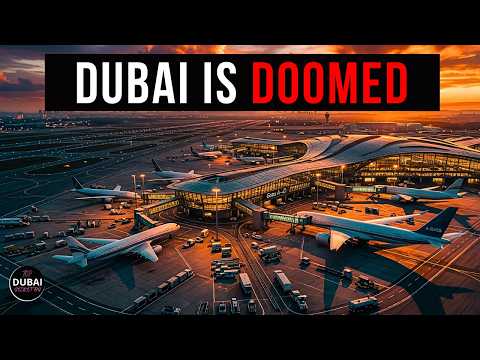
[0:00]Imagine an exclusive hotel in the heart of Palm Jumeirah. Just three weeks ago, its luxury suites were priced at no less than $600 a night. The most incredible part, even at those prices, they couldn't keep up with the demand. The sold out sign hung at every reception desk and the waiting lists were endless. We were in the middle of February, the absolute peak of the high season. That moment of madness where the entire planet seems to want to move to Dubai at the same time. A scenario where space simply doesn't exist and luxury is paid for at the price of gold. But suddenly, something happened. Almost overnight, the rules of the game have taken a 180 degree turn. What is really happening in the market? That same hotel, the one that used to be unattainable, now opens its doors to you with an offer that looks like a system error. Listen closely, a stay and dine package for just 399 dirhams per person. Yes, we are talking about less than $100. But here comes the truly surreal part, the thing that is going to blow your mind. Every single cent you pay for the room is returned to you in full as credit to spend on food and drinks within the hotel. Basically, your stay is free. Are we facing the beginning of the end of the Dubai boom or is this the golden opportunity you've been waiting for? Look at these figures and tell me if they make sense. The Andaz Palm Jumeirah is advertising a one bedroom family suite for only $123 a night, $123. Meanwhile, a luxury apartment with direct views of the Burj Khalifa, which would normally cost you $272, has plummeted to 191. Stop for a second and think about it. We aren't talking about seasonal sales. These aren't flash deals or last minute promotions to attract customers. These are prices born of pure desperation. It's the kind of numbers you only see when something has gone terribly wrong. Why is this happening? Because right now, no one is booking these rooms and it's not an isolated case of a couple of hotels. We are seeing a massive void on a global scale in a city that has suddenly gone silent. In just one weekend, Dubai has gone from breaking occupancy records to falling below 20%. A historic and brutal collapse in the middle of the period that should have been the most profitable of the entire year. How is it possible that the world's most desired destination went empty overnight and? And this is exactly where this story begins. Because what you are seeing right now is not a simple pricing error. It's not a temporary slump and definitely we are not in the low season. Just a few days ago, this same city was on track to welcome 19 and a half million visitors this year. Hotels were operating at full capacity with the highest nightly rates on the planet. Dubai was doing exactly what it has been perfecting for three decades. It functioned like a perfect machine, designed to crush global demand and turn it into unbeatable tourism records. A machinery of luxury and precision that seemed unstoppable. And suddenly, in the course of a single weekend, that machine came to a dead stop. What could have silenced the city that never sleeps? What caused this unprecedented tourism blackout? The resorts that were once fortress tight with every room booked are now plunged into a deathly silence. Rooms that were impossible to get, suites people begged for, are suddenly available at prices that have no commercial logic. If you look at the departure and arrival screens at the airport, the image is bleak. Where there should be a constant flow of landing flights, only red cancellations now dominate. What has happened to the world's engine? This is where we enter the true mystery. The real question isn't simply why prices are falling like there's no tomorrow. That's just the surface. The real question is, how is it possible that a city that built its entire global reputation on the pillars of stability, precision and absolute reliability could crumble this fast? How can you lose control of a tourism empire in a matter of hours? To understand the magnitude of this disaster, we have to focus on a specific date, February 28th, 2026. Because on that day, absolutely everything changed in a way that no marketing strategy, no advertising campaign and no luxury experience could have foreseen or controlled. Imagine the scene. Following a series of coordinated attacks by the United States and Israel, Iran launched a wave of retaliatory attacks directly against the United Arab Emirates. At that precise moment, the sky over Dubai stopped belonging to the tourists. What happened next was a devastating chain reaction. The tourism engine that Dubai had spent three decades building with watchmaker precision didn't just slow down. It disintegrated in real time. How do you react when paradise suddenly becomes the center of a geopolitical conflict? What do you do when safety, the most sacred value of this city, disappears in the blink of an eye? We are seeing the answer right now in those prices of absolute desperation. In a matter of days, the figures starting to emerge from the hotel sector stopped looking real and became a true nightmare. Preliminary data from Smith Travel Research, circulating like wildfire among hotel executives, showed something unheard of. Occupancy plummeted between 35 and 60% in just the first week. Do you realize the magnitude of this blow? The most exclusive properties in My Syria, Palm Jumeirah and Downtown Dubai, the crown jewels, started reporting occupancy levels below 20%. But the worst wasn't the present, it was the immediate future. Some internal projections were chilling, suggesting that those figures could drop to single digits in the following weeks. And no, this wasn't an isolated incident affecting a few industry giants. Groups like Accor, Marriott and IHG were forced to step up and acknowledge the inevitable. They all admitted to a vertical and violent drop in bookings across the entire region. The giant has been brought to its knees. How do you manage a billion dollar hotel empire when suddenly the hallways go empty and the phone stops ringing? The words of those on the front lines leave no room for doubt. Eddie Boson, CEO of Majestic Hotels, a firm that manages 450 rooms across three of Dubai's most important properties, has been brutally honest about the reality they are facing. The next two weeks look extremely slow, Boson confessed with a tone of clear concern. And the numbers are enough to make you tremble. Between 70 and 75% of bookings have cancelled within a window of just 15 days. The reason? A war that shows no mercy and has wiped Dubai off the map of safe destinations. This isn't just an economic slowdown. It's a systemic collapse happening in real time right before our eyes. But what makes this situation truly catastrophic is the timing. The calendar marked March 19th and 20th, Eid Al Fitr. These days were supposed to be one of the most lucrative travel windows of the entire year.
[7:52]The moment when thousands of tourists from Saudi Arabia, Kuwait, Bahrain and Qatar flood Dubai to enjoy luxury getaways. We are talking about full hotels, restaurants without a single free table and beach clubs operating at maximum capacity. Everything was ready for the great feast of regional tourism. However, that wave of visitors never arrived. The silence on the beaches of the Palm is currently the most expensive sound in the world. Can Dubai survive a high season turned into a desert of concrete and empty luxury? What Boson says is chilling. Even Aid Week, which according to all projections was going to be a frenzy of activity, has crumbled under the unbearable weight of cancellations. The bookings simply vanished overnight. What should have been the peak of demand transformed in the blink of an eye into an inventory of empty rooms and deserted hallways. But the disaster didn't stop at the hotels. Almost at the same time, the aviation sector began to break down completely. The figures are devastating, more than 700 flights cancelled by Emirates and Etihad in less than two weeks. Can you imagine the chaos in the terminals? Nearly 20,000 passengers were immediately stranded. People who couldn't leave, but who couldn't enter the country either. Entire families watching their luxury plans turn into a logistical nightmare in a matter of hours. If you think this is serious, look at what happened at the port. An MSC cruise ship with more than 6,300 passengers on board sat anchored in the port of Dubai, helpless. The guests couldn't disembark because quite simply, their return flights no longer existed. The situation became so unsustainable that MSC took a drastic decision. To cancel all winter itineraries in Dubai permanently. The giant of the sea has cast off its lines and left, not to return this season. Is this the finishing blow for tourism in the region? How does a city recover when its skies and its seas are slammed shut? When you zoom out and look at the full picture, the magnitude of the disaster is simply terrifying. Tourism Economics has released a forecast that has shaken the foundations of the region. The Middle East could lose between 23 and 38 million international visitors this 2026. We are talking about a mortal wound to global tourism. Total losses in visitor spending are estimated between 34 and 56 billion dollars. But wait, because there is a figure that will leave you cold. According to industry estimates, Dubai alone was losing approximately $500 million every single day. $500 million in daily tourism revenue evaporated while the skies remained closed. Can you imagine the black hole that generates in an economy? This is no longer just a hotel problem or a bad streak for airlines. We are facing a brutal economic shock hitting directly at the heart of one of the most tourism dependent cities on the planet. Dubai lives on flow, on movement, on people. What happens when that flow is cut off and the money stops coming in at that breakneck speed? Is it possible to sustain this glass empire when the ground beneath it has begun to crack? But if you really want to understand why this crisis has hit Dubai with such ruthlessness, you have to stop looking at the numbers for a moment. Because this was never just about lost bookings or empty rooms. What Dubai has lost is something much deeper, something infinitely more fragile. It has lost the foundations of its own global existence. Think about it. Every great destination in the world is built on a clear and resounding promise. Paris offers you history in every corner. The Maldives sell you paradise on their beaches. Kyoto is the cradle of tradition and culture, while Tuscany seduces you with its landscapes and its wine. But what did Dubai offer? Dubai made a promise, unlike any other. It built its entire identity, its brand and its empire on a single idea. One word that defined everything, certainty. The certainty that everything works. The certainty that luxury is absolute. The certainty that, no matter what happens in the world, here you will be safe and at the top. What happens when that perfect safety bubble bursts before the eyes of the entire planet? What is left of Dubai when doubt begins to seep into its glass skyscrapers? Dubai's promise was an absolute guarantee. It didn't matter what was happening in the region. The deal was simple. You arrive, you spend astronomical amounts of money and in exchange, everything happens exactly as you expect. No surprises. No failures. Flights land with mathematical precision. Hotels operate with an almost unreal perfection. Every experience, from the desert safari to dinner in the tallest skyscraper, is controlled down to the smallest detail. In Dubai, the word error did not exist in the dictionary. Because Dubai is not just a tourist destination. It is a designed environment, an artificial and armored ecosystem in the middle of one of the most unpredictable regions on the planet. Think about it this way. Dubai functioned almost like a Swiss bank, but applied to tourism. A refuge of unshakable stability where outside chaos was simply not allowed in. But what happens when the walls of that bank begin to crack? What value does exclusivity have if safety, that invisible pillar, vanishes in a single weekend? And that is precisely what makes this moment so extremely dangerous. Because a brand built on absolute safety doesn't fail gradually. It doesn't wear down bit by bit through competition or price adjustments. It has a single breaking point. That critical moment arrives when the world receives clear, visible and undeniable proof that the promise of safety was never absolute. What do you do when the refuge stops being one? On February 28th, 2026, that breaking point hit with all its force. Iranian ballistic missiles, drones and cruise projectiles crossed the UAE's airspace, transforming what was always an abstract risk into something terrifyingly real. Something impossible to ignore. The images that circled the globe were not from luxury catalogs.
[14:50]Columns of black smoke rising from Palm Jumeirah, fires devouring the iconic Fairmont Hotel. Fragments of projectiles hitting the Burj Al Arab itself. Can you imagine the panic? Emergency evacuations at Terminal 3 of Dubai International Airport while sirens drowned out the sound of luxury. The armored paradise had just blown apart. How do you convince the world now that Dubai is still that Swiss bank of tourism? Can trust be rebuilt when the sky has been filled with fire? For years, instability in the region was just a distant headline. Something you read in the news, but that felt completely disconnected from the Dubai experience. That glass bubble kept you safe from the outside reality, but now fear has images. And in the world of marketing, an image changes everything. Here is the key. Damage to a brand based on safety is never proportional to the actual physical impact. If we look at the cold data, the UAE's air defense systems intercepted the vast majority of the attacks. In total, four people lost their lives. Most hotels remained operational and by March 7th, flights had already resumed. From a logistical standpoint, the city returned to working in record time. But is it enough that the airports are open? I'm sorry to tell you, but tourism doesn't work on facts. Tourism feeds on perceptions. Once those images of fire and smoke are uploaded to the web, shared and repeated on millions of screens, they don't disappear just because operations return to normal. Those photos stay burned into the traveler's retina. They shape their fears. And slowly, but relentlessly, they change the destination of their next vacation. Who wants to relax in a hammock under a sky they've already seen burning? Is it possible to erase the trail of smoke with a $99 offer? And in the end, this is where the real damage begins to show its face. You won't see it in financial reports or in major press headlines, but in the silent decisions people make, one by one, in the privacy of their own homes. Take the case of Victoria Thompson, a Scottish tourist whose family was dining peacefully at the Fairmont when the hotel was hit. Her words summarize the feelings of thousands. I just don't know when I'll feel comfortable coming back to Dubai again. In that small doubt, in that, I don't know, lies something that numbers alone cannot explain. Because Victoria is not alone. She is simply the visible reflection of a seismic shift shaking the entire market. Behind every cancelled reservation, every empty room and every grounded flight, there are thousands of people making the same silent decision to look elsewhere. It's almost an instinctive gesture. They open their travel apps, see the name Dubai and without thinking too much, they slide the cursor to another destination. It's not because the city isn't operational or because the hotels aren't ready to receive them. It's because something much less tangible has been broken forever. We're talking about trust. And when trust shifts, it doesn't return following a marketing calendar. It doesn't respond immediately to recovery plans or aggressive offers. What we are witnessing right now is not just a temporary bump in the road. It's the start of a recovery process that is much longer, more painful and more uncertain than anyone in Dubai dares to admit. How long does it take for a city to be safe again in the eyes of the world after seeing its icons burn? And this is where the story gets much murkier. Because the February attacks didn't create Dubai's weakness. They simply laid it bare. Long before 2026, the foundations of the tourism model were already under unbearable pressure, camouflaged by record visitor numbers that didn't tell the whole truth. Let's talk about supply. By the beginning of 2026, Dubai had a staggering 818 hotels and over 152,000 rooms. But the most shocking part is that nearly 67% of that inventory belonged exclusively to the luxury and ultra luxury segments. And as if that weren't enough, another 12,000 high end rooms were already under construction. Who was going to fill all that? The warning signs were already there, flashing red for anyone who wanted to see them. In 2024, luxury hotels managed to increase their occupancy, but their average daily rates began to fall. What does this mean? That even before the crisis, hotels were already desperately lowering prices just to maintain interest. It was a dangerous pattern we had seen before. Between 2015 and 2019, this same strategy caused a price collapse that lasted years. But now, the scenario is infinitely worse. Those same luxury properties are stuck at 20% occupancy with prices cut in half. What once took five years to crumble is now happening in a matter of weeks. Is this the final popping of the biggest real estate bubble of the century? Can a city survive when its only strategy is to build more and charge less in the middle of a military conflict? This is where Dubai's very structure begins to play against it. This city's tourism economy only works at full capacity for half the year, from November to April. The rest of the time, the extreme heat exceeds 40 degrees and the humidity makes outdoor tourism impossible. During those months of fire, prices plummet and rooms stay empty. But what has happened now is a surgical strike to the heart of its finances. The attacks didn't hit at just any moment. They hit right when Dubai generates most of its annual income. They have wiped the most valuable weeks of the calendar off the map. How do you recover an entire year's budget when your golden season has vanished in the smoke? And there is an even deeper problem, something that even Dubai's tourism leaders have had to admit in private. For years, the city was obsessed with spectacle. With building the tallest skyscraper, the biggest shopping mall and the most extravagant experiences. But in doing so, they created a dangerous perception. That of a city without a soul, impressive, but lacking a deep human story. This matters much more than it seems. A destination without deep cultural roots depends exclusively on offering an impeccable technical experience. It's a product, not a feeling. And the moment that product fails, even for a brief instant, other destinations with history, with culture and with that authenticity that cannot be bought, become infinitely more attractive. Why take a risk in a desert of glass when the world offers shelters with centuries of soul? Is this the moment when the traveler stops looking for empty luxury to search for something real? History doesn't lie and what it teaches us is that perception shocks on this scale don't heal in weeks. They take years to mend. This brings us back to the image we have before our eyes today. Those empty resorts, those luxury rooms at bargain prices, and that deathly silence where the planet's most exclusive demand once vibrated. Make no mistake. All of this isn't a simple temporary glitch in a system that was otherwise perfect. What we are seeing is the massive crack that has opened between what Dubai promised the world and what the world has now begun to seriously question. Enclosing that crack isn't as simple as reopening hotel doors or restoring flight routes. Why? Because this is no longer a problem of logistics or operations. It's a matter of faith. Rebuilding the belief that a place is the safest refuge on earth takes time. Much more time than any physical reconstruction. That's why the real unknown isn't whether Dubai will manage to recover economically. The question that really matters is, when will people return to trusting it blindly? Think about it for a moment. If you had to plan your vacation right now with everything you know, would you still choose Dubai as your dream destination? Or would you prefer to find your piece of paradise somewhere else on the map? The future of the city depends today more than ever on your answer.


