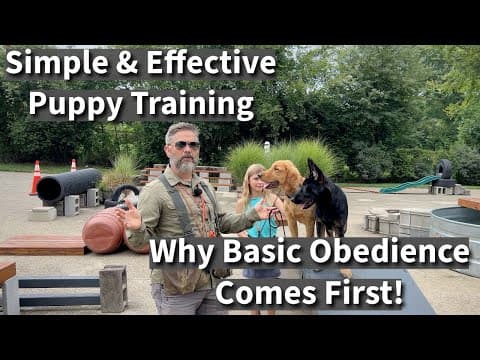
[0:00]Welcome back to the Blue Grass on this beautiful August afternoon. I'm out with May, about a five-month-old working bloodline German Shepherd. Charlotte has Scout, about a five-month-old golden retriever. And uh what we're talking about today, it's just the value of establishing a very reliable and simple basic obedience foundation on your puppy before you start pursuing kind of more complex behaviors. Okay? Now, uh I know it's really, come on. I know it's really popular, okay, to get your puppies out nowadays and uh get some food and kind of lure them around into, you know, a variety of fun positions like get them to weave in between your legs and get them to sit and stand and lay down. Uh, but from our perspective, we always believe that the practical dog training should come first, okay? And so we teach a very simple vocabulary, calm, let's go, up, easy, wait and stay, and we find that that vocabulary is um, I mean, covers pretty much all aspects of general dog ownership. And we get out and we try to make sure that we get plenty of practice implementing that variety, that, um, vocabulary in a wide variety of physical conditions. All of that starts up here on our exercise and small challenges course, uh then we transfer it to pre-adventure area out and back and then we go to our farm and then we just go uh looking for adventures wherever we can find them, okay? Uh our primary working hypothesis is that the best learning is learning by doing, okay? So, what I'm after in an obedience program is I'm after the kind of basic obedience that quickly and effectively allows me to get my puppy out and put him in a lot of situations because the more situations that I put them in, the more they're going to learn, okay? So, right there as I was walking around the course, come on, nerds. As I was walking around the course, you saw that I was able to, you know, kind of talk to you. Charlotte was able to, to tag along while I was talking to you guys. The dogs are being calm, attentive and polite. Charlotte and I are able to have the dog sit and stay and walk away. Just that little bit of core basic obedience that we've put on these puppies. It allows us to fully integrate those dogs into our lives, okay? And it's not that we don't like to give treats, right? We give lots of treats, don't we, Charlotte? So we can stand here, go ahead and give your dogs some treats. We give them lots of treats. I mean, when we first get started, we're giving them a treat, just all the time, treats for every obstacle, treats for, you know, treats for coming, treats for this and treats for that. But there is a practical limitation to doing treat work as it relates to getting your dog out and like um, you know, fully integrating it into real life situations. And I'm we're going to kind of illustrate that to you right now. The reason I'm not too much into carrying the balls around or holding the food in my hand and doing all this is because I believe that if I can make it to the one year mark, if I can make it to the post-adolescent phase and I have a dog that'll always come when it's called, it'll always be still when it's told, and always has good manners from my neighbor's perspective. It refrains from behavior that is dangerous, destructive or rude. I feel like then I've got 10, 12 years to work on specific things, okay? But I can sit out here with this puppy and lead it around with this food, okay, and still not be able to take it for a walk. Still not be able to take it to a soccer game, still not to be able to, uh, you know, uh take it down to the boat dock, whatever. So, simple and effective, right? That's what we're after with our basic obedience. So Charlotte, we're going to go over here to this table. All right, now, May, uh, she's a, she's being, she's being, she's here and she's being trained as a, like an old-fashioned guard dog. So, fun project that we're working on. Okay, so one of the things I do with May a lot is I go out back and we kind of go on patrol, it's pretty fun, you know. And now, Scout, um, Scout lives in about a perfect situation for a field-bred golden retriever. He lives on a big old farm. Uh, but he does live with some people that are getting a little bit older and so, you know, we know that wheelchairs and like canes and walkers are things that are going to be in play. Well, if if if if Scout's owner has, like say, a cane, maybe has a little, you know, hip procedure, maybe a knee replacement, how is her owner going to manage the cane and a bunch of food? Do you see what I'm saying? If if if May's owner is out doing some, you know, fun guard dog training stuff, how is he going to carry his rifle and give the dogs to the treats all the time, okay? So, this is very important. When you're doing your basic obedience training, okay, with your puppy, it it you need to make a list of all the places that you would like to take your puppy and ask yourself if the type of training protocols that you're using are going to lend themselves to being effective in the different situations that the puppy is going to find itself in, okay? Charlotte, do you feel like you're able to walk that dog and carry that cane? Okay. And so, same thing. I feel like I'm able to walk this dog and carry this little rifle around. And if I had to, like, you know, hold the food, if I had to depend on food or a ball to hold this dog's attention while I'm doing basic obedience, then how would I hold my rifle? If Charlotte had to depend on holding a ball or holding food to get her dog to walk while she's using a cane, well, then how would she hold its attention? I mean, she's got to make a choice. And so, a lot of frustration in dog training comes from choosing protocols that although they may work well for some people in some situations, they don't work well for you and your dog and your particular situation, okay?
[5:45]Like, so for what we do, we're after practical people, okay? We don't uh, we don't do very much in a way of training for for people that don't have simple practical goals. What we want for every dog that comes here is just to be able to get out and get moving and do interesting things with its owner because we truly believe that the best kind of learning is learning by doing, okay? If that's the, if that's the kind of person you are, then following like my channel, that's a great channel to follow, okay? If, however, you have a dog and you don't plan on, you don't you're not going to use a cane, you're not going to use a rifle, you're not going to be carrying a tool bag, okay? You your your dog training experience revolves around what you and the dog can do together. Well, there are plenty of people that teach that too, okay? And it's not a matter of being right or wrong, it's a matter of finding what fits for you and your dog, okay? So, I hope this little video kind of, you know, gives you some inspiration to get out and put some uh real forethought in the type of training that you're going to pursue, right? Okay? And of course, I I'd like to influence you to do the kind of stuff we do, because I think everybody ought to get out and do a little bit more exercise, do a little bit more interesting stuff, you know, but like, there's room for everybody in the Charlotte. All right, good job. High five. All right, and I'll see you all later.