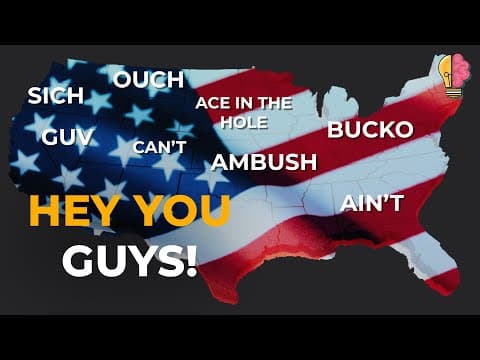
[0:05]Where did the American accent come from? What did the earliest Americans actually sound like when they spoke English? On this episode of Intrigue Mind, we'll be taking a look at the history and the future of the American English accent that you probably speak every day without thinking about it. If you're interested in early access to videos and live chats with the creators of Intrigued Mind, consider subscribing to our Patreon. What sort of accent did early American colonists have? What did the founding fathers sound like? Languages and accents aren't things that are set in stone. They change and evolve over time. The history of the modern American accent is tied up with the history of the country that created it. Despite the fact that early Americans were getting tired of British rule, they still basically spoke British English. Jamestown leader John Smith, for example, wrote in a way that was virtually identical to the writings of his colleagues who had stayed back home in England. It wouldn't be until the 18th century that American English would start to come into its own as a unique accent. In the early 1700s, Americans began to notice that they were speaking a dialect that was different from how people were speaking on the other side of the Atlantic. The Scottish and the Irish also began to arrive in America in greater numbers around this time, and they brought their own distinctive accents along with them. American English was leaving parts of British English behind and also adding some new words from other cultures. By the 19th century, there were three distinct dialect areas in America that have their own way of pronouncing certain things, even though they basically have the same vocabulary. There was the Northern region with the New York and New England accent, the Southern region and the Midland region that included Pennsylvania and the Lower Midwest. This basic map largely still holds true today for modern Americans, although as the US moved west, new accents were created. For instance, an influx of Scandinavian immigrants to the Upper Midwest gave us the accent that everyone has in the movie Fargo. Certain founding fathers like Benjamin Franklin and Thomas Payne actually wanted America to have its own accent and tried to push this internationally. They wanted their own government and thought that they should have their own language to go along with it to further distinguish them from the hated British. Over time, Americans developed new words and phrases, not just a new accent. These new additions to the English vocabulary were known as Americanisms. The British thought these new terms were barbaric and looked down on the new American accent. American English continued to use words that had dropped out of circulation in England, such as wilt, allow, bureau and fall as opposed to autumn. Americans also invented entirely new words like groundhog and belittle, which were actually first used by Thomas Jefferson. American English also came to be known for using a lot of contractions like can't and ain't, which some British purists didn't like. Americans didn't invent contractions, but they were the first to really use them a lot to improve grammatical freedom and conversational flow. Americans also adopted words from other languages quite freely. Words like moose, raccoon, and opossum come from different Native American languages. The word armada comes from Spanish, chocolate from French, and ouch comes from German. By the middle of the 18th century, the differences between American and British English were so pronounced that Samuel Johnson's historically important Dictionary of the English Language took note of it. Samuel Johnson, who was British, was very critical of the Americans, as well as others who he saw as not speaking properly. He went out of his way to make fun of other cultures and his dictionary. For instance, he defined oats as a grain which in England is generally given to horses, but in Scotland supports the people. The physical movement of Americans also affected their accents. As large amounts of Americans moved away from the East Coast and the more industrial cities and out into the West, the language changed with them. Historical surveys of that era's newspapers and other texts shows that sometimes out West, they would just spell words exactly how they sounded without regard to the actual rules of English. Some settlers to the West probably retained whatever regional dialect they had for a while, but later on, everything blended together and leveled out in the western part of America. The terms bucko, ambush, and ace in the hole are all leftovers from the Wild West. Other things that were common in early American English have disappeared or changed. For instance, Americans a couple centuries ago, might have used the word sich instead of such, something that would get you odd looks today. Guv was also used instead of gave. There have also been some grammatical changes. The word, hopefully, wouldn't have been used to start a sentence back then. You also wouldn't put a noun or phrase right in front of someone's name, such as saying famous actor Tom Cruise or future president Kanye West. These quirks are much later grammatical developments that would have been unknown to someone in the days of George Washington. As time went on, American English continued to solidify itself and gain its own identity. In 1923, the state of Illinois even passed a distinction between the two accents into law. The so-called American language bill was passed. A congressman named Washington J. McCormick said that it was important for Americans to recognize that they had their own language so that they could drop their top-coats, spats, and swagger-sticks, and assume occasionally their buckskin, moccasins, and tomahawks. It's a very patriotic sort of sentiment, even if it's not totally clear what this even means. During the 20th century, around 185,000 new words were added to the English language, based on the Oxford English Dictionary's records. An explosion of new technology necessitated the creation of new words that we don't even notice today, like car and airplane. The 20th century saw the English language experience a 25% expansion in size based on the number of words in circulation. Most modern language trends begin with a trickle somewhere in the past, even if people don't realize it. American English is no exception. For instance, using the word like very frequently in conversation is thought to be a very modern way of speaking. And while people certainly said like less in the past, using it incorrectly as a filler word was around back then. In the 1956 novel, Seize the Day, there's a character who is known for constantly overusing the word 'like'. Thanks to things such as standard dictionaries, instant communication, and globalization, American English grammar is now more unified than it was in its earlier days. However, different accents definitely still persist. Some Southerners say y'all instead of you all or you guys. Depending on where you live, you might say soda, pop, or Coke. What most Americans would call a sub sandwich, a Philadelphian might call a hoagie, and a New Yorker might call a hero. Roads that most Americans would call a highway might be called a freeway by people on the West Coast. The regional accents of modern day America are in an interesting time. They seem to be converging and diverging at the same time. Some accents are being homogenized and leveling out, which means in the future, they might disappear altogether. But other accents are diversifying and actually getting further away from one another. New York and Southern accents are the most prominent and distinct regional accents in America. Oftentimes, when you hear a non-American try and do an American accent, they will try and mimic one of these two accents. These two accents are also the most stigmatized and most disliked by certain people. Most Americans don't think of themselves as having any accent at all. In reality, what they speak is called General American English. It's a sort of umbrella accent that the majority of American English speakers use. It is seen as lacking any kind of distinctly regional, ethnic, or socio-economic characteristic. It is seen by most people as just being the default way of speaking English. It encompasses a continuum of accents and isn't really one single accent. Americans with a high level of education, and Americans from the western half of the country, are the most likely to be seen as having General American accents. Black English, also known as African-American Vernacular English, is no longer a region-specific accent like other American accents. Black Americans spread out over the country and took it with them. It remains the dominant accent among lower and middle-class African-Americans. It's closely related to the Southern dialect since that's where the majority of African-Americans initially lived. However, thanks partially to the internet and hip-hop culture, Black English now greatly influences everyday speech for many Americans. Hispanic and Latino Americans have also developed their own varieties of English. The two best studied of these dialects are Chicano English, which is spoken in parts of the West and Midwest, and New York Latino English, which is spoken in the New York metropolitan area. There are other ethnic English varieties as well, such as Yeshiva English, or English, which is spoken by some American Orthodox Jews. Some Cajuns in Southern Louisiana have their own Cajun vernacular English, and in Pennsylvania, there's Pennsylvania Dutch English. The state of Hawaii, while primarily English-speaking, is home to a native language that's commonly known as Hawaiian Pidgin. Some Hawaiians speak English with a sort of pidgin influenced accent. American English also created new dialects outside of the country. For example, there's Philipino English that began during the American occupation of the Philippines and carries on to today. What does the future hold for the English language? How will all of us being in constant contact via the internet affect our vocabulary? An American colonist from the 18th century wouldn't know what you meant if you said something was cool. But if they knew you had come up with it without help from the British, they would probably think it was pretty cool.
[8:47]For more videos on the most amazing forgotten parts of our history, be sure to subscribe to the intrigued Mind channel. Like the video and leave your suggestions in the comments below.


