Thumbnail for Linear Algebra with Theory; Lecture 4: Properties of Fields and Introduction to Proof by Madeline Brandt

Linear Algebra with Theory; Lecture 4: Properties of Fields and Introduction to Proof

Madeline Brandt

33m 39s217 words~2 min read
YouTube auto captions
Transcript source

YouTube auto captions

This transcript was extracted from YouTube's auto-generated caption track. The transcript below is server-rendered so it can be read, searched, cited, and shared without opening the original YouTube player.

AI Video Summary

This lecture introduces the fundamental concepts of mathematical statements and proofs, particularly within the context of abstract algebra and field theory. It defines a statement as a declarative sentence that can be unequivocally true or false, and a proof as a series of steps that irrefutably establish the truth of a statement. The lecture focuses on different types of statements and corresponding proof techniques.

The instructor elaborates on proving "If P then Q" statements, suggesting two main approaches: directly assuming P is true to prove Q, or using the contrapositive method by assuming Q is false to prove P is false. An example using the Cancellation Law in a field illustrates these concepts. The lecture also briefly touches on proving statements involving "P and Q" (proving P then Q separately) and "P or Q" (assuming P is false to prove Q). An exercise is introduced to prove that the square root of 2 is irrational, starting with the assumption that it is rational.

Key algebraic properties like multiplicative inverses, associativity, and multiplicative identity are highlighted through the Cancellation Law proof. The session also provides practical information about office hours for students seeking additional help or clarifications on proofs.

Key Takeaways

  • A statement is a sentence that can be declared either true or false.
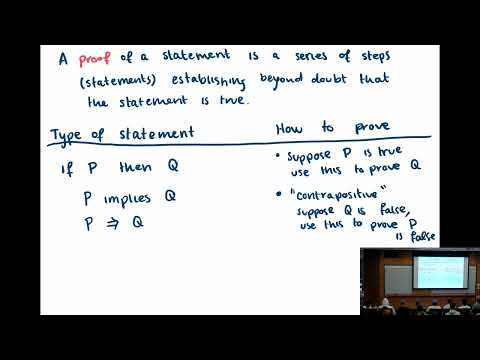
  • A proof is a series of steps establishing beyond doubt that a statement is true.
  • To prove "If P then Q", one can assume P is true and prove Q, or use the contrapositive: assume Q is false and prove P is false.
  • The Cancellation Law in a field (if ba = ca and a != 0, then b = c) serves as a concrete example of a proof, utilizing properties like multiplicative inverses and associativity.
  • Proving "P and Q" requires showing P is true and then showing Q is true.
  • To prove "P or Q", one can assume P is false and use this to prove Q is true.
  • An exercise on proving the irrationality of sqrt(2) is introduced, starting with a proof by contradiction.

Topics Covered

Mathematical ProofsLogicAbstract AlgebraField TheoryProof Techniques
Pull quotes
[0:00]Uh before we get started, just a quick announcement about office hours, if you have any questions or want to go over anything or proofs, Uh my office hours are going to be held in this building room 218 for office hours.
[0:00]A proof of a statement is a series of steps establishing beyond doubt that the statement is true.
Use this transcript
Related transcript hubs

[0:00]Hello, everybody. Uh before we get started, just a quick announcement about office hours, if you have any questions or want to go over anything or proofs, Uh my office hours are going to be held in this building room 218 for office hours. A statement is a sentence that can be declared either true or false. A proof of a statement is a series of steps establishing beyond doubt that the statement is true. Type of statement: If P then Q. How to prove: Suppose P is true, use this to prove Q. "Contrapositive": suppose Q is false, use this to prove P is false. P implies Q. P => Q Example: Cancellation Law. Let F be a field. Let a,b,c be in F, with a != 0. If ba = ca then b = c. Proof: Let a be in F. Suppose that ba = ca. Let a' be the multiplicative inverse of a.

[15:00]Then (ba)a' = (ca)a'. b(aa') = c(aa') by associativity. b*1 = c*1 since a,a' are mult. inverses. b = c since 1 is the mult. identity.

[20:07]P and Q. Show P is true. Show Q is true. P or Q. Assume P is false, use this to prove Q. Exercise: prove sqrt(2) is not equal to Q. Assume sqrt(2) = a/b.


Need another transcript?

Paste any YouTube URL to get a clean transcript in seconds.

Get a Transcript
